Before Ernesto Reza-Garduño was helping Amazon sellers decide where their advertising money should go, he had a rather different assignment: keep the ball out of MIT’s net. In 2010, he wore number 00. The goalkeeper’s shirt is an agreeable place to begin a founder’s story. It comes with a team, a defined problem and very little opportunity to disguise the result with a presentation.
On September 11 that year, he played the full 90 minutes against Newbury College. MIT won 6–0; Reza-Garduño made two saves. A tidy afternoon. Years later, after an engineering degree, consulting jobs, an early role at Thrasio and the creation of Mayan, he would begin building a business around football itself. The game had stayed in the picture through the changes of employer and country.
Number 00 had other plans
Born in Mexico City, Reza-Garduño moved to Houston as a child. Football figured prominently in his ambitions. He eventually chose an education over pursuing the professional game, reasoning that education would give him more control over his path. MIT offered a way forward. He graduated in 2013 in mechanical engineering, with a focus on entrepreneurship.
Choosing a degree did leave room for playing. MIT’s rosters list him as a goalkeeper in both 2009 and 2010, with Houston as his hometown and Cypress Ridge as his high school. The records give a little texture to an otherwise familiar phrase in a founder’s biography: a passion for sport. There was a position, a shirt number and a place on a college team.
A small entry in the match record. A real chapter in the founder’s life.
An engineer’s interest in slippery things
Another part of his MIT record concerns movement on a much smaller scale. Reza-Garduño was a co-author of “Droplet mobility on lubricant-impregnated surfaces,” published in Soft Matter in 2013. The research examined how droplets behave on textured surfaces infused with a lubricating liquid. Among his fellow authors were J. David Smith, Rajeev Dhiman, Sushant Anand, Robert E. Cohen, Gareth H. McKinley and Kripa K. Varanasi.
The paper looked at the liquid ridge formed around a droplet and how the interactions affect resistance and sliding speed. It is specific, physical work: what changes when one material meets another, and how do you measure the consequence? His name also appears on the patent application for liquid-impregnated surfaces, filed in November 2011 and published in February 2013.
There is no need to turn a laboratory finding into a prophecy about a future company. The scientific work deserves its own place in his story. Before Reza-Garduño was discussing sellers, campaigns and customers, he had contributed to a technical investigation in which the details of a surface mattered. Engineering was something he had done, as well as something printed beside his name.
A business education with a bicycle attached
His early work also supplied a less orderly classroom. At an alcohol-delivery startup around the time he finished MIT, he helped think through delivery logistics and made deliveries himself. In one recollection, a bicycle journey near campus ended with a traffic ticket. There are few more economical introductions to a young company than working on the routing problem and then becoming part of the route.
He subsequently worked in data consulting, including at Accenture and everis, and joined a leadership development program at NRG Energy. Across those settings, data was connected to practical decisions: organizing information, making it accessible and, at NRG, using weather forecasts to help anticipate demand for electricity. The industries changed; the need to turn information into an action remained.
Thrasio brought him into Amazon brand operations. He joined in August 2018 as employee number three and the first brand manager, later becoming head of product. Operating a brand gave him an immediate view of awkward processes and bottlenecks. Building internal reporting and automation systems then put him on the other side of those problems, working on tools intended to make the operation function as more brands arrived.
Four friends, one seller problem
In 2020, Reza-Garduño co-founded Mayan with Chris Compean, Javier Garcia and Armand Mignot. They had known one another since MIT. Their experience covered the Amazon ecosystem, marketing analytics, technology and finance. The company joined Y Combinator’s Winter 2021 batch, taking a shared university history into a rather more consequential group project.
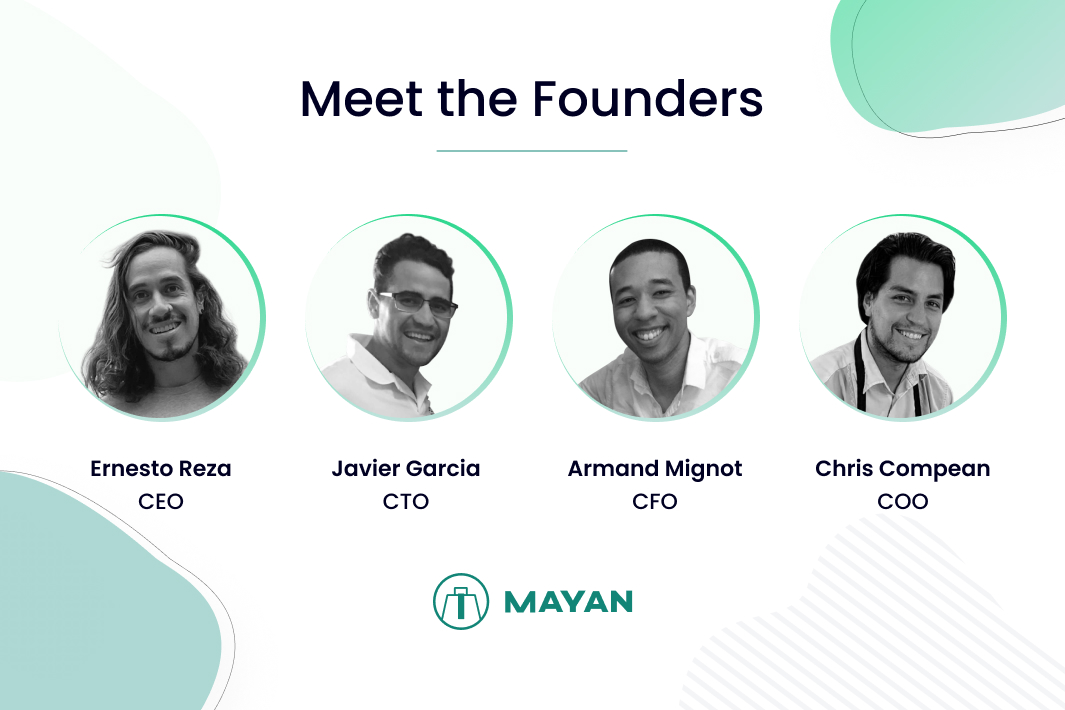
Friendship provided a basis for communication. Reza-Garduño described a working habit of hearing different views, finding alignment and proceeding. His explanation was compact:
“We listen to all the viewpoints, get realigned and then move forward.”
Ernesto Reza-Garduño · 2021
The commercial problem was equally concrete. Amazon sellers needed help managing the many decisions involved in growing a brand. Mayan began with advertising and inventory, using data and automation to support those decisions. For a small business owner, time spent interpreting campaign reports is time unavailable for another part of the business. The appeal of the product depended on doing useful work inside that crowded day.
Reza-Garduño also connected the company to a wider personal ambition: extending access to educational and career opportunities like those he had received. Independence mattered to him. Helping business owners develop their own companies fitted that motivation. It gave the work a human subject beyond the advertising account: someone had built the brand, and someone was making decisions about its future.
The advertisement has to meet the cupboard
In a 2022 discussion of Amazon growth, Reza-Garduño warned about overreliance on automated advertising. Automation could help discover keywords, but it could also spend money on searches that failed to produce sales. The distinction mattered for someone selling optimization. Turning a system on is only the beginning of judging whether it is doing a useful job.
Inventory adds another constraint. A seller’s stock position can change the sense of an advertising decision. Mayan described adjusting campaigns for products with low inventory, bringing the stockroom into a discussion that might otherwise remain inside an advertising dashboard. More attention for a product is useful only in the context of the business that has to supply it.
A conceptual loop behind inventory-informed advertising, rather than a performance forecast.
This helps explain the connection between his operational background and the company he started. The work at Thrasio had required understanding the brand’s day-to-day difficulties. Mayan applied that sort of attention to sellers running their own businesses. The software could make a decision faster, but the relevant question still came from the operation: what is worth doing now?
A new team sheet
In March 2023, Mayan announced a $5 million Series A led by Bright Pixel, following $2 million in seed funding. The plans included further advertising automation, a lower-priced self-service offering and a free analytics and forecasting suite. Those were ways to put the product within reach of sellers with different budgets and requirements.
Series A led by Bright Pixel.
Planned expansion: advertising automation and self-service tools.
By that announcement, Compean was identified as CEO. Reza-Garduño’s time as founding CEO belongs to the earlier chapter; subsequent listings place him on Mayan’s board. In his own post celebrating the financing, he described expanding from advertising into inventory optimization and emphasized the human work involved in helping customers. The company’s development and his personal career were beginning to occupy different lines on the same timeline.
Back where the conversation started
Reza-Garduño and Aakash Ahuja began exploring their football venture in November 2023. Tekkers appeared in the spring 2024 class of the Techstars New York City powered by J.P. Morgan accelerator. Its description then centered on a digital storefront for soccer teams, with personalized content and commerce recommendations for fans. Later that year’s Demo Day preparations included pitch practice in Central Park. A founder’s audience can be surprisingly literal.
His public introduction of Tekkers AI put community at the center. Football, he explained, had helped him connect with people after relocating and while attending World Cups. The experience preceded the app. Supporting a team gave him an opening for conversation with someone he had only just met, often in a place where he was a visitor.
Tekkers AI describes features for following teams, finding personalized content, discovering places to watch matches and connecting with other fans. The ambition moves between a worldwide sport and a local encounter. The interesting unit is small: a person finding somewhere to watch, or another person with whom to watch it. A global audience still has to decide where to sit on Saturday.
That puts Reza-Garduño back near an interest that existed before the degree and the companies. MIT’s goalkeeper became an engineer, an operator and a founder; now the sport has become the setting for his work. The next result belongs to the business he is building with Ahuja. The older record is already settled: number 00, two saves, a clean sheet.
Follow the next fixture
Interviews, research and the companies in this story.