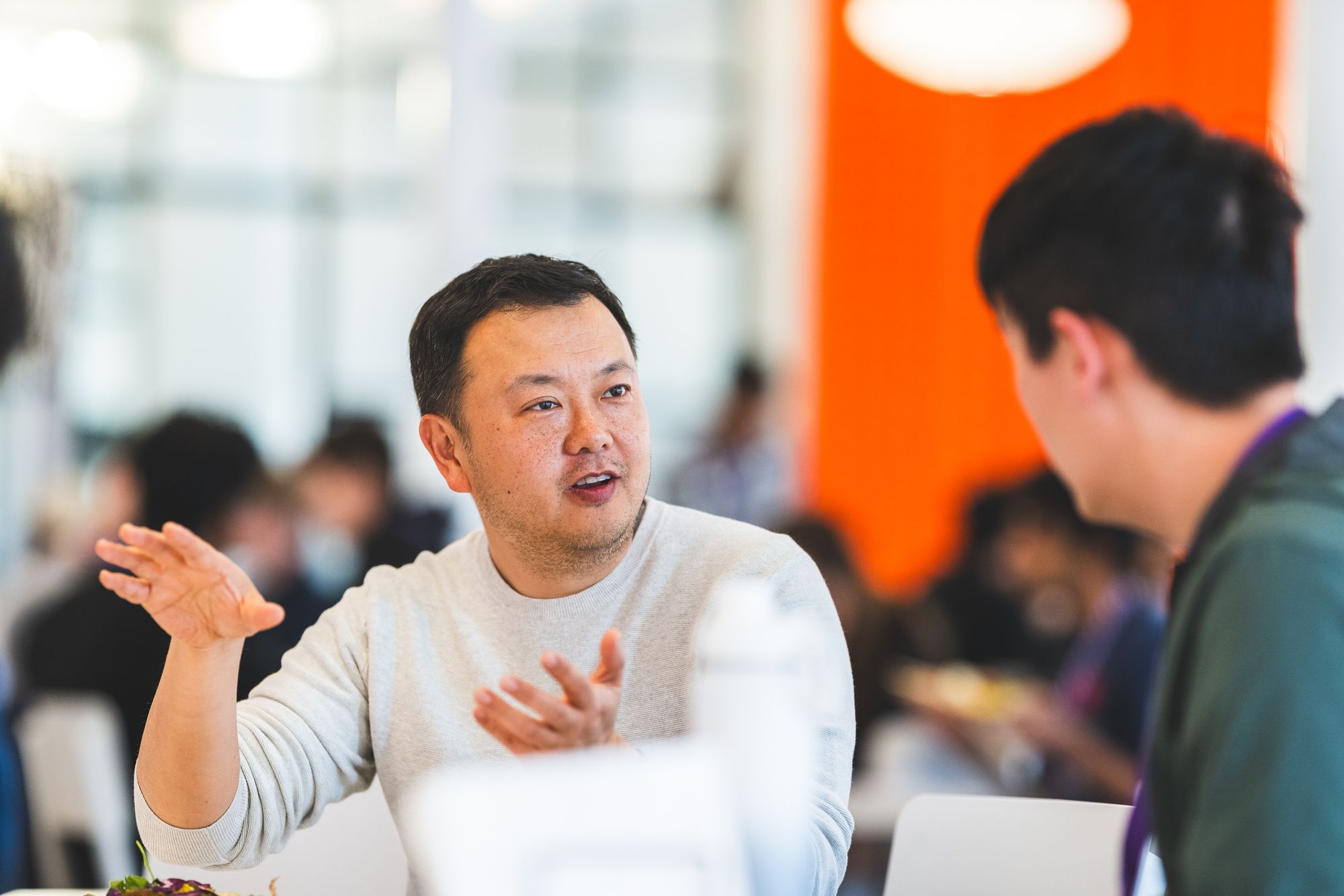
The robo-advisor pioneer who came back to build the builders - one YC batch at a time.
Most people who end up at Y Combinator's partner desk got there through a filter: Stanford, a unicorn exit, the right firm. Jon Xu got there differently. He walked in the front door fifteen years ago carrying a pitch, got funded, built something, sold it to the world's largest asset manager - and then, methodically, worked his way back to the room where the decisions get made. Not as a visitor. As a General Partner.
The detail that matters: before Xu was advising founders, he was one. FutureAdvisor, the fintech startup he co-founded with Bo Lu in YC's Summer 2010 batch, was early enough to the robo-advisor space that the category barely had a name yet. They were democratizing investment management before it became a marketing slogan - building software that gave ordinary people access to the kind of portfolio optimization that had previously required a wealth manager and a seven-figure account minimum.
By the time BlackRock came knocking in 2015, FutureAdvisor was managing $600 million in assets. Sequoia Capital had backed it. So had Canvas Ventures, Keith Rabois, and Jeremy Stoppelman. The acquisition price - reported in the $150-200M range against $21.5M raised - was a clean win. But what Xu did next is the less-told part: he stayed.
Four years inside BlackRock's Digital Wealth Group, working as Managing Director to turn FutureAdvisor into an enterprise-grade platform for financial institutions. Most founders take the acquisition check and sprint toward their next thing. Xu shipped product. That post-acquisition tenure - unglamorous, deep in the machinery of the world's biggest asset manager - tells you something about how he approaches problems. He finishes them.
Investors invest in founders who stay top of mind.
- Jon Xu, on fundraising strategyAfter leaving BlackRock in 2019, he circled through Canvas Ventures as Entrepreneur in Residence - a role that let him evaluate early-stage companies from the other side without fully committing to the partner track. He served on the board of Wahed, the halal fintech platform, and joined the MIT Sandbox Innovation Fund as a funding board member. He was building a portfolio of perspectives.
The path back to YC was deliberate. He joined as a Visiting Group Partner for the S24 batch in 2024, logging hundreds of hours with founders - not as a formality, but as a test. Could he do the work? In May 2025, YC announced Xu and Andrew Miklas as the firm's newest General Partners. The announcement was notable for what it signaled: YC was promoting someone who had been through the program as a founder, not just around it as an investor.
The dual credential is rare. Most VC firms hire former operators or career investors. Xu is both - with a specific form of lived credibility that's hard to fake. He knows what it feels like to sit across from a partner in office hours with your company's survival on the line. He was that founder. He remembers the questions that helped and the ones that wasted time. That changes how he shows up in the room.
"Defensibility must be architected into the business model from the start, not retrofitted later."
"The 'we'll monetize later' era for infrastructure startups is dead. If you don't have a clear path to revenue, you won't get funded."
"The spirit of productivity can still hit me in the evening." - On the myth of the single ideal work routine
"Treat investors like prospects, not random pitches. Build a lightweight CRM, track stages, follow up weekly."
YC portfolio companies Xu has advised as GP and Visiting Partner:
Xu is one of the few YC partners who was a YC founder first. He knows what office hours feel like from the chair on the other side of the table - and that specific knowledge shapes every conversation he has as a partner.
His Twitter/X handle is @xuster - a compact identity he's held since the early days of social media. 669 Instagram followers, 222 posts. No influencer performance, just the work.
Most founders bolt after acquisition. Xu stayed at BlackRock for four years building enterprise tools. That willingness to grind inside a $10T institution - rather than sprint to the next thing - is a data point about how he operates.
FutureAdvisor was in YC's Summer 2010 batch - when the accelerator was still a tight-knit community of a few hundred companies total, not the global institution it became. He saw YC before the scale.
He describes himself as a morning person - but credits parenthood, not discipline. "The spirit of productivity can still hit me in the evening," he noted, suggesting he runs on opportunism as much as routine.
Xu stayed connected to MIT after graduating - eventually joining the MIT Sandbox Innovation Fund board and speaking at the 2023 MIT AI Conference. The university appears to be a lasting anchor point in how he thinks about innovation.
Before becoming a full General Partner, Xu had already logged over 500 hours of office hours with YC founders as a Visiting Partner. That's not a warm-up - that's a second full-time job done voluntarily to earn the role.
In 2010, the financial advisory industry was built on relationships - and most of those relationships required substantial minimum investments. High-quality portfolio management was a luxury product, available primarily to people who already had significant wealth. Jon Xu and Bo Lu walked into Y Combinator with a different thesis: software could do what human advisors do, at scale, at a fraction of the cost, available to anyone.
FutureAdvisor wasn't the only robo-advisor to emerge in that era - Betterment launched around the same time, Wealthfront not long after. But FutureAdvisor carved out a specific position: it was designed to work with whatever accounts you already had, across different brokerages, rather than requiring you to move your money somewhere new. It was a coordination layer, not a destination.
The company raised $21.5M in total - a Sequoia Capital-led round gave it institutional credibility, and backing from Keith Rabois and Jeremy Stoppelman added Silicon Valley density. By 2015, with $600M in assets under management and a growing client base, it had proven the model. BlackRock noticed.
BlackRock - the world's largest asset management firm - acquires FutureAdvisor.
- Y Combinator blog, August 2015The acquisition was significant beyond the dollar amount. BlackRock was signaling that digital wealth management wasn't a startup curiosity - it was the future of their industry. Xu's four-year tenure there, building enterprise tools for large financial institutions, was essentially a graduate program in how legacy finance actually works at scale. That knowledge is now informing how he thinks about fintech startups at YC.