A credit card payment has two audiences. The shopper sees a purchase completed. The merchant sees a purchase completed, minus a fee. Eric Shoykhet has built a company around the difference between those two experiences. The part of checkout most people hurry past is the part he wants them to reconsider.
There is something pleasingly unglamorous about his chosen battlefield. A payment-processing bill has little of the theatre of a stock-market debut. Yet Shoykhet, who began his career inside institutional finance, keeps returning to the machinery behind familiar transactions. His first company, Atom Finance, tackled investment information. Link Money, which he co-founded with Edward Lando, tackles the route money takes from a customer to a business.
His two ventures suggest an appetite for useful financial services whose price or design leaves room for a different approach. He has chosen problems that sound straightforward until someone has to solve them. Research should be easier to obtain. A merchant should have a cheaper way to get paid. Neither proposition requires a new human desire. Both require someone to question an old bill.
“I got the itch to actually build something”
ERIC SHOYKHET / ON LEAVING INVESTING
A good education in other people’s businesses
Shoykhet studied at the University of Pennsylvania, graduating from the Huntsman Program in International Studies and Business. His degrees span economics at Wharton and international studies in the College of Arts and Sciences. He attended from 2010 to 2014, with finance and accounting concentrations at Wharton. The combination would prove useful for a career spent looking at how financial businesses work across markets.
His early professional stops were Blackstone’s restructuring and reorganization group and Governors Lane, an event-driven hedge fund. At the latter, he covered businesses across industrials, financials, technology and consumer staples. Before he was asking customers to use his software, he was examining companies as investments.
His interest shifted toward creating a product of his own. Explaining his departure from investing in 2021, he described a desire to build. He explored ideas and kept returning to financial information. The attraction was practical: this was a product category he had used, understood and found wanting.
His relationship with Lando also reaches back to Penn. They became friends on their first day as Wharton undergraduates. A first-day introduction eventually became a working partnership in payments, a rather more elaborate outcome than borrowing someone’s lecture notes.
When the research desk belongs to everyone
Atom began in 2018. The gap Shoykhet saw was between expensive professional research systems and the thinner resources available to individual investors. Someone could buy a share with ease while still struggling to assemble the information needed to understand the business behind it. The trade had become convenient; the homework remained a nuisance.
His answer put market news, company financials, analyst estimates and research tools into one platform. Document search and financial modeling mattered alongside live prices. These are workaday tasks, but they determine how much time an investor spends investigating an idea rather than collecting the ingredients for an investigation.
Atom’s early reception gave that idea some substance. By October 2019, it had recorded more than 80,000 sign-ups following its public beta launch that June. It announced a $10.6 million Series A led by General Catalyst. The figures measured interest and funding, rather than investment success for users, but they showed an audience for something between a free quote page and a professional terminal.
By early 2021, the discussion around retail investing had become louder and more speculative. Shoykhet’s own writing stressed education, accurate information and the risks of putting complex trading tools within easy reach of inexperienced investors. His argument made an instructive companion to Atom’s product: opening the door to a market creates a responsibility to help people understand what is inside.
In June 2021, Atom announced a $28 million Series B led by the SoftBank Latin America Fund, with General Catalyst and Base Partners participating. A Banco Inter partnership and plans for a Miami office pointed toward a wider business. Shoykhet, who had moved to Miami, would anchor the office. Alongside its consumer offering, Atom was developing integrations that let financial institutions put its research capabilities into their own products.
The next bill was at checkout
Link Money, founded in 2021, carried Shoykhet into a different corner of finance. His attention to European financial businesses had introduced him to the growth of bank-based payments there. He saw room for a similar option in the United States, where merchants were accustomed to paying for card acceptance.
In January 2023, Shoykhet and Lando introduced LinkPay and disclosed $30 million in funding: a $10 million seed round led by Tiger Global and a $20 million Series A led by Valar Ventures. Their launch named merchants including Misfits Market, Thrivos, Play by Point and Passport. The company described several billion dollars of committed payment volume. Committed volume was a promise of business, rather than a report of money already processed.
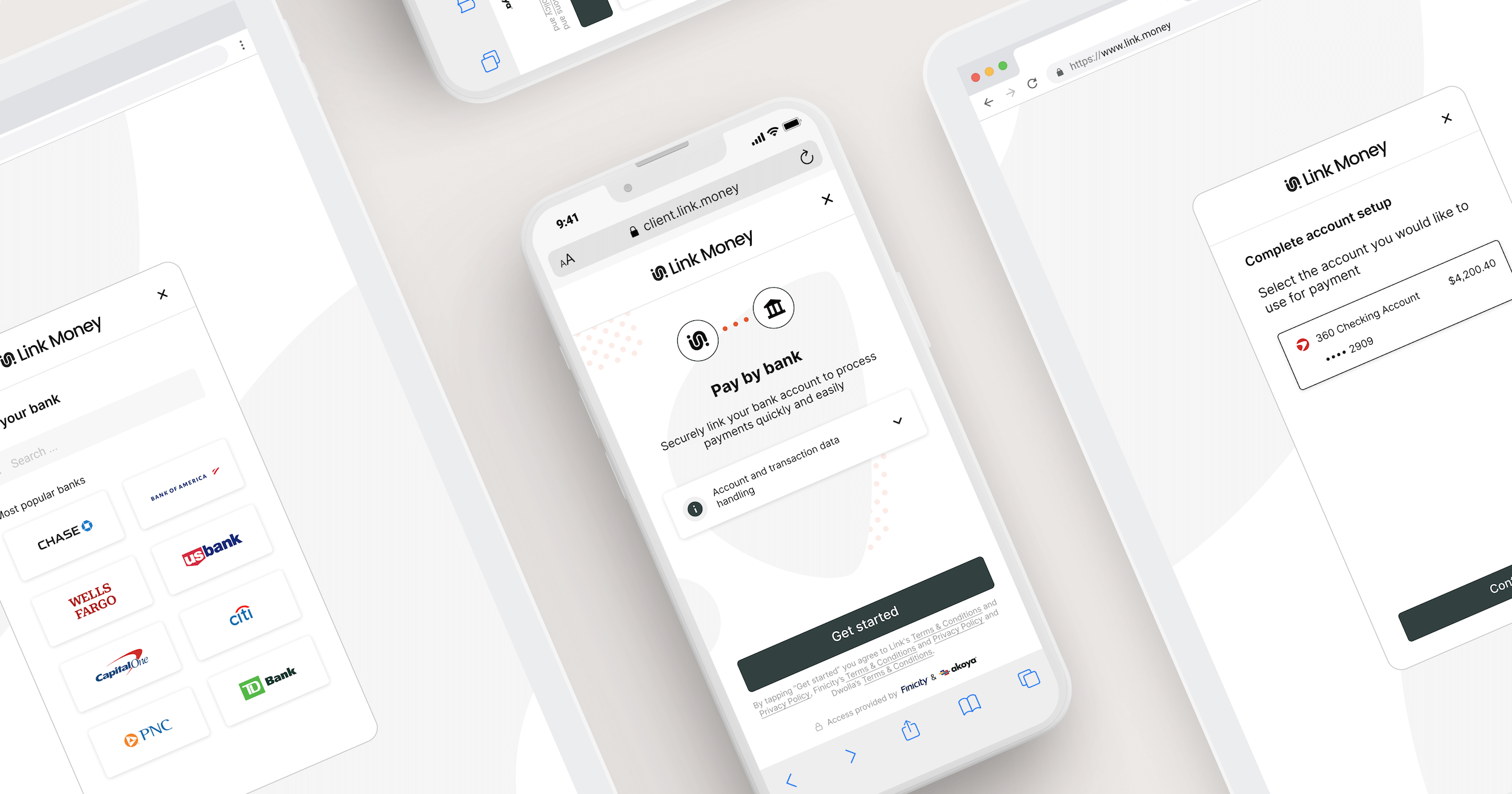
The customer-facing proposition was straightforward. Choose a bank-payment option at checkout, connect an existing account and authorize payment. For the merchant, Link would handle the less visible work around verification, payment decisions and moving funds. Shoykhet was selling infrastructure to businesses; shoppers did not need to become enthusiastic followers of a new financial brand.
That distinction suited his preference for working close to the underlying service. In a 2023 interview, he described proximity to core infrastructure as a factor in how he assesses a fintech business. For Link, being the payment method itself put the company near the activity whose cost it wanted to reduce.
Why he would pass on your coffee
Shoykhet’s sales logic gets more interesting when he discusses where the product belongs. Asked in 2023 about approaching a local coffee shop, he explained that a five-dollar purchase offered too little dollar savings to justify the effort. Repeated purchases and larger transaction amounts made a better starting point.
Parking, storage and subscriptions appeared in his discussions of the opportunity. These are relationships in which a business already knows its customer, and the customer returns. A payment method can become part of an existing routine. That is a different persuasion problem from asking a stranger to try something unfamiliar for a small, one-off purchase.
There is a useful restraint in this example. A founder can describe an enormous market and still decline the coffee. Shoykhet’s emphasis was on the cases where changing the payment route produced enough savings to matter. A low percentage becomes interesting when it is multiplied by a meaningful purchase and repeated often enough.
- 01Choose pay by bank
- 02Connect an existing account
- 03Authorize the payment
The inconvenient business of being trusted
Lower fees can get a merchant’s attention. Reliability determines whether a payment option deserves to stay. In March 2024, Link announced a collaboration under which Silicon Valley Bank, a division of First Citizens Bank, would handle ACH processing and money movement for its merchants. Shoykhet highlighted the bank’s processing expertise and ability to support scale.
His public case for pay by bank also acknowledged the American market’s complications. In May 2024, he wrote about fragmented bank connections, consumer habits and the separation between access to account information and immediate settlement. The opportunity depended on making those pieces work together. A bank connection, by itself, would not finish the job.
Fraud added another test. In 2025, Link and its fraud-prevention partner Sift reported that Link stopped $3 million in verified fraud attempts for one ticketing merchant within a year. At another merchant, fraud volume fell 90% within six weeks after an initial wave. Those were reported customer outcomes, with different customers behind the two figures. They were neither company revenue nor a guarantee of every merchant’s results.
The operational detail is revealing. Suspicious patterns could involve bank accounts rotating among users, devices or IP addresses. The low-cost payment pitch now depended on recognizing behavior as well as moving money. Shoykhet’s business had to become good at the things a legitimate customer would prefer never to notice.

A bank connection with a return journey
In April 2025, Link launched Instant Payouts. The product extended the same relationship in the other direction: a business could send refunds, seller proceeds or other payouts back to customers. Eligible transfers used The Clearing House’s RTP network, with same-day ACH as a fallback when RTP was unavailable.
The company’s explanation was almost mischievously simple: pay-ins and payouts used a single API, with source and destination accounts reversed. Product chief Rohit Mehtani described Link handling the routing behind the scenes. June announcements with Sweepium and SpinQuest then put the two-way payment proposition into specific gaming relationships.
Shoykhet had anticipated more collaboration between fintech companies and traditional banks in his predictions for 2025. He also expected people to adopt open-banking technology without necessarily recognizing the term. That aspiration fits a business built to sit inside another company’s checkout. Success can arrive without a customer learning the vocabulary.
Across Atom and Link, his career has moved from interpreting financial businesses to changing the tools through which people use them. The research desk, the payment button, the return transfer: each is ordinary enough to escape attention until its cost or inconvenience becomes impossible to ignore. Shoykhet keeps finding work in that interval. For a former analyst, there are worse places to look than the line item everyone has learned to accept.