Eric Lander’s latest scientific undertaking comes with excavators. In August 2026, Pacific Fusion broke ground on a research and manufacturing campus in Albuquerque, New Mexico. The company he co-founded plans to build a machine there that releases more fusion energy than the energy initially stored in it. After a career spent helping scientists read the human genome, Lander has taken on a project whose eventual usefulness will be judged, in part, by an electricity bill.
It is an improbable-looking change of subject. Lander is a mathematician and geneticist, rather than a career fusion physicist. Yet the job of bringing specialists, institutions and money into the same enterprise has occupied much of his adult life. The apparatus changes considerably. The difficulty of getting a large group to build something together remains familiar.
His résumé can be arranged into a reassuring procession of prizes and appointments. The more revealing version contains a student newspaper, an unexpected business-school job and repeated returns to being a beginner. There is also a serious failure of leadership. Those pieces sit less neatly together than the appointments do.
The mathematics of a detour
Born in Brooklyn in 1957, Lander became interested in mathematics through a sixth-grade teacher named Jack Druckman. Only later did he learn that Druckman was a social studies teacher filling in. A specialist had not been required to open the door.
At Stuyvesant High School, mathematics became a group activity as well as a private pleasure. As captain of the math team, Lander taught his teammates each weekday morning. At an age when most students were still negotiating with the alarm clock, he was getting practice explaining difficult ideas to a room.
In 1974, he won the Westinghouse Science Talent Search for work on quasiperfect numbers and earned an individual silver medal at the International Mathematical Olympiad. Princeton followed, then Oxford on a Rhodes Scholarship. His doctorate was in mathematics; the thesis became a book on symmetric designs. On paper, the destination looked settled.
It was less settled to the person holding the paper. After Oxford, Lander moved to Boston, drawn by its concentration of universities and the chance of useful encounters. He would later describe the attraction as a higher “probability of productive collisions.” It is a mathematician’s rather agreeable way of saying he wanted to meet interesting people.
“the probability of productive collisions was higher”
Eric Lander, on choosing Boston
The reporter inside the mathematician
Princeton had already supplied a parallel education. Lander worked on The Daily Princetonian and took John McPhee’s nonfiction writing course. Reporting offered an excuse to ask questions outside mathematics. During the 1976 presidential campaign, he sought advice from the Gallup organization and helped develop student polling across several colleges.
There is something appealingly practical about the episode. An undergraduate had an idea, went to people who understood the machinery and asked for help. Later collaborators would operate much larger machinery. The willingness to cross the street was already there.
Classmates remembered more than academic performance. One recalled him bringing cookies or brownies; another remembered his humor and stories of school pranks. These recollections describe an outgoing student who enjoyed company. They also complicate the familiar picture of mathematical talent as a life conducted at a safe distance from other people.
He graduated as Princeton’s valedictorian in 1978. In a constitutional law class, he met Lori Weiner, whom he later married. Neither the newspaper nor that class was necessary for a mathematics degree. Both mattered to the life that followed.
A project bigger than one laboratory
Lander’s first faculty appointment was at Harvard Business School, teaching managerial economics. He had trained for a different subject and learned the new one while teaching it. During those years, curiosity pulled him toward biology. He audited classes and learned genetics, including work with fruit flies. By 1986, he was a Whitehead Fellow; in 1987, he received a MacArthur Fellowship.
The move was more than an unusual line on a biography. Mathematics and computing offered ways to organize biological information that was becoming too extensive for older habits. Lander worked across those disciplines, helping develop maps and methods that could make enormous quantities of genetic data usable.
In the early 1990s, he established the Whitehead/MIT Center for Genome Research. It became a major contributor to the international Human Genome Project, whose completed sequence was announced in 2003. The achievement depended on many laboratories and many researchers. Lander was one of its principal leaders, directing an enterprise in which coordination belonged alongside discovery.
The Broad Institute grew out of that collaborative world in 2003-2004, bringing MIT and Harvard researchers into a shared undertaking. As founding director, Lander worked on the architecture around the science: how people with different expertise could share tools, data and a sufficiently ambitious question. An institution can make certain kinds of research possible before anyone knows the answer.
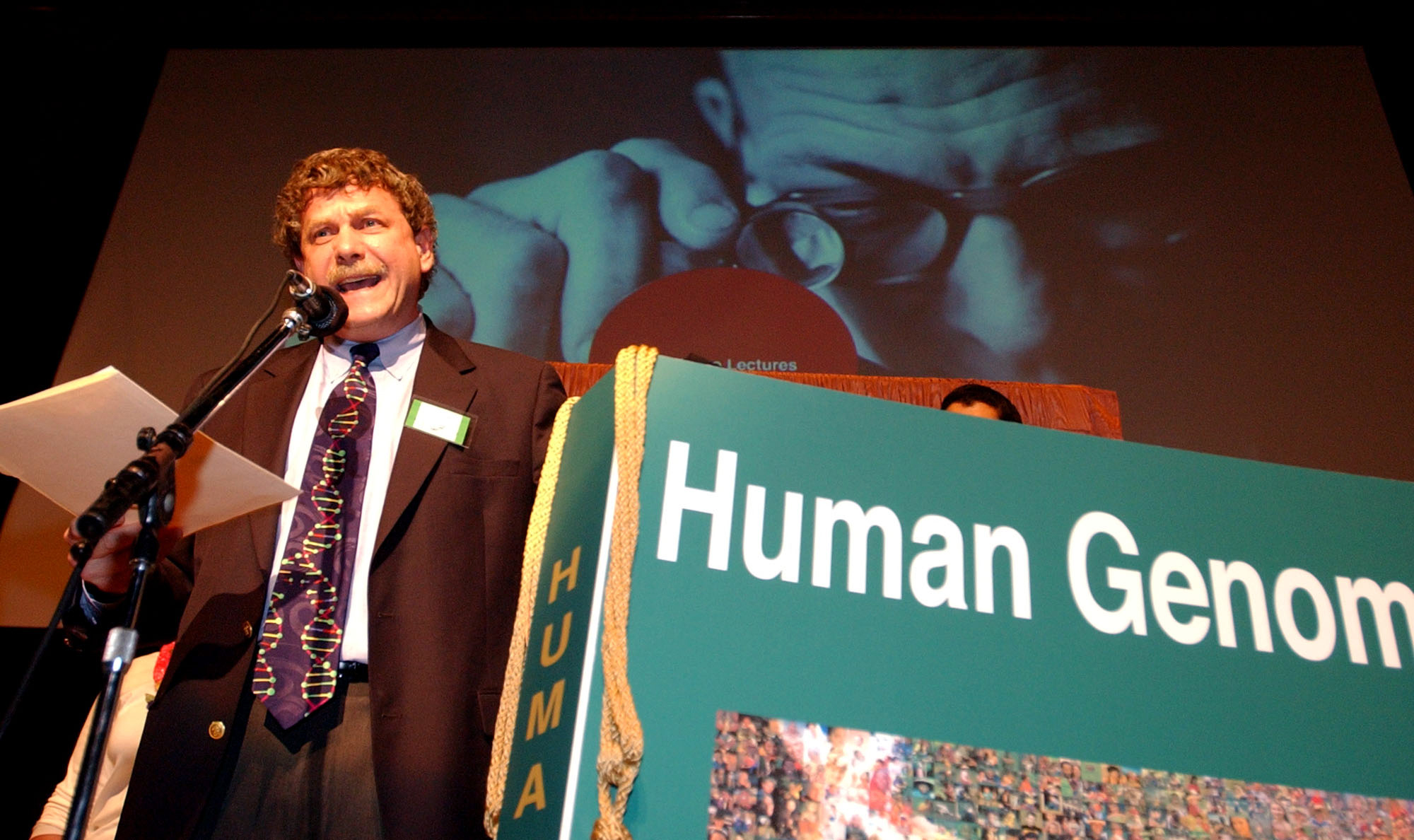
In October 2003, he tried a different sort of compression: explaining the Human Genome Project in a 24-second technical description at the Ig Nobel awards. Years of work, a very short speaking slot. Even a genome project leader occasionally has to obey the clock.
The Washington chapter has a hard ending
That work brought him into government. From 2009 to 2017, Lander co-chaired President Barack Obama’s Council of Advisors on Science and Technology. Under President Joe Biden, he became science adviser and director of the White House Office of Science and Technology Policy, with a place in the Cabinet.
In February 2022, he resigned after a White House investigation found that he had violated its workplace policy. Reports described bullying and demeaning treatment of staff. In a note acknowledging his conduct, Lander said: “It is never acceptable for me to speak that way.”
The episode puts a limit on any easy story about the gifted organizer. Bringing talented people together carries an obligation toward the people themselves. His accomplishments remain part of the record. So does the failure that ended his White House service. Running another team makes that history relevant, rather than conveniently distant.
The next problem comes in shipping containers
In 2022, Lander launched Science for America, a solutions incubator. Pacific Fusion followed in the summer of 2023. Its founding group includes Keith LeChien, Carrie von Muench, Will Regan and Leland Ellison, whose responsibilities span technology, operations, science and simulation. Lander became CEO.
The technical approach draws on decades of national-laboratory research. Instead of using lasers to drive fusion, Pacific Fusion is developing equipment that delivers rapid electrical pulses. These pulses compress a small fuel target toward fusion conditions. LeChien, the company’s chief technology officer, co-invented the pulser architecture at the center of the design.
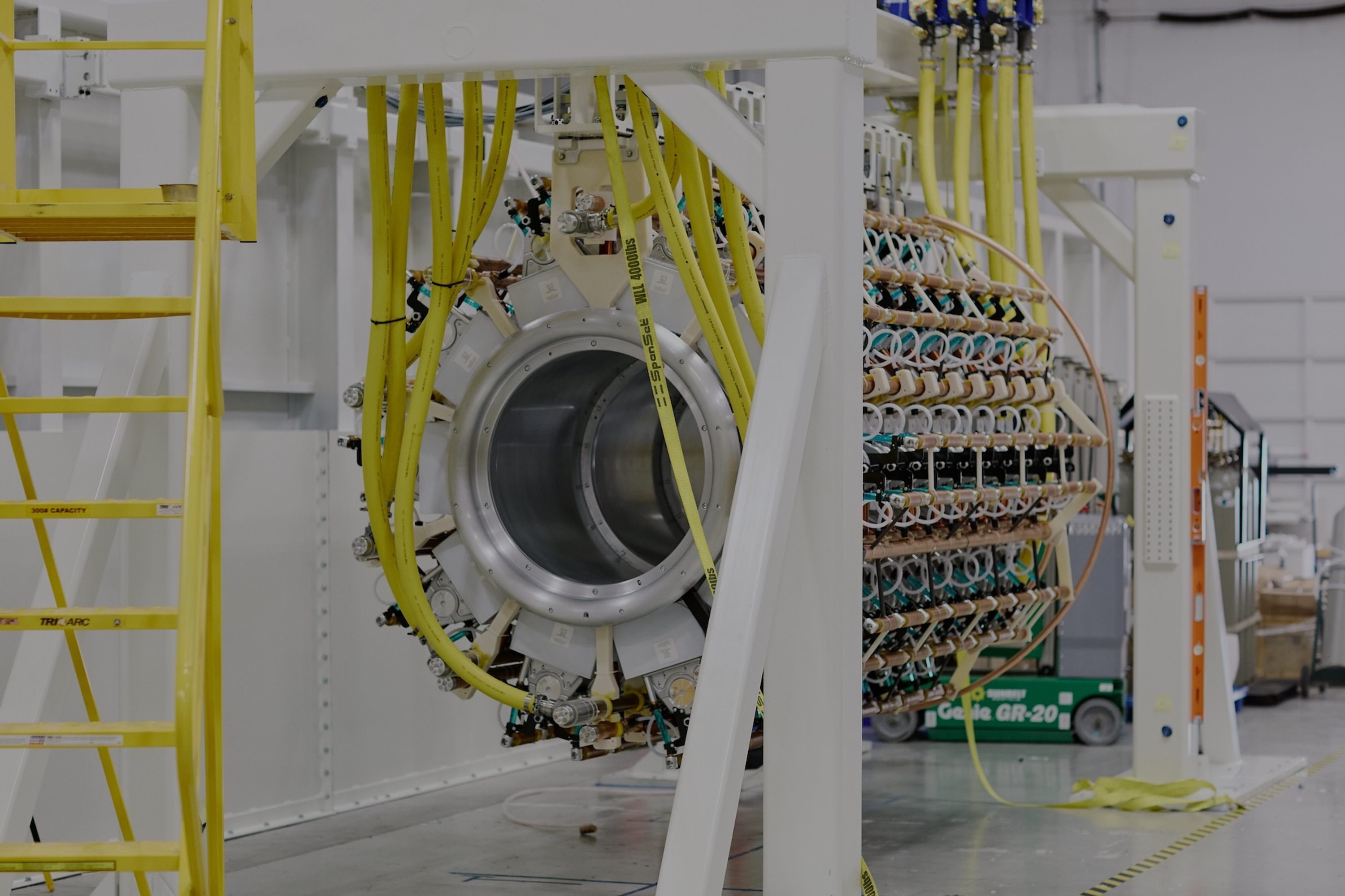
The planned system combines 156 pulser modules around a fusion chamber. Each module is intended to fit in a shipping container. That choice brings manufacturing into the scientific proposition: can a difficult machine be assembled from repeatable units, built and serviced with industrial methods?
The financing reflects the length of the assignment. When Pacific Fusion introduced itself publicly in October 2024, it announced more than $900 million in Series A commitments, led by General Catalyst. The money was committed upfront and would be released against predefined milestones. Investors included Eric Schmidt and Patrick Collison, who joined the board alongside Hemant Taneja.
That arrangement makes the next experiment a financial event as well as an engineering event. It gives the team a longer funding framework while keeping conditions attached to progress. A famous founder and a persuasive presentation can start a conversation. The agreement still asks the hardware to do its part.
Three thousand chances for something to break
By June 2026, Pacific Fusion reported validation of a scaled pulser-module prototype, roughly one-third of a full module. The reported results included about 440 gigawatts of peak output power in an 80-nanosecond pulse. Those are measurements of an extremely brief discharge, rather than a claim that the prototype is supplying continuous electricity.
Another useful number arrived through Lawrence Livermore National Laboratory. A related prototype called Sirius had passed 3,000 test shots in a campaign supported by a collaboration with Pacific Fusion. The point was to learn how components behaved through repeated use, including switches and capacitors.
This is the part of ambitious science that rarely makes a good poster. A switch must keep switching. A component has a lifetime. Simulations help design the experiment, but repeated operation reveals how the actual machine ages and fails. For a business that hopes to manufacture systems, those unglamorous questions deserve prominent seats at the table.
Three thresholds, three different questions
- Scientific gainDoes fusion release more energy than reaches the fuel?
- Net facility gainDoes fusion exceed the energy initially stored in the machine?
- Power gainDoes the complete system produce net electricity?
Pacific Fusion targets the second threshold by 2030. Affordable electricity adds another economic test.
The company’s next large objective is net facility gain by 2030. Turning fusion energy into electricity introduces further losses and equipment. Producing that electricity at a competitive cost introduces capital spending, maintenance and operating constraints. The steps are connected, but reaching one does not automatically complete the others.
The view from a construction site
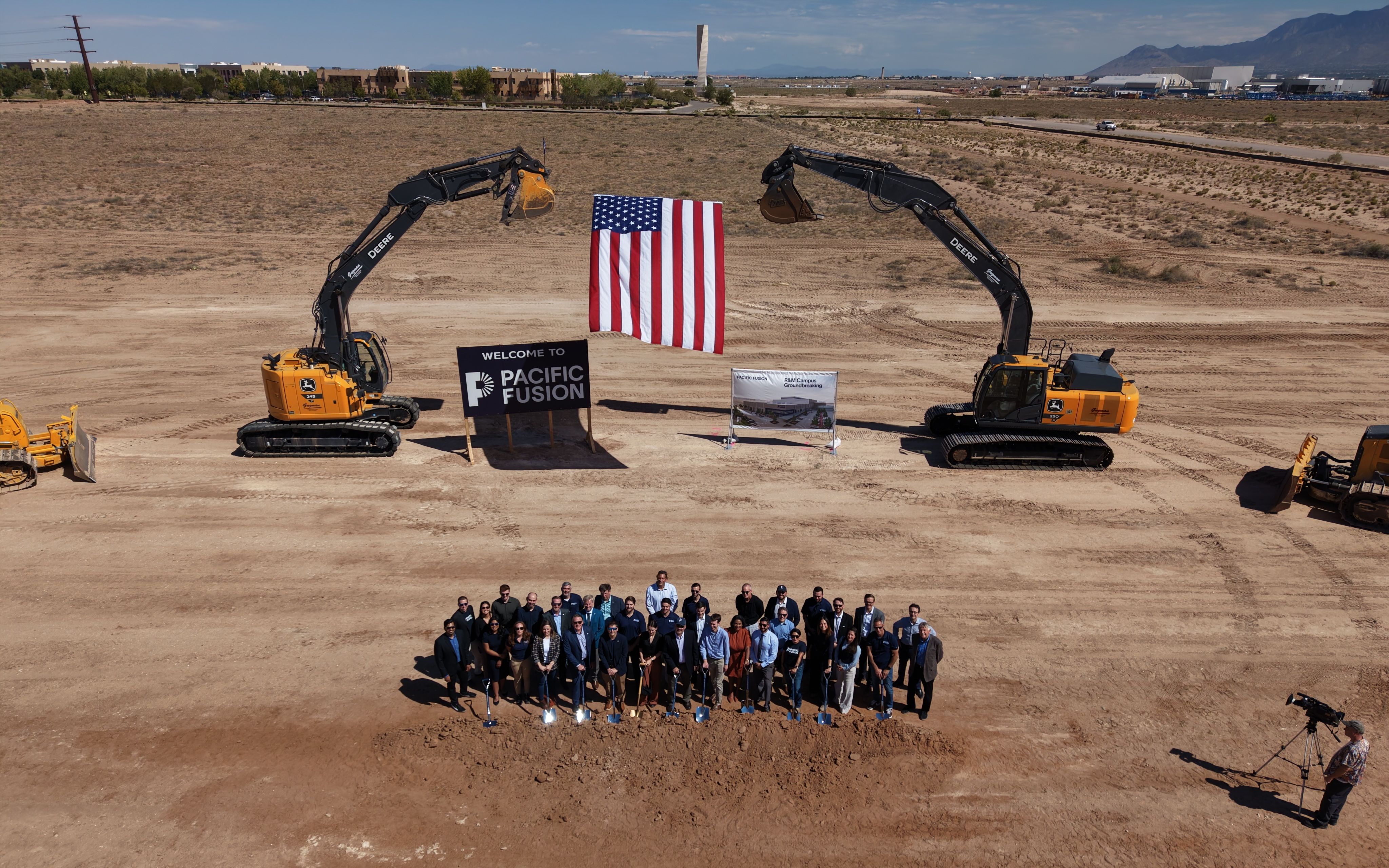
In Albuquerque, the proposed Research and Manufacturing Campus represents a $1 billion-scale investment. The Demonstration System is planned for Mesa del Sol; components are being manufactured through the company’s New Mexico operations in Los Lunas. Its ambitions also include experimental capabilities for national security research. The work extends beyond a future power station.
For Lander, this chapter gathers several older threads: the mathematician learning another discipline, the teacher translating between specialists, the institution builder assembling a team. It also carries a harder question about how that team will be led. His career offers experience, connections and caution in the same package.
The construction photograph supplies a useful final image. People stand with shovels in an expanse of dirt. The ground has been broken; the scientific and industrial outcomes remain ahead. Lander has spent much of his life making large questions into shared projects. In New Mexico, the question has an address, a schedule and a machine still to build.