The Gravy Train required black plastic, dishwashing soap, water, and dog food. At Singing Hills camp in the Texas Hill Country, these were the ingredients for a slide. Eric Goldreyer remembered it well enough to help turn the idea into a product. Years later, his company FunAir made a version that needed only water. Some kinds of progress are mercifully easy to measure.
Goldreyer had been a camper and counselor at Laity Lodge Youth Camp. When FunAir's large inflatables arrived on the Frio River, something from his own summers returned in a more durable form. There were side bumpers now. The vinyl did the slippery work. The original recipe could retire.
Goldreyer’s career can look, on paper, like several unrelated careers. There are bed-and-breakfast listings, vacation rental management, classroom portfolios, a small Texas inn, and enormous inflatable yacht toys. Spend a moment with the camp slide, though, and a connection emerges: Goldreyer keeps building businesses around things people want to do together.
A guidebook problem, in 1995
Before the yacht slides, there were the guidebooks. Goldreyer and his wife enjoyed staying at bed-and-breakfasts, but finding them took effort. In 1995, he founded BedandBreakfast.com. The appeal was concrete: bring scattered places to stay into a searchable online directory. A weekend away should not require a research department.
He had studied business at Texas A&M and worked in account management at Southwestern Bell, handling customers including Texas Instruments and Exxon. Leaving that work for a lodging website meant taking a familiar frustration seriously enough to build a company around it. His early career had involved serving large accounts. The new business would help much smaller establishments find an audience.
By March 2010, when HomeAway announced the acquisition, BedandBreakfast.com listed more than 10,000 properties across 100 countries. HomeAway said it would preserve the business as an independent brand. A particular category of travel, once awkward to search, had acquired a place on the web where people knew to look.
The company also reached beyond listings into lodging software. Its acquired business included RezOvation and Webervations, alongside BedandBreakfast.com and Inns.com. That combination matters to the story: finding a room and running the business behind the room are connected problems. Goldreyer's later ventures would keep taking him between those two sides of hospitality.
The room has to work, too
TurnKey Vacation Rentals followed. Goldreyer was a co-founder; the company applied technology to the operational business of managing vacation homes. Vacasa completed its acquisition in April 2021. At that point, TurnKey operated in more than 80 destinations across the United States. A listing might introduce a traveler to a property, but somebody still had to deliver the stay.
He also became a co-owner of Sage Hill Inn & Spa outside Austin. By his 2025 account, the property had 20 rooms on 88 acres near Driftwood. It gives his hospitality interests a physical address: a small inn with land around it, rather than an inventory count on a screen.
These businesses expose different parts of the same experience. A directory deals with discovery. A management company deals with delivery. An inn puts the guest on the premises. Taken together, they help explain why Goldreyer's current argument about travel includes both the price of a reservation and the professional responsible for it.

The detour into the classroom
Then there is Bulb. Goldreyer's work as co-founder and CEO of the digital portfolio company took him into education, where the material being organized was a student's work. The product gave students and teachers a place to assemble projects, images, text, and video without first becoming website designers.
A June 2014 financing announcement already identified him as the company's leader. Bulb had secured more than $1 million from angel investors for growth. Here, the customer problem involved a different kind of visibility: helping someone show what they knew through the work they had actually made.
Bulb's promise extended beyond a single assignment or school year. A portfolio could go with its owner. In a world of school accounts and changing institutions, that was an appealingly practical ambition. A project should remain useful after the class that required it has ended.
In January 2019, Bulb announced a partnership to put its web application on HP education devices. The company described nearly one million portfolios created by people in more than 100 countries. Access through a device already headed for a classroom gave the product a route to students that an attractive website alone could not supply.
That same month, Bulb announced Google Classroom sharing capabilities and participation in Google's education technology partner program. Students could make work in Bulb and submit it through Classroom; Google sign-in reduced another small obstacle. This was the everyday machinery behind the larger promise. Teachers and students had existing routines, and new software needed to fit them.
“We believe your work should never be lost.”
Eric Goldreyer, June 2019
Later that year, Bulb announced an integration designed to preserve embedded Google Drive files as PDFs in its asset library. The point was to let people retain content after losing access to a school account. The ambition to keep a lifetime of work suddenly had a very specific engineering requirement: make sure graduation did not take the files with it.
In August 2019, the company offered its premium bulb+ accounts free to teachers. The proposed uses included curriculum collections, professional development records, and learning plans. Goldreyer was also listed among the participants in that year's EDUCAUSE pitch competition. For all the talk of lifelong learning, the work involved ordinary steps: getting in front of educators, building connections between tools, and making participation easier.
There is still room for a very large slide
FunAir, founded in 2013, makes a cheerfully physical companion to the portfolio business. Its origin was Goldreyer's search for ways to make his lake house more fun for family and friends. The company went on to manufacture inflatable products for yachts, including the tall slides hanging from the sides of large boats.
His company biography describes an e-foiler, snowboarder, and stand-up paddler who pays attention to details. These are useful interests for someone selling recreation: he participates in the category. The lake house idea and the camp memory also give the business a personal history that a market-size calculation would struggle to capture.
The contrast is entertaining. A portfolio has to preserve something. A slide has to release someone, preferably into water. Both require the maker to think about what a person will actually do with the product. Goldreyer's collection of companies becomes easier to understand when use comes before industry classification.
Back to the booking window
In January 2025, bnbfinder became Savvy under Goldreyer's leadership. The older directory had been connecting travelers with independent properties since 1998. He expanded its focus toward professionally managed vacation rentals and built connections to the software property managers already used.
Savvy's pitch combines direct booking, professional hosts, and price comparison. Savvy reports 150,000 properties and says managers undergo third-party identity and business verification. The practical proposition is straightforward: give travelers a place to search together, then connect them with the people managing the stay.
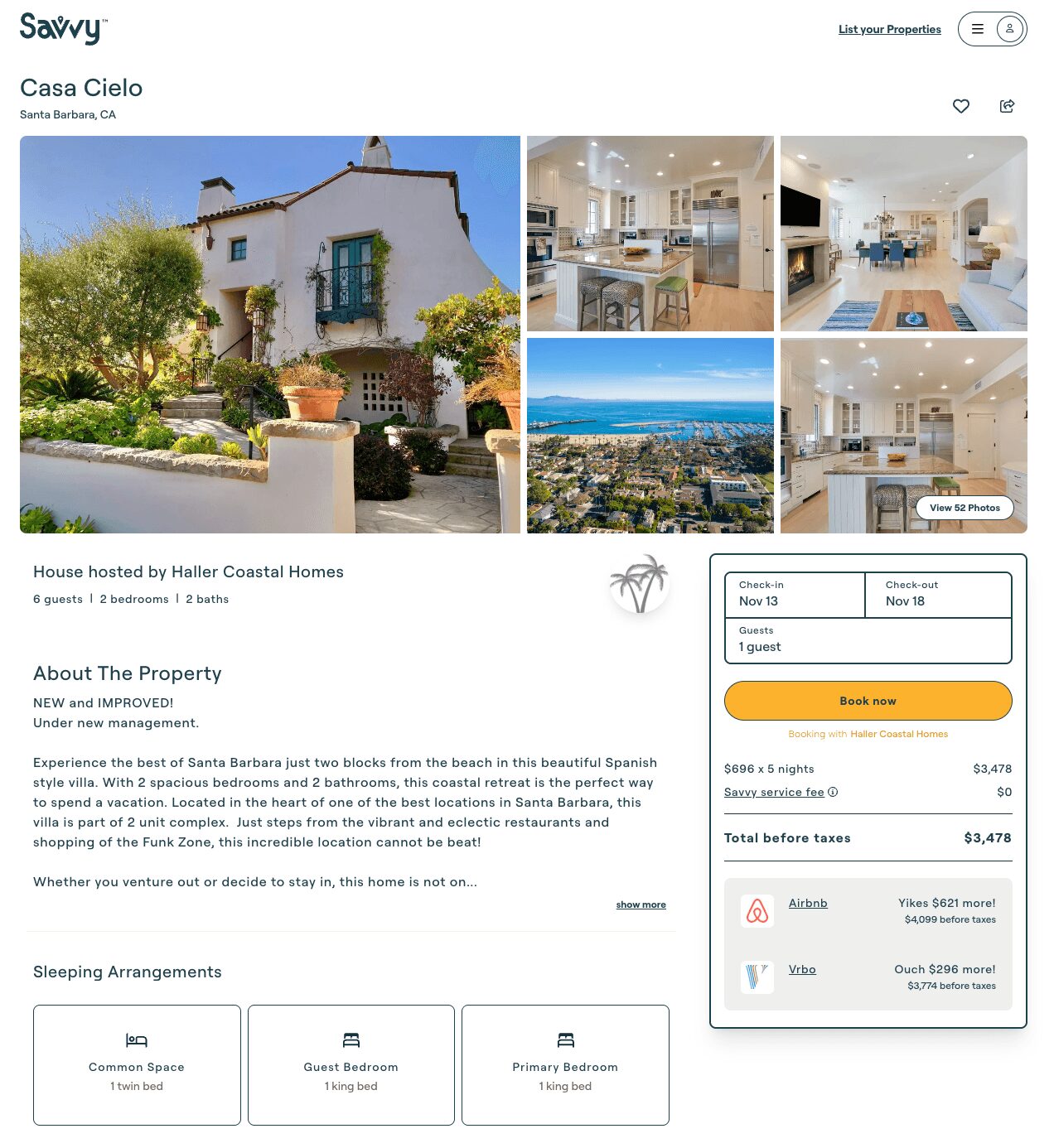
The question has occupied him in public well beyond the rebrand. In a February 2024 essay, he argued that property managers should diversify their distribution and retain more control over communication, pricing, and policies. His argument acknowledged why large booking platforms attract customers: putting many properties in one place is convenient. Managers still need ways to build relationships that continue after checkout.
By July 2026, his conversation on the Alex & Annie podcast was focused on discovery. Lower fees alone would not make direct booking a consumer habit. Travelers had to be able to find and trust the alternative. In October, he returned with Lasoh founder Orlie Benjamin to debate what direct booking actually means when a large platform still handles the reservation.
That is a revealing place for a lodging entrepreneur to arrive after three decades: back at the problem of helping people find somewhere to stay, with more experience of everything that happens afterward. The web made searching easier. The relationships behind the search remain contested.
Working with people he likes is part of the attraction, too. In a July 2026 conversation, he described changing his view of hiring friends. Earlier in his career he had kept friends and family apart from the business. Later, he wanted colleagues whose company he enjoyed. He also acknowledged the difficulty when a hire did not work out and investors still needed results. It is an unusually ordinary problem beside the acquisitions and platform ambitions: wanting to spend the working day with friends, while accepting that friendship cannot make every business decision for you.
Goldreyer has said he would spend more time with family and friends, play pickleball, and go foiling if he were not running Savvy. The answer sits comfortably beside the lake house and the camp slide. His businesses have repeatedly brought him close to the things he likes doing. One hopes the meetings finish in time for the water.
Keep the conversation going
Visit Savvy, FunAir, and Sage Hill Inn. Follow Eric on LinkedIn.
Read the CEO conversation, his essay on direct booking, and the Austin interview. Listen to his Alex & Annie episodes or watch interviews through Savvy's YouTube channel.