A company founder can tell you a great deal about leadership. A colleague who has watched him make the coffee may tell you more. At InMarket, Todd Dipaola could move from a major partnership meeting to brewing a fresh pot in the kitchen. Dave Heinzinger, then the company’s communications chief, described a boss who remained approachable as the business spread across three cities. It is a small detail, pleasantly resistant to being turned into a quarterly earnings slide.
The larger business was devoted to measuring things. Ads, shopping behavior, even the experience of working there: the company tested, asked for feedback and adjusted. Dipaola had built a career around making commercial promises answerable to results. Yet the coffee offers another way into his story. Someone still has to notice what needs doing, and then get up and do it.
In 2026, after three years as executive chairman, he returned to InMarket’s CEO job. The company he co-founded in 2010 had traveled from shopping apps and retail beacons into advertising measurement and AI. The machinery had changed considerably. The question underneath it remained stubbornly familiar: what happened because of the money a customer spent?
A click is a useful place to start
Dipaola’s earlier company, Vantage Media, put him and his brother Mark in the business of performance marketing during the growth of search advertising. They built the company without the cushion of outside funding at the outset. Todd served as its chief financial officer. Vantage reached number 31 on the Inc. 500 and earned the top spot in Deloitte’s Los Angeles technology growth ranking.
Search offered a practical attraction. A person looking for something was already revealing an intention. An advertiser could respond and measure the result. For a business selling performance, that made the transaction easier to explain than a general promise that somebody, somewhere, might remember a brand.
“I don’t make a dollar until my client makes two.”
Todd Dipaola
It is a good sentence for a finance executive. It also sets a rather demanding condition for a salesman. The customer gets to ask for the arithmetic.
His education had taken a different route. At UC Berkeley, he graduated as a Regents Scholar in molecular and cell biology, with a public policy minor. The combination puts experimental thinking and institutions on the same transcript. Both would recur in his work, although the immediate commercial opportunity involved phones and shopping carts.
The grocery list had other ideas
InMarket began in 2010. Its early CheckPoints app rewarded shopping activity; List Bliss followed with a more domestic proposition. Users could scan barcodes into grocery lists, share those lists, track pantry ingredients and consult coupons and product reviews. The ambition entered the supermarket through the ordinary business of remembering what to buy.
There were mistakes. Dipaola acknowledged that extra features had complicated the CheckPoints launch. The team removed some and left them for a later release, when they could receive proper attention. His explanation was appealingly physical: “Building an app is like building a house.” Anyone who has lived through construction can supply the unpleasant sequel involving the deadline.
The lesson was about sequencing. A feature can be attractive in isolation and still make the whole product harder to finish. For a founder, postponing it means accepting that an imagined launch and a usable launch may have different guest lists. Grocery shopping, already a competitive sport in some households, did not need help becoming more complicated.
Another adjustment proved more consequential. CheckPoints had limits as a standalone route to a large audience. InMarket opened its underlying retail beacon network to other publishers’ apps. That gave the company more ways to reach shoppers without requiring every shopper to adopt its own app.
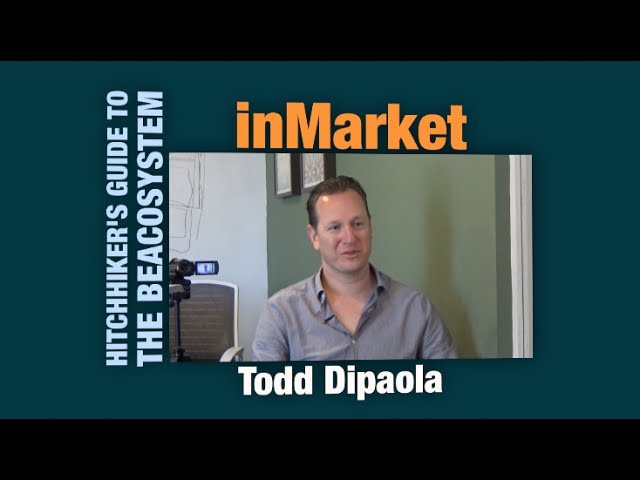
By 2016, the model connected three groups: app publishers, retailers hosting beacons and brands paying to promote products. A recipe app, for example, could remind someone about ingredients upon entering a store. Timing gave the message its usefulness. A reminder delivered after checkout has the comic precision of an umbrella arriving tomorrow.
Dipaola even joked that some beacon competitors behaved like nonprofits because they were burning through cash. It was an unusually pointed joke from someone who also helped run an actual foundation. InMarket’s choice was to find advertising revenue around the technology, with brands supplying the promotional budgets.
One useful moment: a relevant message during the shopping trip.
Giving the money another job
Commercial success also gave the Dipaola brothers a decision about what money was for. They committed several million dollars to endow a charitable foundation while still young entrepreneurs. By 2007, the Dipaola Foundation was taking shape around environmental and systemic societal issues.
Todd’s argument extended beyond writing a large check once business was finished. He encouraged entrepreneurs to allocate part of their profits to giving and treat philanthropy as a continuing responsibility. “Business doesn’t begin and end with the almighty buck,” he said. The phrase has the agreeable sound of someone interrupting a spreadsheet before it acquires religious authority.
His public service included chairing California Common Cause and serving with RepresentUs. He also joined the advisory board at Berkeley’s Goldman School of Public Policy. Cycling became another means of contributing: he rode across America and through California to raise money for charity. That is a substantial amount of time to spend considering whether the next hill was mentioned in the brochure.
A later project brought the civic and commercial work together. For the 2024 Angelenos for Fair Maps campaign, InMarket contributed digital advertising support. California Common Cause credited the company with reaching more than a million voters in the Los Angeles region. The campaign backed Measures DD and LL, concerning independent redistricting for the city and school district.
The organization reported a click-through rate of 0.38%, against a 0.15% goal. Both measures passed with more than 74% of the vote. Those are different kinds of results: engagement with an ad and a decision at the ballot box. The distinction matters. An advertising campaign can contribute to a coalition’s work without claiming ownership of every vote it hoped to influence.
Growing into the question
Meanwhile, InMarket was adding capabilities. In September 2020, it acquired assets from NinthDecimal, bringing together audience tools, activation, analytics and attribution. Dipaola said the companies’ customer bases overlapped by less than 2%. The fit allowed the combined business to offer more services to customers it did not already share.
He estimated combined 2020 revenue would reach $100 million; that was a forecast at the time. More than 90% of NinthDecimal’s employees were set to join InMarket. The acquisition expanded the practical scope of his original question. A company that helps place advertising and measure its effects has to connect several stages of a customer’s journey, rather than declare victory at the first visible interaction.
Leadership expanded too. In January 2022, Todd Morris became co-CEO. Morris took responsibility for growth, finance, sales, marketing and operations. Dipaola continued with innovation and culture, particularly product. The arrangement gave the founder a defined area of attention while another executive managed much of the business’s expansion.
That same year, Dipaola received EY’s Entrepreneur Of The Year Central South award. Earlier recognition in Greater Los Angeles had named him a finalist. The distinction is worth keeping straight, even in a career concerned with making numbers look useful. A finalist and a winner occupy different cells in the spreadsheet.
From 2023 he served as executive chairman. In announcing his return as CEO in 2026, he thanked Morris, who would remain on the board, and said the company had grown fivefold since Morris joined. He also reported more than $1 billion in cumulative revenue over InMarket’s history. Cumulative revenue describes years of business; it is a different measure from an annual revenue figure or a valuation.
- 2010InMarket begins with mobile shopping.
- 2020NinthDecimal assets add measurement capabilities.
- 2022A co-CEO structure divides product and growth.
- 2026Dipaola returns as CEO; Maestrø enters beta.
Accountability travels in both directions
There is a harder chapter in this business of understanding where people go. In 2024, the Federal Trade Commission finalized a settlement with InMarket over allegations that it collected and used consumers’ location data without adequately informed consent. The agency’s concerns included the disclosures made through InMarket’s own apps and through apps using its software.
The order prohibited selling, sharing or licensing precise location data, along with products that categorize or target people using sensitive location data. It also imposed requirements around deletion, withdrawing consent and privacy programs. The settlement concerned the company. It belongs in any account of the enterprise Dipaola founded.
The issue complicates the word accountability. Advertisers want evidence that spending produced a result. Consumers need to understand what has been collected about them and have meaningful choices about its use. A convincing answer for one group does not settle the question for the other. More precise measurement makes the second responsibility more consequential.
Back at the desk, with faster machinery
In June 2026, InMarket announced the beta launch of Maestrø, a tool designed to connect AI-driven advertising decisions to measured store visits and purchases. The company described a system that feeds results back during a campaign, allowing adjustments before the budget has disappeared into history.
Dipaola’s stated ambition was to give AI-powered media an accountability layer. The proposition fits his earlier work: improving the speed of a decision has limited value unless someone can establish whether it helped. InMarket’s claims about causal measurement remain the company’s claims, and the product’s commercial promise will depend on what it delivers for customers.
For Dipaola, the return to CEO places that promise under his direct management again. There are more tools on the desk than there were in 2010. There are also more obligations attached to using them. The useful habit is still the one suggested by the coffee pot: notice the work, take responsibility for it, and make sure somebody actually benefits.
Follow the thread
- InMarket / company profile
- InMarket / current leadership
- Todd Dipaola / LinkedIn
- Berkeley / public biography
- Watch / the 2016 beacon interview
The decisions, in more detail