Lorne Abony had acquired businesses, raised capital and run a company whose music followed people through their shopping. Then came an assignment with a simpler measure of success: climb the ladder. During his January 2013 appearance on Undercover Boss, the Mood Media chairman and CEO had to help install equipment. He was afraid of heights. A large corporate footprint offered little assistance with the next rung.
It is a useful place to meet him. Much of Abony’s career has involved companies that sit behind an everyday activity: buying supplies for a pet, playing an online game, hearing a song in a store. The customer sees the enjoyable bit. Behind it are distribution arrangements, financing, software, rights and people doing fairly unglamorous work. On television, one of those people briefly happened to be the boss. The installation assignment made the distance between a corporate plan and a working customer location unusually easy to see.
The lawyer who wanted a different working day
Born in Toronto in 1969, Abony followed an educational route with plenty of respectable destinations. He studied at McGill, graduated from Windsor Law in 1994 and earned an MBA at Columbia Business School. He practiced securities law at Aird & Berlis in Toronto. The work put him close to the machinery of business: how companies raise money, structure transactions and turn an intention into an agreement. He eventually chose a job with more exposure to the consequences.
In 1998, he left legal practice and launched the online pet-supply venture that became Petopia.com. San Francisco and internet retail offered a considerably different working day from a Toronto law office. Petopia ultimately passed to Petco. The episode belongs to the period when entrepreneurs were testing how much of ordinary shopping could move onto a screen. Dog food was among the test cases. The commercial promise of the internet was broad enough to include the family pet. Petopia was his first major entrepreneurial chapter.
With Andrew Rivkin, Abony then co-founded the business that became FUN Technologies. It entered London’s Alternative Investment Market in 2003 and the Toronto Stock Exchange in 2004. Its field was casual games and fantasy sports: familiar diversions made accessible through online networks. An office ping-pong table, recorded in a 2007 Windsor Law profile, seemed a reasonable piece of furniture for the enterprise. The business had found a way to take play seriously without requiring visitors to do so immediately.
FUN grew through acquisitions as well as its own services. Its 2006 purchase of WorldWinner brought together competing skill-game operations. Liberty Media became its controlling shareholder, and FUN’s management entered 2007 talking about the work of combining platforms, reducing duplicate costs and making its distribution more efficient. Those are less entertaining subjects than games, but they explain how a collection of acquisitions becomes a company. FUN’s plans for 2007 already contained a problem that would return in Abony’s next venture: after buying the pieces, make them work together.
A shopping trip has a soundtrack
Fluid Music Canada gave that approach a different setting. The business listed in Toronto in 2008. In June 2010, it completed a EUR160 million purchase of Mood Media Group, a company operating in 35 countries. Fluid subsequently took the Mood Media name. The acquisition brought an existing international customer base and regional offices into the group. Expansion arrived with people, relationships and operations already attached.
The product was easy to encounter and easy to overlook. A retailer wants its stores to feel recognizably like its stores. Music helps establish that atmosphere. Screens, messages and scent can become part of it too. Mood supplied those elements to businesses whose own names were more familiar to the people walking through the door. For Abony, the commercial opportunity lay in the systems behind the experience. A shopper could enjoy the soundtrack without ever needing to know who delivered it.
In March 2011, Mood announced an agreement to buy Muzak in a US$345 million transaction. Muzak brought an American presence and a substantial base of customer relationships to the combination. More than three-quarters of its revenue was associated with multiyear contracts. The proposed combined footprint was 470,000 commercial locations worldwide. In a business assembled around atmosphere, that was an unusually tangible measure: hundreds of thousands of doors behind which the service had a job to do.
Abony also had an interest in music that required no acquisition agreement. He liked R&B and Janet Jackson. In a 2010 interview, he talked about his family and the satisfaction of watching a business idea develop. He was traveling extensively, with trips to New York and Switzerland on the agenda. The account catches a particular period: an executive moving between flights, pleased with a new transaction, trying to explain why the building itself held his attention. His mother’s maxim supplied the gentler counterpoint:
“It’s nice to be good, but good to be nice.”
Lorne Abony · 2010 interview
Growth comes with another column
Recognition followed the expansion. In 2011, he won the media and entertainment category at the Ernst & Young Entrepreneur of the Year Awards. Mood was serving clients across multiple continents. Abony described a desire to keep finding new opportunities. His own wording was short enough to fit on a business card: “The key to this success is to never stand still.” It captures the appetite behind the transactions, although movement creates its own demands once the documents have been signed.
The financial record supplies those demands with numbers. For 2012, Mood reported revenue of $443.8 million, compared with $274.7 million the previous year. It also reported a $79.23 million loss. The share price fell sharply after the results. Growth and losses appeared on the same set of accounts. Acquisitions had enlarged the operation; making the enlarged operation perform remained a separate task. The distinction matters in understanding Abony’s tenure. A bigger company had emerged, with the obligations and complications of its new size.
In September 2013, Steve Richards succeeded him as CEO and Philippe von Stauffenberg became chairman. Abony initially remained a director. The company credited him with taking Fluid from fewer than 30 employees at its 2008 IPO to a group of 2,100. It also announced that its strategic review had concluded and that it would continue as a standalone company. The transition closed his period in the two top jobs. Mood’s subsequent history belongs to the executives who followed him; his own career was already moving into other interests.
The racket was more than a prop
One of those interests had been visible all along. In a photograph accompanying his 2010 interview, Abony kneels with a tennis racket, wearing jeans and socks. It is a pleasantly impractical outfit for match play. The sport itself, however, was a serious pursuit. He competed as an amateur, and his ITF player record gives the tennis its own existence outside the business biography. A racket was something he used as well as something he could pose with.
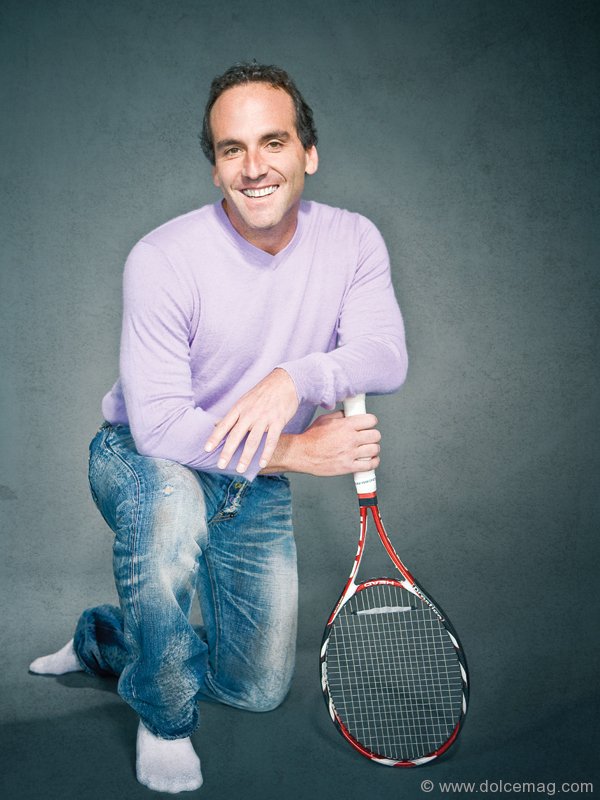
Abony with his racket in 2010. Photograph: Dolce Magazine.
In 2012, the ATP Player Council nominated him to the tour’s new six-member Competition Committee. The group included former Wimbledon champion Richard Krajicek and was created to advise on possible changes to the sport. Abony’s appointment put him in a discussion about the presentation and conduct of professional tennis, a different responsibility from playing his own matches. There was room here for his commercial interests and his sporting ones to meet without having to pretend they were identical.
He subsequently bought the World TeamTennis franchise that became the Austin Aces. The team spent two seasons in central Texas before returning to California as the Orange County Breakers. The return is a reminder that owning a sports business involves the location as well as the athletes: a venue, local supporters and a workable place in the calendar. By late 2016, the franchise was up for sale. Eric Davidson bought it in February 2017, with the financial terms undisclosed. Abony’s turn as an owner had a beginning, a geographical detour and an exit.
The next acquisition is still a job to do
Austin remains the setting for his more recent work. With Tal Shmueli, Abony established Texas Venture Partners, which announced a US$50 million fund in 2024. Its stated focus was early-stage Israeli defense technology, with investments of US$1 million to US$4 million and support for expanding into the United States. The proposition combined investment with a route into a market. For founders, the money was intended to arrive alongside introductions, guidance and help building a presence in Texas.
His current work also reaches into advanced computing and freight. A February 2026 prospectus records M&A committee chairmanships at quantum-control company SEEQC and electric and autonomous freight company Einride, beginning in March and June 2025 respectively. Those assignments place him close to transactions again, with technology that is far removed from a store playlist. The recurring element is the business work around it: capital, ownership, negotiations and a plan for what the combined operation might become.
In February 2026, Abony Acquisition Corp. I, where he is CEO and a director, closed a US$230 million initial public offering. Its stated areas of interest include defense technology, advanced computing, software and media. The capital was raised for a future business combination. It establishes a new assignment rather than a completed acquisition. Abony signed the company’s June-quarter report as CEO in August 2026, another dated entry in a working life measured partly through filings.
The variety is striking, but there is no need to invent a single grand plan that joins dog food, fantasy sports, Muzak and a tennis franchise. They belong to different moments and different markets. What survives across them is a documented willingness to leave a comfortable role, take on another business and return to the practical details. Back in the installation job, those details included a ladder. Even a career spent arranging large transactions occasionally comes down to putting one foot above the other.