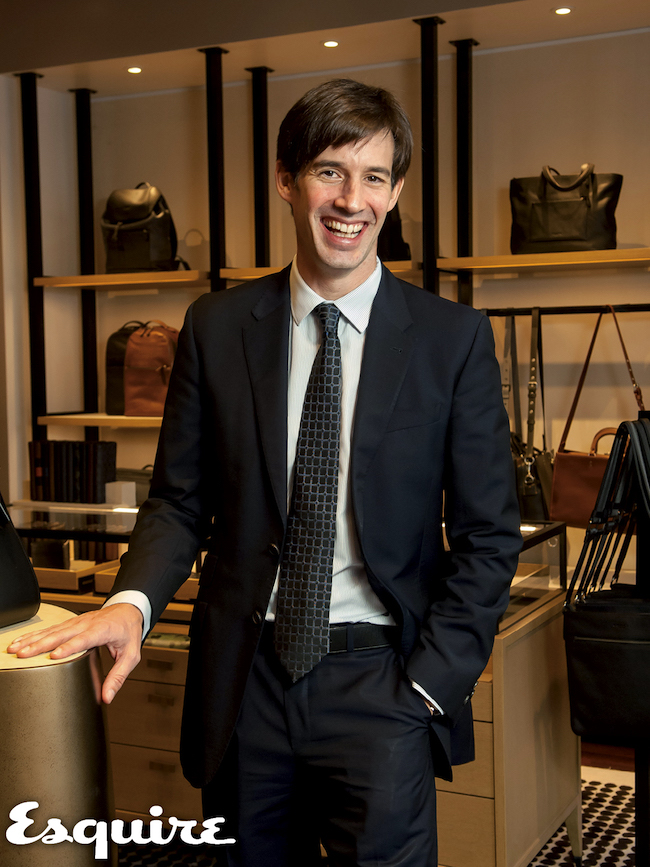
Before Emmanuel Ruelland worked for Coach, he went shopping for a briefcase. He chose Coach. It is a pleasantly practical beginning for a fashion executive: an object needed for the working day, bought before there was a professional reason to admire its maker. The customer came first. The job followed.
There is another small detail worth keeping beside that briefcase. As a young person, Ruelland wanted to make jewelry. He later described himself as meticulous, drawn to the stitching and leather of Coach products. He also spoke of playing trumpet for ten years and occasionally picking up a guitar. There was room, apparently, for both careful workmanship and a little noise.
Today, based in Tokyo, he is President and CEO of Coach North Asia, covering Japan and Korea. The briefcase anecdote offers a useful way into that larger job. A brand has to make sense in somebody's life before it can become a convincing proposition in a boardroom. Ruelland has spent a career moving between those two scales.
Japan, before the handbags
His route began in cosmetics. In 2002, he started his career in Japan, working for L'Oréal. The early positions were concerned with product development and logistics, followed by commercial responsibilities in travel retail. It was an apprenticeship in the practical machinery behind a brand: products have to be developed, moved and made available before anyone can fall in love with them.
His responsibilities expanded across several markets. At L'Oréal, his travel retail work included Lancôme in Greater China and Southeast Asia, followed by Korea and Japan. In 2011, he moved to Clarins as Director of Travel Retail Asia Pacific. Jurlique followed in 2012, first as General Manager International and then, from 2014, as Managing Director, International and Hong Kong.
That sequence matters because it places the regional experience before the fashion title. Ruelland had already worked across beauty businesses and Asian markets when he joined Coach in 2016. A cosmetics counter and a leather-goods store sell different objects, but each asks an executive to connect product, distribution and a customer whose choices cannot be settled at headquarters.
His studies had combined engineering and business: a master's in general engineering and finance from Arts et Métiers in 2001, followed by a master's in business and management from IAE Paris in 2002. Read beside his early logistics roles, the education gives the career an operational starting point. The later work in brand leadership added a different vocabulary to it.
A promotion with a map attached
Coach brought Ruelland into leadership of Southeast Asia and Oceania. Singapore was his base during that chapter. In February 2020, Tapestry announced that he would succeed Giorgio Sarné as President of Coach Asia, with responsibility for Japan, Korea, Southeast Asia, Australia and New Zealand. The announcement placed him under Joshua Schulman, then Coach's CEO and brand president.
The geography was substantial, but it was also specific. Japan was part of the brief alongside markets with different retail histories, partners and customer habits. An appointment of that kind involves a map full of decisions rather than one tidy idea of an Asian shopper. His present North Asia title names Japan and Korea explicitly.
- 2002L'Oréal
Career starts in Japan - 2011Clarins
Asia Pacific travel retail - 2012Jurlique
International leadership - 2016Coach
Southeast Asia & Oceania - 2020Coach Asia
President appointment
Coach itself had been in Japan long before he arrived at the company. Its first Japanese store opened in Yokohama in 1988; its first Ginza flagship followed in 2002. Ruelland was therefore taking responsibility for an established relationship, with customers who already knew the name. Familiarity is useful. It also gives a retailer something to live up to.
That history makes his current emphasis on younger customers more interesting. The task is to introduce a familiar business afresh while keeping it recognizable to people who have known it for years. A new generation may encounter the same brand through an entirely different doorway.
A store you can do something in
In April 2024, Ruelland celebrated the Korea team's first pop-up in Seoul's Seongsu neighborhood. The project centered on the Tabby bag and the spring collection. Giovanni Zaccariello, Coach's visual-experience executive, described three floors combining physical and digital experiences. Ruelland's message gave the credit to the local team and thanked Zaccariello and his colleagues for their support.
By the beginning of 2026, his invitation to visitors to Japan pointed to two projects: the renovated Ginza flagship in Tokyo and the newly opened Osaka Coach Play store. These were the places he chose to show people what the brand's recent work looked like. A store is a useful answer when an executive is asked to explain a strategy. Visitors can walk through the argument.
In a later post, he described Karuizawa as Japan's fourth Coach Play destination, following Tokyo Cat Street, Osaka Shinsaibashi and Kyoto. Each, he said, was rooted in its own location. Their shared feature was the Coach Create bar, where personalization and co-creation put customers into the process.
There is a modest but meaningful change in that arrangement. A customer can select something and also make a choice about how it becomes theirs. The activity gives staff and shopper something concrete to discuss. For a company seeking an emotional connection, a conversation about an object is a sensible place to begin.
“Each of these destinations is a fully immersive expression of our brand, telling a unique story rooted in its location”
Emmanuel Ruelland, on Coach Play in Japan
In August 2026, Ruelland set out three priorities for the brand: emotional connection, innovation and excitement. He described an approach extending across online and physical retail, and continuing research into younger customers' values and lives. The store projects give those priorities an address. The broader ambition is to make different encounters with Coach feel part of a coherent relationship.
Who gets to speak inside?
Ruelland's public discussions of work have also turned inward. At the 2024 Nikkei Diversity & Innovation forum, he appeared alongside Ayako Yanagisawa, then President of Kate Spade Japan, in a conversation moderated by the artist and entrepreneur Sputniko! The subject was how a company makes its workplace more inclusive.
He described employee surveys and opportunities for feedback. He also acknowledged an awkward finding: despite a workforce with many women, women scored lower than men on some inclusion measures, including whether they could be themselves at work. It was a revealing distinction between counting who is present and asking how they experience being there.
His proposed response was dialogue through the APAC Inclusion Council and the Japan Inclusion Team, with an emphasis on improving the experience rather than simply closing a gap in an index. The point is easy to appreciate outside fashion. A favorable statistic can be reassuring to management while leaving an employee's daily experience untouched.
The Job Challenge Program lets store employees try office work for a limited period, with a route back to their store.
A separate initiative offers a more tangible crossing between roles. Tapestry Japan's Job Challenge Program allows store staff to experience office positions for roughly three to four months. The temporary arrangement makes a career experiment possible without requiring an immediate permanent move. Ruelland described the benefit as a wider perspective that employees could carry back to their stores.
The company's 2023 account also linked 10 percent of annual bonuses for vice presidents and more senior leaders to active contributions to equity, inclusion and diversity. That puts a number beside an otherwise easily applauded ambition. An organization reveals some of its priorities in what it pays people to pay attention to.
The customer gets a say earlier
Coachtopia offers another version of participation. Launched globally in April 2023, the Coach sub-brand set out to use recycled, repurposed and renewable materials and design products for further lives. Its development involved a community of younger collaborators. Ruelland discussed its arrival in Japan as part of the same conversation about bringing different perspectives into the business.
The manufacturing proposition is concrete: consider what happens to a product after its first use, and what material can be used before ordering something new. Coach describes Coachtopia as a work in progress, with products made using discarded materials and designs informed by circular-economy principles. These are the brand's stated methods and ambitions, rather than a claim that fashion's waste problem has been solved.
For Ruelland, the relevant connection is participation. Inside the company, staff can test an office role or respond to a survey. In a store, a customer can personalize an item. In product development, younger collaborators can contribute before the finished object reaches a shelf. The arrangements differ, but each opens a decision to someone beyond its usual owners.
The onetime briefcase customer now has responsibility for many more encounters with Coach. His career has taken him from logistics and cosmetics to handbags, store formats and conversations about who feels able to speak. It is a busy range for someone who once imagined making jewelry. The attention to detail has found rather more floor space.