The first visitor wanted a building. The second wanted a dam. By the time the third prospective customer arrived at Emil Somekh’s apartment, the morning’s experiment in selling software had become an exercise in unreasonable requests. Even the company sign had fallen off the door. The civil engineer politely handed it back.
Then came somebody in work clothes. He drew two circles, connected them with tangent lines and asked for four coordinates. Somekh’s CAD software supplied the answer in seconds. The visitor owned a CNC machine shop. For him, this small calculation was a recurring obstacle between a drawing and a machine doing useful work.
Somekh remembers recognizing the commercial possibility immediately. Here was expensive equipment waiting on a problem his software could handle. He decided to develop for machining. The customer eventually bought the product. A morning that began with a building and a dam ended with a considerably more manageable ambition.
Two circles. Four tangent points. A reason to buy the software.
SCHEMATIC ILLUSTRATIONA late arrival, a new language
Years before that demonstration, Somekh had faced a more consequential problem of access. He completed his B.Sc. at Al-Hikma University in Baghdad in 1968. As a Jew in Iraq, he could not obtain the passport he needed to leave for further study. The University of Toronto kept corresponding with him. In 1970, his family escaped through Iran.
Reaching Canada required a sympathetic diplomat, confirmation of his university place and a student visa stamped on a sheet of paper. During an unscheduled stop in London, he waited outside the aircraft under police supervision. Eventually, he reached Toronto, stayed at a YMCA and made his way to the engineering faculty.
He changed advisers soon after arriving. The new adviser, Professor Selby, gave him a Fortran book to catch up on programming. Somekh took to it. Later, a lecture slide showing computer graphics redirected his interests toward engineering applications. A display became a career possibility.
His subsequent work would connect images on a screen with objects being made. The student learning Fortran had found a subject that could keep him occupied for rather longer than a degree.
The apartment had a company sign
In Israel, his work at Israel Aircraft Industries included CAD, engineering software and later real-time programming. He also completed a Technion doctorate in interactive structural optimization. Teaching microprocessors and CAD part-time at Bar-Ilan University gave him another useful connection: students who could become collaborators.
SolidCAM dates its founding to 1984. The early product was CADTOOL, developed for vocational education. Two PCs sat in a room of the family apartment. Somekh recruited students and pursued the project alongside his other work. Customers would eventually decide whether those computer drawings were useful enough to pay for.
Linda, his wife, appears throughout his account as a practical adviser. When a crucial evaluator could not run CADTOOL on his own computer, her solution was to take him the computer on which it already worked. The demonstration could proceed; diagnosing the other machine could wait. It was an economical way of protecting a business from a technical distraction.
The educational market gave Somekh a start. The visitor with the circles helped suggest where to go next. Developing CAM required expertise he did not yet have, so he brought in people who understood machining. A software company was taking shape around a founder willing to ask for help.
- 1984CADTOOL begins the business
- 1997MicroStation integration launches
- 2002SOLIDWORKS integration launches
- 2011iMachining 2D reaches customers
- 2024SolidShop officially launches
The useful stop on the way to Baden-Baden
His first international reseller emerged from a trip that was supposed to include some pleasure. After an exhibition in Germany, Somekh headed toward Baden-Baden. He had met several potential partners at the show, including a smaller machine-tool reseller called CNC Team. Its owner had given him a map.
Looking at the route, Somekh realized the company was nearby. He called on a Saturday and arranged a visit. His demonstration produced a machining program, which the reseller tested with a dry run on a CNC machine. CNC Team became his first international reseller. The larger prospects he had considered more promising came to nothing.
One employee watching the demonstration, Gerhard Laegeler, later became an important colleague in Germany. Somekh’s recollection gives a holiday stop a place in the company’s expansion. The map had proved worth keeping.
“So if you mix business with pleasure, you can get both in big amounts!”
Emil Somekh, recalling the German trip
The discipline of building less
By the mid-1990s, his company was developing both design and manufacturing software. Each demanded sustained attention. Somekh concluded that concentrating on CAM and integrating with other CAD systems offered a more workable direction. Giving up part of the product meant reconsidering what the company needed to own.
The engineering reflected that choice. The team separated its CAD and CAM components and connected them through an integration layer. Bentley MicroStation integration launched in 1997. The design environment could change while the central machining software remained common. Partnership had become something the architecture could support.
SOLIDWORKS integration followed in 2002, introduced at a reseller conference in Las Vegas. Somekh returned with contacts from around 30 resellers. Asked whether he had gambled, he joked about the $25,000 spent on the booth and team. His wager had involved exhibition space. Gold certification followed in 2003; Autodesk Inventor integration launched in 2005.
Another partnership began with Yavuz Murtezaoglu, who had developed simultaneous five-axis technology. Somekh encouraged him to establish a component-software company, with SolidCAM as its first customer. That company became ModuleWorks. In Somekh’s telling, benchmark parts machined over New Year’s Eve helped secure the commitment. Cooperation still needed something tangible to inspect.
An invitation to lunch
The beginnings of iMachining involved another encounter outside an office. In 2006, Somekh’s daughter Natalie found a part-time restaurant job. Its owner, Mickey Berman, had years of machining knowledge and knew her father. He invited Somekh to come over. Somekh took programmer Doron Osovlanski along.
A Japanese reseller had recently asked about a spiral toolpath. Over lunch, Somekh drew one on a napkin and challenged Berman to develop it with Osovlanski. The invitation led to a project. Berman brought machining knowledge; Osovlanski brought the programming experience needed to express it in software.
The napkin is the memorable prop, but the development took years. Testing brought further contributions from the Calderone brothers. Chris Calderone developed the Technology Wizard to calculate cutting conditions using the tool, material and machine specifications. The commercial iMachining 2D release arrived in 2011, followed by 3D in 2013. Lunch had supplied a beginning, with considerable work still to do.
The program has left the office. Now what?
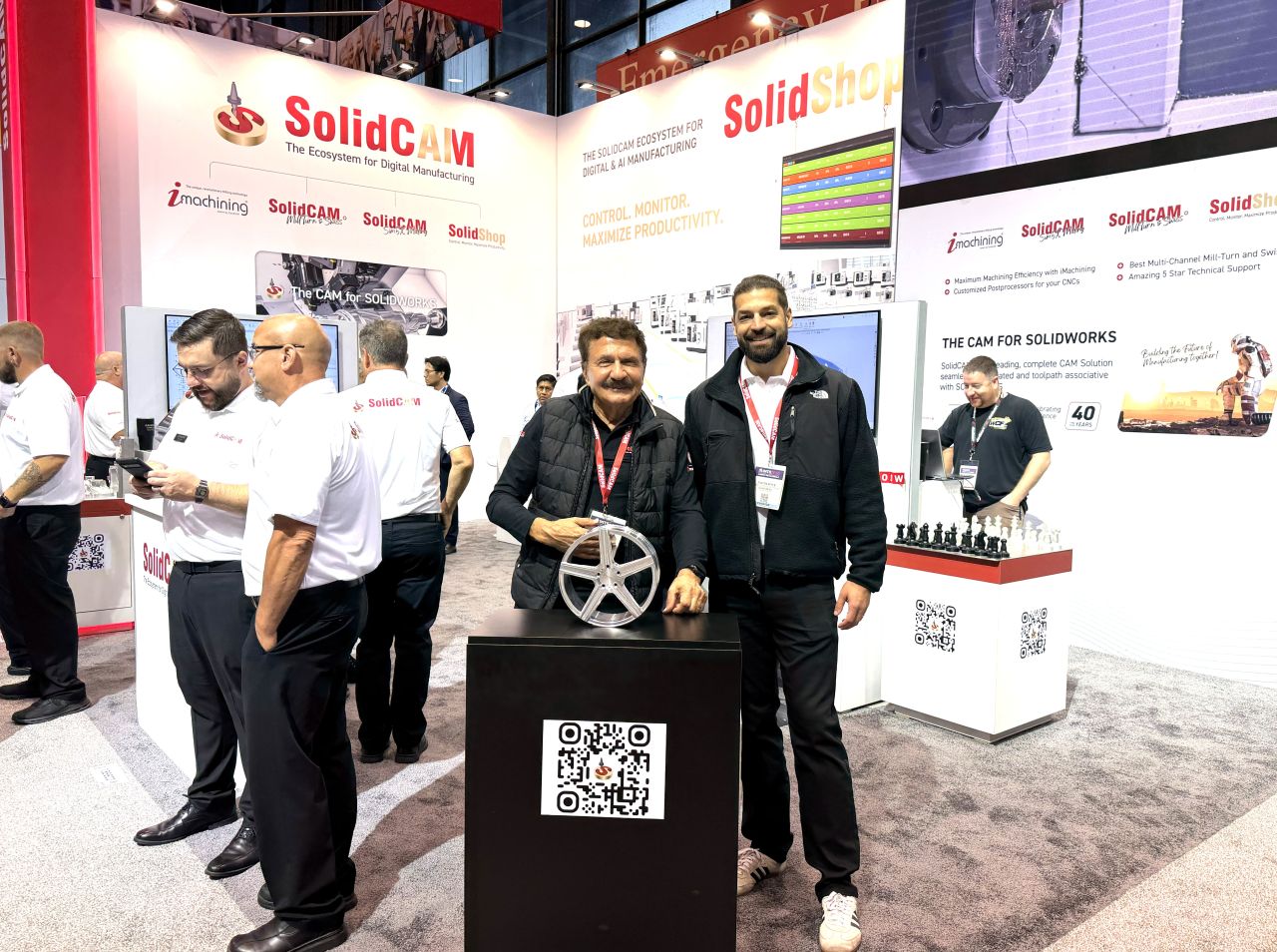
Somekh’s more recent work follows manufacturing beyond the programming desk. In describing SolidShop, officially launched in 2024, he talks about USB transfers, paper setup sheets and limited visibility into machine performance. A good CAM program still has to reach the correct machine, in the correct version, with the information an operator needs.
He worked with Daniel Santos and Diego Campos on that broader shop-floor offering. Connectivity, program management and real-time monitoring sit alongside the machining software. For a founder whose business changed after a request for four coordinates, the expansion has a recognizable logic: follow the customer’s next practical difficulty.
His October 2026 account of a visit to Tech 7 describes SolidShop connected with a Priority One ERP system. He presents WizChat, intended to interpret production information with AI, as the next step. The distinction matters: an implemented connection is an existing result; an AI assistant’s proposed use is a direction to pursue.
He had already pursued another extension of the machining business. In a 2022 interview about additive manufacturing, he described metal 3D printing as complementary to the work of CNC customers. SolidCAM Additive was intended to help those shops adopt the technology. The premise was familiar: customers might need a new process, and they would also need help making it useful. His attention had moved beyond the boundaries of the original software without leaving the manufacturing customer behind.
The company’s 2026 Asia-Pacific event in Wuxi, China, gave that international work another physical base. Somekh addressed the opening of a technology center equipped with Tornos and Brother CNC machines. Demonstrations, training and application development were part of its purpose. For a software business, keeping actual machines nearby has a straightforward advantage: a proposed workflow can be tested against the equipment and the people expected to use it.
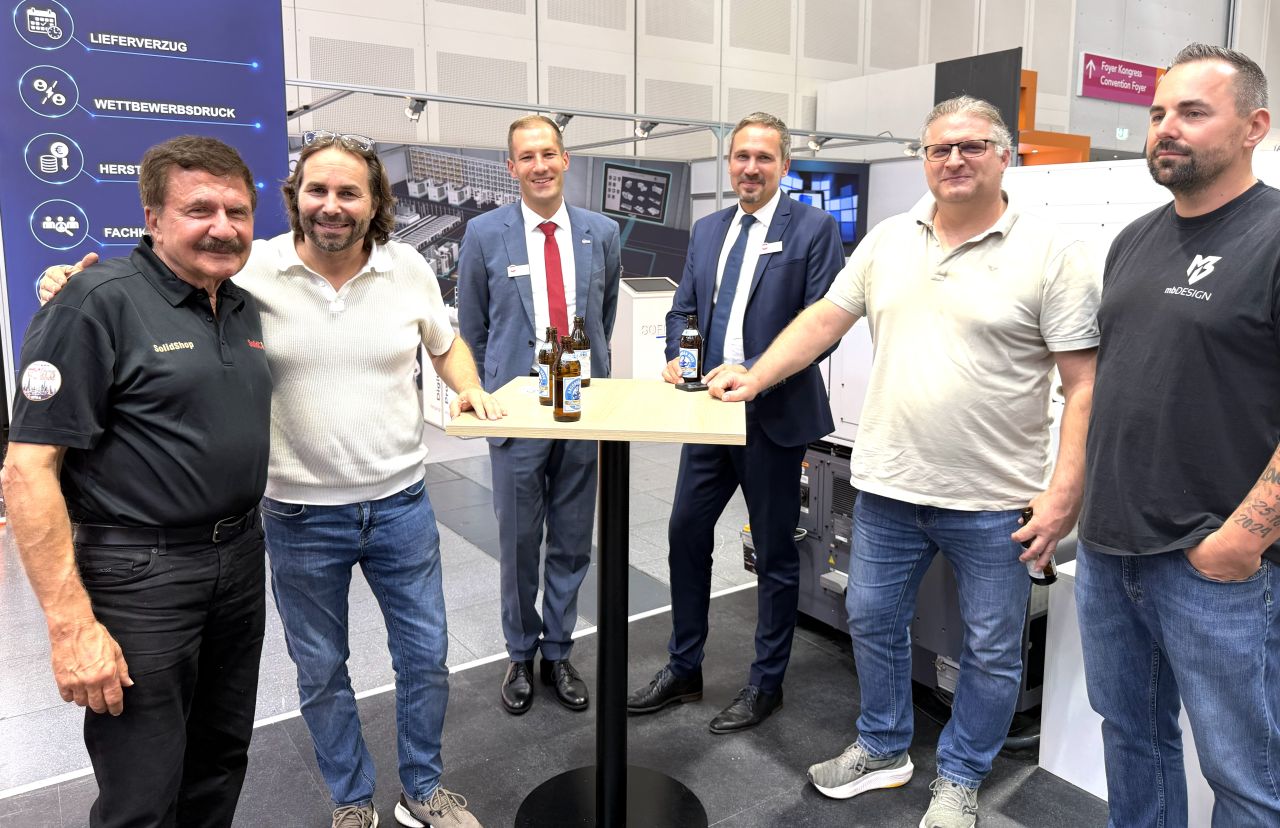
Other recent visits and events keep him close to the physical business of making things. In Switzerland, discussions with Werkma AG involved the customer and its local reseller. At AMB in Stuttgart, a collaboration with mbDESIGN paired a McLaren display with live wheel machining. The car drew attention; the cutting demonstration explained the work.
His stories give other people consequential parts: an adviser with a programming book, a wife with a workable suggestion, a reseller with a request, a programmer who can turn geometry into instructions. Somekh often makes the decision, but somebody else has usually supplied a useful piece of the problem.
Some of his recollections are pleasingly ordinary. The name SolidCAM occurred to him while he waited in his car at his son’s school. Even the name had to fit around the rest of a life. It joined the company’s two concerns, solid models and manufacturing, without requiring a meeting to invent it.
That leaves room for a particular kind of curiosity. Take the meeting. Keep the map. Ask what the customer needs calculated. Forty years after the apartment demonstrations, he is still turning up where machines are running and people have questions. The next request may be small enough to fit on a piece of paper.
Follow the next turn
More from Somekh, plus conversations about the work.
Personal website & essays Emil Somekh on LinkedIn Emil Somekh on Facebook SolidCAM Watch: the MISTER CAM conversation Watch: Somekh wraps up SolidCAM World 2025 SolidCAM’s YouTube channel Interview: moving into additive manufacturing Professional profile on XING