The drawing is immaculate. The metal is expensive. Between them sits a question that looks almost embarrassingly small: where should the cutter go next? A CNC machine will obey the answer with impressive devotion. Give it an unfortunate answer and it will manufacture your mistake as faithfully as your masterpiece. This is the territory Mastercam occupies - the decisions that turn a shape on a screen into something you can hold.
- Mastercam helps programmers prepare geometry, plan toolpaths and check machining before cutting.
- Its customers include job shops, industrial manufacturers and technical schools.
- Its appeal combines machining breadth with people who understand the equipment.
- Buyers should test a real part and budget for implementation, not merely a license.
A machinist meets a mathematician
In 1983, Mark and Jack Summers brought two useful perspectives to desktop programming. Mark knew machining; Jack knew mathematics. Their brother Brian soon joined. The ambition was practical: make numerical-control programming accessible on a personal computer. The first software was called Meghan, after Mark’s daughter. Mastercam was a more informative name, though decidedly less suitable for a family birthday cake.
“I was a machinist. My brother was a mathematician.”Mark Summers, recalling the company’s origins
That pairing explains the product better than a fashionable software category could. Geometry supplies possibilities. Manufacturing supplies objections. The company’s expertise lives in reconciling the two, preferably before an objection becomes a broken tool.

The shape needs a route
Mastercam is CAD/CAM software: computer-aided design coupled with computer-aided manufacturing. Users create or prepare a model, choose machining operations, calculate toolpaths and examine the result. A post processor translates the programming into instructions suited to the machine control. That translation deserves attention. A toolpath on a screen and a working program on a particular machine are different stages of the same job.
The product family follows shop work: milling, turning, combined Mill-Turn machining, supported Swiss machines, routing and wire EDM. Design tools sit alongside those operations. The common thread is deciding how to make a part, rather than admiring how neatly it has been drawn.
Four hours, then one
At GK Machine in Oregon, the old process moved work among three machines. The shop introduced a larger mill-turn machine and used Mastercam with Sandvik Coromant’s PrimeTurning tools and strategy. A process described as taking roughly four hours came down to about one. That is a useful result precisely because it has several causes: equipment, tooling and programming changed together.
One customer’s combined machine, tooling and CAM change. Not a software-only benchmark.
The initial implementation needed adjustments to the machine post file. Local reseller MCAM Northwest corrected them after receiving a Mastercam project package. Here is the unglamorous detail worth remembering: the route from purchase to production included somebody who could fix the translation.
A second customer, Monsees Group in Rochester, described a complementary approach: remove operations before chasing shorter cycles. Its multiaxis equipment let some parts leave the machine finished, avoiding subsequent handling. The shop reported average cycle reductions of 25% using Dynamic Motion, with tools lasting about six times longer. Those are customer-reported results within a particular operation, not a promise about the next piece of metal.
The cutter has manners
Dynamic Motion is Mastercam’s proprietary approach to controlling how a tool engages material. Its value is easier to understand through a specific example. Mastercam’s application engineers revisited a chain-guard part originally programmed with sixteen 2D operations for the first setup. One OptiRough strategy replaced those operations while achieving the same machining result.
The company also describes a customer cutting Hastelloy X whose endmills barely survived one part. After switching to OptiRough, the customer reportedly made seven to eight parts per endmill. The sensible lesson is to inspect the cutting strategy when tools disappear quickly. Buying another identical cutter is convenient; questioning its itinerary may be cheaper.
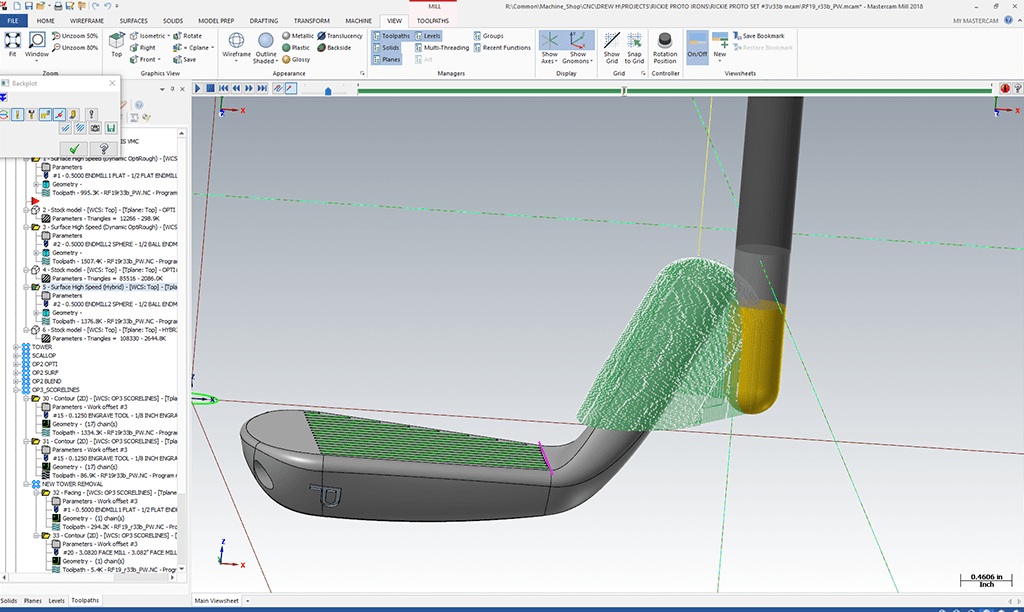
COBRA Golf supplies a different reason to care. Its research shop edits and machines prototypes so engineers can test an idea and revise it. Model preparation lets a programmer make suitable geometry changes without returning every adjustment to engineering. The payoff is an earlier answer about a design. For an experimental part, that answer can matter more than the number of parts produced.
A global product with a nearby human
Mastercam’s company materials report more than 450,000 installations worldwide, spanning small shops and large manufacturers. Installations measure software presence; they do not tell us how many distinct businesses use it. Its stated mission concerns difficult manufacturing problems, and its support model gives that ambition a practical address: representatives, educators and experienced users.
At Avans Machine, programmers use Verify and Backplot before releasing work to the floor. The company’s case study also describes reusable operations and geometries for adding parts or variations. At M.R.S. Machining, where small batches are central to the business, tool life and reduced manual deburring matter. These are different economic problems. A prototype shop wants another answer; a small-batch shop wants each limited run to pay.
Education extends the same network. Texas State Technical College uses Mastercam in a machining curriculum that culminates in team-designed assemblies. Students divide responsibilities among design, programming and project management. That arrangement makes a useful point about CAM expertise: operating the interface is one skill; coordinating a finished object is another.
The bill has more than one line
Commercial Mastercam is sold through subscription and perpetual licensing, with CONNECT providing maintenance, support and updates. Subscription reduces the initial payment; a perpetual license suits a different budgeting horizon. Packages and implementation needs determine the quote. The useful comparison is the cost of getting a representative job into production, including training and machine-specific work.
There is a free starting point. Learning Edition allows geometry creation, toolpath programming and visual verification, but it cannot output G-code to run a CNC machine. Its EMCAM files are incompatible with industrial versions, and post processors are excluded. It is a place to learn the decisions, not a free production license hiding behind a download button.
Autodesk Fusion offers integrated design and manufacturing within a cloud-connected product environment. Siemens NX CAM sits within a broader manufacturing system and supports advanced programming and simulation. Mastercam’s case rests on its machining coverage and support network. Which fits best depends on the actual machines, existing design workflow and available expertise. A demonstration with your troublesome part is considerably more revealing than a demonstration with the vendor’s agreeable one.
Sandvik buys the route
Sandvik completed its acquisition of CNC Software in September 2021. The disclosed business had generated $60 million in revenue in 2020, with about 60% recurring revenue and a reported EBIT margin of 25-30%. Those historical figures describe an established software business, not an early venture searching for its first paying shop.
Mastercam has since brought some regional support closer to the company. Its January 2026 acquisition of Swedish partner AME, renamed Mastercam Sverige, followed more than thirty years of channel work in Sweden and Norway. The move makes an existing local relationship part of direct operations. Distribution here includes manufacturing judgment, which is harder to download than an installer.
The next delay is in the toolroom
Released July 1, 2026, Mastercam 2027 emphasizes deburring, multiaxis motion and Mill-Turn setup. CONNECT customers also gained access to the EverPath beta, with a unified workflow, real-time toolpath updates and seven new toolpaths. These changes address the effort of constructing and checking the program.
September’s partnerships look beyond that program. TDM Systems brings approved tool assemblies and process parameters into Mastercam from a central repository. ToolHive addresses tooling information and availability. ProShop captures setup, quality and process knowledge; U.S. customers can purchase it through Mastercam’s direct sales organization. Each tackles a familiar irritation: the program is ready, but the information needed to execute it has gone wandering.
The practical move is to choose one machine cell or part family, standardize its tooling information and measure the result before expanding. Reuse proven operations where appropriate, check simulations against the real setup, and record the knowledge someone else will need. Faster toolpaths cannot retrieve a missing tool or correct an inaccurate fixture model. Mastercam’s most useful lesson travels well beyond machining: an instruction becomes valuable when the next person can carry it out.