Imagine agreeing to build a machine before every detail of that machine has been settled. There is a price, a customer, and a date circled on somebody’s calendar. There are also drawings that will change, components that must be ordered, and other jobs competing for the same people. The machine exists in several versions at once: the one sold, the one being designed, and the one purchasing thinks it is buying parts for.
This is the world ams.Group has chosen. Its shorthand is Losgröße 1+, or lot size 1+: single-piece, job-order, and variant manufacturing. To an outsider, a batch of one sounds delightfully simple. To a production planner, it sounds like a meeting.
- The customer: manufacturers making complex, customer-specific products.
- The job: connect estimates, engineering, purchasing, production, and service.
- The bet: industry knowledge should live in the standard software.
- The buying test: follow a difficult real order through the whole system.
The trouble with making it once
Manufacturing software must make assumptions about how work behaves. A business repeating a stable product can organize around repetition. A plant builder may be buying long-lead components while engineering is still refining the design. The interesting question becomes how to coordinate work whose description is still being written.
ams.erp, the group’s main product, brings commercial and technical processes into a shared system. It covers the path from sales and quotation through engineering, procurement, production, logistics, installation, and after-sales work. Its target industries include machinery and plant construction, steel and metal fabrication, special-purpose vehicles, shipbuilding, and interior fitting. The equipment differs considerably; the need to manage customer-specific projects travels well.
The company dates its founding to 1988. Its origin story names engineer Willibald Müller, supported in commerce and sales by Manfred Deues, as people who understood the mismatch between conventional ERP and project businesses. Today, board chair Simone Schiffgens leads the principal German company in the second generation. That continuity matters because ams is selling familiarity with a stubborn industrial problem, as well as software.
A job needs a memory
Consider HOLTEC, which makes customer-specific equipment for the sawmill, wood-products, and pellet industries. Its ERP selection began with a familiar inheritance: multiple applications, accumulated modifications, and considerable administration. A November 2021 account describes how the company brought in outside process-analysis help and held workshops with key users. It wanted modern technology, integration, and broad process coverage in the standard product. Its later user report dates the ams.erp introduction to November 2022.
That sequence offers a useful lesson. HOLTEC made its requirements explicit before committing to a replacement. For a buyer, “flexibility” becomes a more useful word when it means a particular workflow can survive a change of system.
Reinert-Ritz, a specialist in plastic components, supplies a different example. It introduced ams.erp in early 2023 and uses ams.taskmanager alongside it. The ERP supplies the shared data foundation; the collaboration tool holds the extra information surrounding tasks. Material that had moved verbally, by email, and in departmental paper folders became centrally available.
An order record can tell you what was purchased. The surrounding conversation can tell you why it was changed. Both have value. The practical attraction of this arrangement is that a job gains a memory accessible beyond the department that first encountered it.
The drawing and the deadline
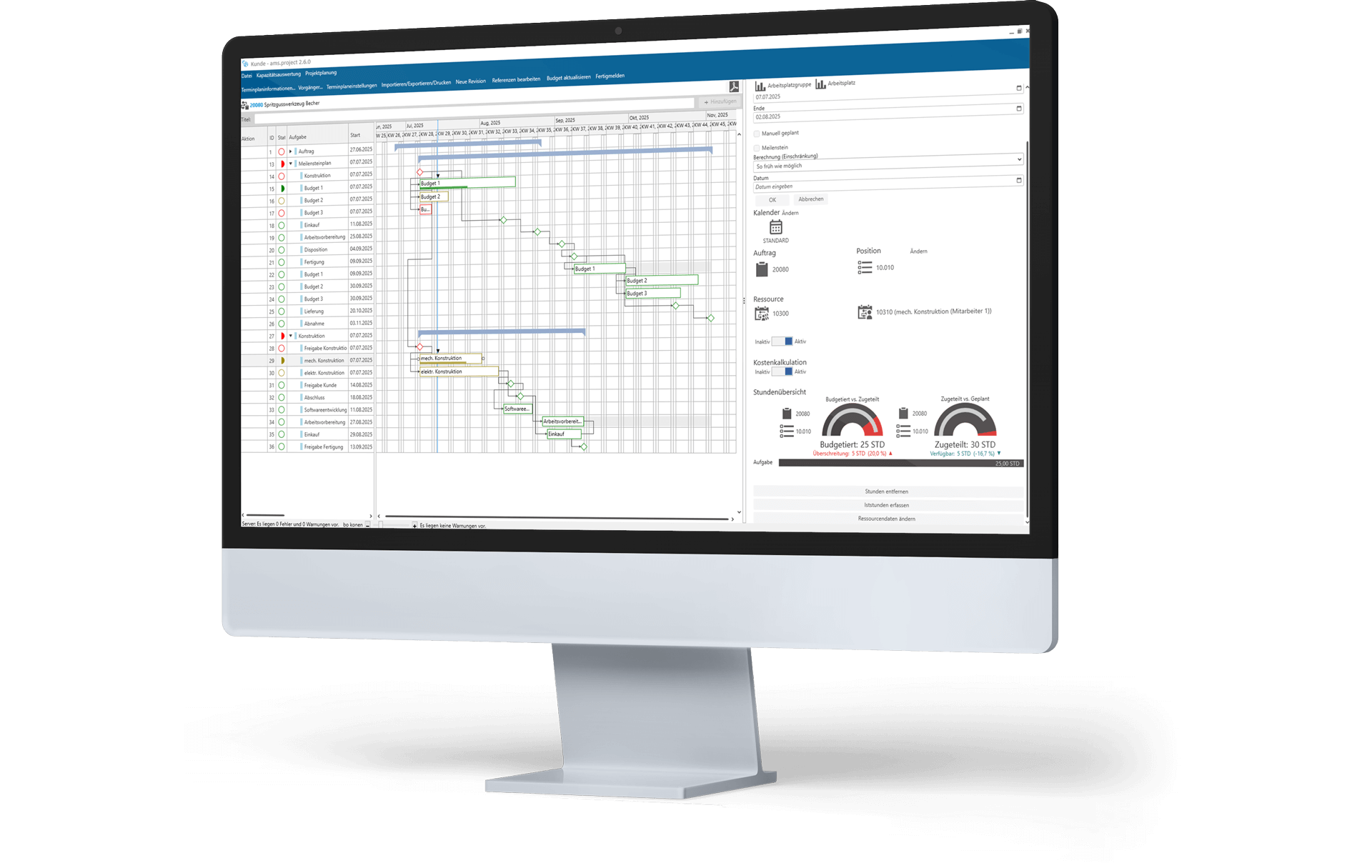
The product portfolio follows that logic. ams.project connects capacity and schedule planning to ERP data. ams.export handles customs and shipping work. Document and product-data functions address drawings, revisions, and related records. Mobile functions let people capture or consult information closer to where the work happens.
Multiple projects make the planning problem particularly interesting. A resource assigned to one order is unavailable to another. A promising delivery date may depend on a workshop already carrying three promises. Shared planning gives people a place to see those collisions rather than discover them through a disappointed customer.
Schirmer Maschinen illustrates the setting. Its published customer story describes an autumn 2020 ERP introduction, followed by workforce growth from 170 to 240 between 2020 and 2022 and the opening of two additional plants. The case lists 65 ams users. Those figures describe the customer’s expansion; they do not establish that software caused it. They do show the kind of operational coordination a growing custom-machine builder must sustain.
A demonstration small enough to hold
For the AMB trade show in September 2026, ams announced a demonstration using individually engraved giveaways. Visitors would choose a configuration; the ERP would create an individual order, schedule it, pass it to a laser-engraving system, and receive the completion message.
A small object is a sensible way to explain a large system. You can follow the transaction without needing a yacht yard. The point is the continuity between a customer choice and a completed manufacturing task.
- 01Configure
- 02Create order
- 03Schedule
- 04Engrave
- 05Confirm
Illustration of the workflow described in ams’s AMB announcement.
The same announcement describes AI-assisted quotation creation: reading existing reports, recognizing similarities to earlier offers, and assigning information to draft offer positions. The appeal is concrete. Sales staff spend less effort transferring information before they have an offer to review. A draft still needs scrutiny; the demonstration describes a capability, rather than a measured saving across every customer.
Keep the knowledge close
ams’s AI proposition also reflects its customers’ information concerns. Designs, calculations, and contracts are valuable working knowledge. The company is developing a local AI architecture that can retrieve relevant context from ERP records and company documents. Its current website describes version 16.0 as AI-capable, with assistance embedded in existing processes and an integrated chat for accessing knowledge.
In October 2025, ams announced federal research support for this development and described its work with AI/UI. The project leader acknowledged that the local architecture had taken more time than connecting familiar cloud services. That is a revealing tradeoff: keeping the processing close to the customer requires engineering effort.
Local deployment also leaves infrastructure and operating responsibilities somewhere inside the customer’s arrangements. Buyers should ask who maintains it, what data the system can access, and how permissions are enforced. “On-premises” tells you where a system runs. Its usefulness still depends on the quality and accessibility of the information it receives.
The vendor has a coordination problem, too
ams has had to examine its own handoffs. In its February 2025 business update, the company acknowledged that a workforce roughly doubled to around 250 in a few years had brought stronger silos and less efficient decisions. It engaged organizational consultancy intrinsify in 2024 and described changes across sales, consulting, and development, alongside the sale of subsidiary Wegasoft.
The financial backdrop was more restrained growth: company-reported German revenue of €27.7 million for 2024, up 3.5%. That figure covers the German business and should not be read as consolidated group revenue. Industrial customers were delaying investments amid economic uncertainty. ams’s response included organizational work and a technology partnership with the Smarte Demonstrationsfabrik Siegen.
There is something instructive about a vendor naming the friction created by its own success. The same coordination problem can recur inside the company selling the coordination tool. Growth expands the distance an answer must travel.
Bring your awkward order
ams sits among established manufacturing ERP suppliers. Proalpha connects mid-market business processes; Abas supports several manufacturing modes, including engineer-to-order; IFS also addresses project-based and customer-specific production. ams’s distinction is its sustained concentration on lot size 1+ and the accompanying consulting expertise. Buyers must test that concentration against their actual work.
The consulting offer starts with process analysis and target-process modeling, then moves through implementation, migration, training, integration testing, and go-live support. A fast-track option is advertised at two to six months, using preconfigured standards and focused workshops. That timetable makes sense as a conditional offer: unusual requirements and extensive changes demand their own assessment.
Bring the order with the late drawing, the substituted part, and the inconvenient deadline.
An editorial test for an ERP demonstration
Price that exercise properly. Ask for a proposal separating software, implementation, interfaces, migration, training, support, and deployment responsibilities. A fast introduction can still consume considerable staff attention. Agree what counts as completion and which customer employees must be available.
There is encouraging feedback to investigate. In its September 2026 account of the Trovarit survey, ams reported an overall software grade of 1.76 against a market average of 1.89, on a scale where lower is better. The sample included 58 ams installations. The release also acknowledged weaker scores for documentation and international usability. A buyer with demanding cross-border requirements should take that seriously.
1 = very good; 5 = poor. Company account of the Trovarit study: 58 ams installations within 1,538 evaluations. These are satisfaction grades, not productivity measures.
The lesson travels beyond ERP. Map an awkward handoff. Put its facts and its context somewhere shared. Decide who owns the next action. If your business makes a standard product in long, stable runs, ams’s particular specialization deserves a different evaluation. If your products change as you build them, that specialization is the reason to start a conversation. A batch of one can be a very crowded place.
Explore the machinery
Go deeper with the company website, ERP overview, customer stories, ams blog, and company news.
Follow LinkedIn, Instagram, X, or Facebook. Watch company videos on the ams YouTube channel.