The most expensive object in a small factory may be a spreadsheet. It is cheap to open, easy to copy, and almost impossible to keep honest once purchasing, the warehouse and production each have a version. Someone receives a pallet. Someone else moves half of it. A salesperson promises the rest. The cells remain politely confident. The people who need the stock discover the truth when the shelf is empty.
Dan Koukol had seen this from both sides of the desk. He worked with manufacturers and distributors, then ran a plastic injection molding business in Dalton, Georgia. The company says he helped return that business to profit and grow its revenue fivefold. His eventual software thesis was less glamorous than the language around artificial intelligence: record what actually happens, where it happens, and let the people doing the work see the same picture.
- Digit connected purchasing, stock, production and sales.
- Its customers are manufacturers and distributors handling physical goods.
- Digit became Sutton in September 2026.
- Studio lets operators request custom tools on live ERP data.
Seven factories and an awkward question
Digit began with a small group of factories, not a giant checklist. In a 2023 company post, the team said it had worked with seven manufacturers across different industries for roughly 18 months. The founders - Koukol, Simon Kronenberg and later CTO and co-founder Alena Dagneau - aimed to make the routine transactions of a physical business happen in one place. A purchase order should lead to a receipt. A receipt should change inventory. A manufacturing order should consume materials. Shipping should close the loop.
That sequence sounds obvious until a company buys one tool for accounting, another for e-commerce, and leaves production on whiteboards. Digit’s product gathered inventory management, material planning, bills of materials, scheduling, shop-floor control, warehouse scanning, traceability and sales orders into a cloud system. Mobile barcodes matter here. They turn “we think that pallet moved” into a dated event, tied to a location, order and person.

The first failure Digit attacked was the gap between an office record and a floor event. No1 Raw Materials, a thermoplastic resin supplier and recycler in Michigan, had tracked inventory, shipping and receiving in separate Excel files. Its owner, Elliott Montgomery, described the process as cumbersome. After moving to Digit, the team said it could barcode boxes and pallets, receive stock against purchase orders, and scan the goods selected for each shipment. A pick list refuses the wrong box. That is a modest sentence with an expensive error behind it.
“We can scan things into inventory live. We can receive inventory live. We can ship product live.”Elliott Montgomery, owner, No1 Raw Materials
Montgomery said the change at least doubled his team’s speed and efficiency, and possibly more. It is his estimate, not an audited benchmark. The concrete result is easier to picture: workers spend less time reconciling yesterday’s cells and more time handling today’s shipment. A small team gets a transaction trail without appointing someone to chase every transaction.
One pallet, four records
The feature request that ate the roadmap
An ERP can connect the standard steps and still leave a peculiar operation stranded. One plant needs a receiving inspection with its own fields. Another wants a production board grouped by material rather than due date. A third wants to see yield loss at a particular work center. The old responses are familiar: submit a ticket, hire a consultant, or add a spreadsheet that quietly becomes more important than the system it was meant to supplement.
In September 2026, Digit took a new name, Sutton, and released Studio to address that awkward middle ground. The company says a user can describe an app, dashboard, form or tracker in plain English; Studio builds it against the customer’s live operational data and places it in the Sutton workspace. Early examples include supplier scorecards, receiving inspection forms, delivery boards and yield trackers. At Pac Basic, Andrew Pedersen described typing a problem and getting a custom app in minutes. That is a customer account of the experience, not a promise that every request takes the same time.
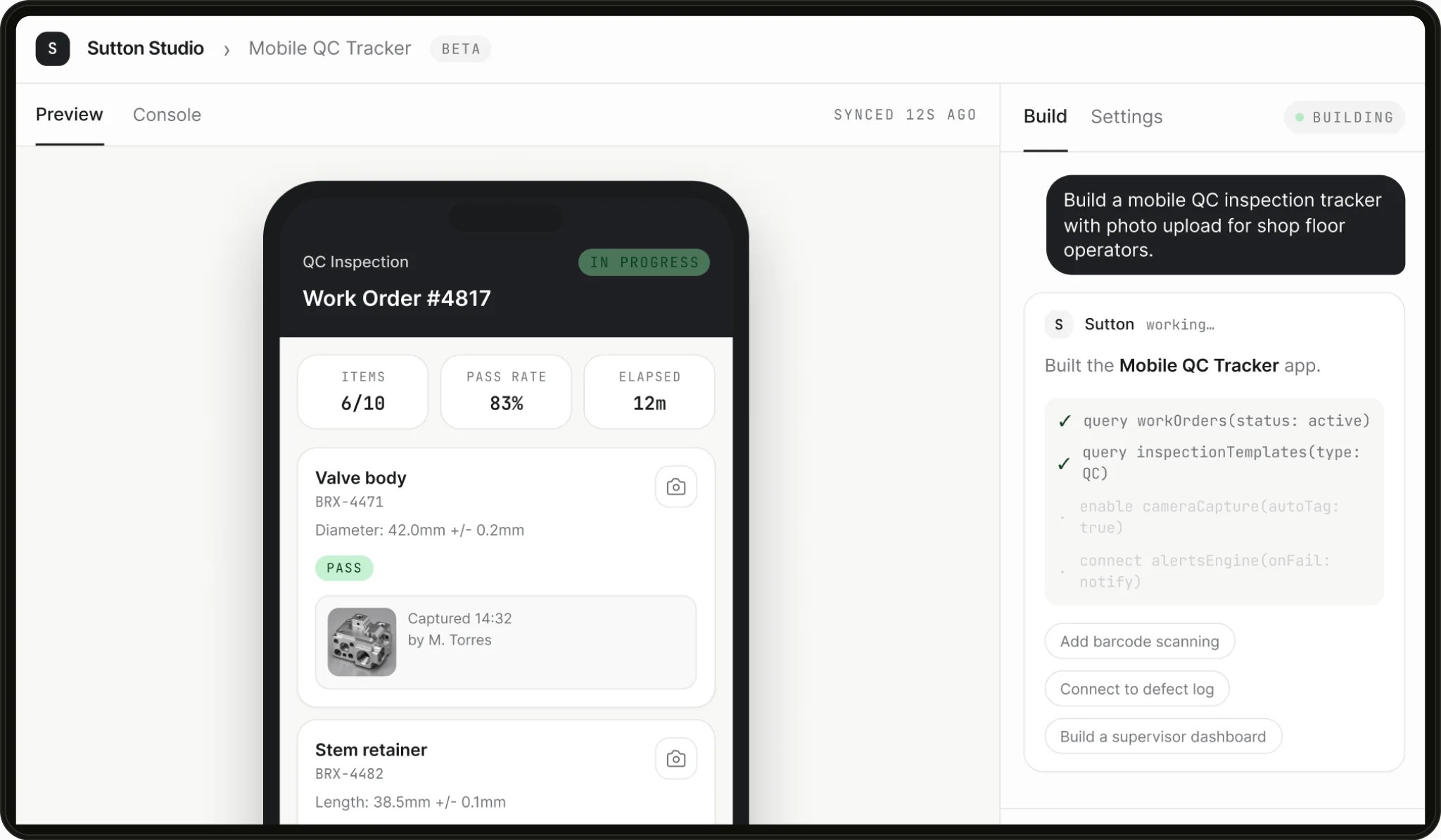
The interesting change is who gets to decide what the software looks like. Digit initially tried to make the core workflow more complete. Sutton now argues that even a well-designed core cannot predict every plant’s exception. Studio turns the exception into something a team can build. That ambition is distinct from a generic AI chat window: the requested tool is meant to live beside the production records, with the same data behind it.
The distinction still needs practical discipline. A generated inspection form is useful only if the underlying item, supplier and lot records are reliable, and if the team checks that the new screen asks the right questions. Sutton’s approach makes sense for operations with repeated, specific gaps around a sound system of record. A business whose stock counts are guesses will have to repair those counts before a clever dashboard can tell the truth.
What the software costs, and what it asks of you
Sutton sells subscriptions. Its published Starter tier is $400 a month on monthly billing, with five users included; additional users are listed at $50 a month each. Growth and Professional add functions such as lot tracking, planning, multiple sites and job costing, while Enterprise is quoted. The pricing page also lists paid extras for more integrations, API access and other functions. Complex onboarding may carry a separate one-time fee. The company says most customers go live in two to six weeks, with timing dependent on the operation and the data being moved.
Starter per month on monthly billing, with five included users. A useful published entry point, not the total cost of cleaning data, training workers or adding modules.
That pricing places Sutton between the improvisation of spreadsheets and the long projects associated with large enterprise software. Its named alternatives include NetSuite and the patchwork of point tools. It also has competitors among newer manufacturing systems. The company’s sharper position is operational: a system that follows the object from supplier to shelf to work order to customer, then lets the operator create a view that suits the way the business actually runs.
Sutton integrates with QuickBooks, Xero, Shopify, WooCommerce, Amazon and other platforms. This is deliberate. A manufacturer may keep its storefront and accounting software while asking Sutton to be the place where material, production and fulfillment agree. It does not need to make every tool vanish to make the daily record useful.
A name for the work after the sale
The company announced a $2.5 million seed round in February 2025, backed by Assembly Ventures, Hyde Park Angels and Grand Ventures. A further $3 million round in March 2026, led by Tech Square Ventures, brought its reported total funding to $6.3 million. The fresh money was for product and team expansion. By September, the most visible product change was Studio, accompanied by the Sutton name.
What can a reader take from this? First, choose one physical event that everyone argues about: a receipt, a partial pick, a consumed component. Make it scannable and visible to the people who act on it. Next, identify the spreadsheet that exists because the main system cannot answer one recurring question. That is a candidate for a small custom tool. Finally, test whether that tool uses live, trusted records. If it depends on a second, manually maintained list, the old problem has simply acquired a nicer screen.
Digit’s old name suggested counting. Sutton’s new pitch is about shaping the count into an action. The romance of this story, if factory software is allowed any, lies in a humble moment: the worker scans a box, the system knows which box it is, and nobody has to argue with a spreadsheet afterward.