On September 3, 2024, embecta announced the sort of news a medical-device company spends years pursuing: FDA clearance for an insulin patch pump. Its reservoir held 300 units. Its design reflected feedback from people with type 2 diabetes. Less than three months later, embecta announced it was ending the program. The device had passed a regulatory test. The investment still had another test to pass.
- Pen needles and syringes underpin a roughly $1.08 billion annual business.
- A cleared pump still needed years of investment to reach the company’s intended market.
- The next expansion combines injection supplies with acquired drug-delivery expertise.
That reversal is a useful introduction to a company whose products are easier to recognize than its name. embecta supplies the small, disposable objects that help people administer insulin. Its estimated reach is roughly 30 million people in more than 100 countries. For those users, the interesting question is often less about technological spectacle than whether tomorrow’s injection will be manageable.
Four millimeters of human behavior
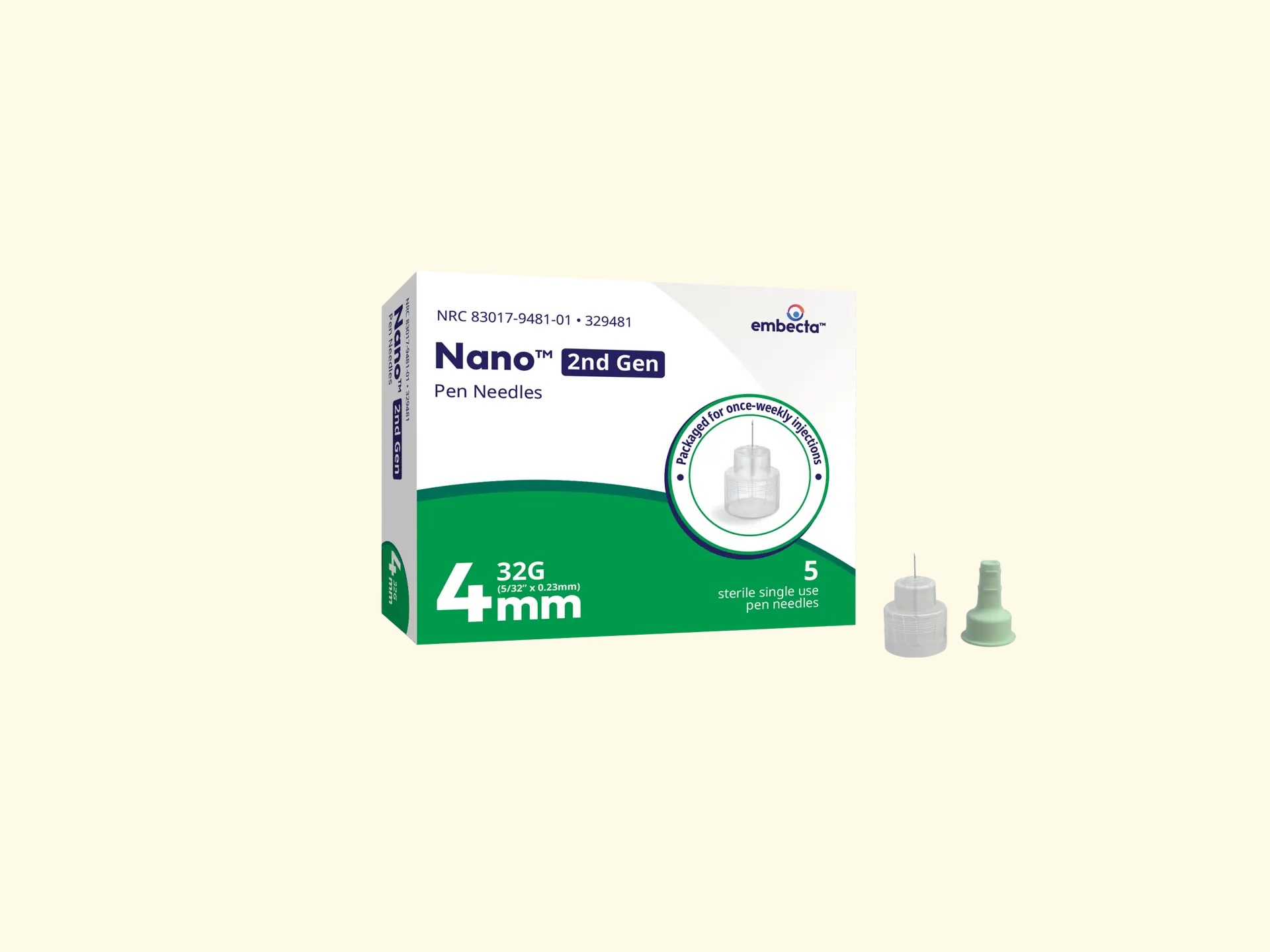
Consider a pen needle. The engineering problem includes the person holding it. People press with different amounts of force. A needle intended to deliver insulin beneath the skin can reach muscle, where absorption behaves differently. embecta’s Nano 2nd Gen uses a contoured base designed to compensate for variations in that pressure. The needle is four millimeters long.
There are other details: a five-bevel tip, an ultra-thin wall, covers designed for easier handling. Each addresses a particular interaction between fingers, plastic, steel and skin. These features belong to a product category where improvement can mean making a familiar action easier to perform. There is plenty to design before anyone adds a screen.
The company also provides instruction. Its Injection Lab includes lessons on technique, avoiding common mistakes and rotating injection sites. A device and its instructions have to work together. For patients and healthcare professionals, the practical offering is a combination of supplies and education, with product selection shaped by the prescribed therapy, compatibility and local availability.
A new name on an old habit
embecta’s corporate chronology has two clocks. Its legal entity was formed in 2021; it became independent of Becton, Dickinson and Company in April 2022. The inherited business reaches back to BD’s specialized insulin syringe in 1924. At the spinoff, embecta reported manufacturing about eight billion injection devices annually. This was a new public company with a very practiced factory floor.
The business model follows repetition. Single-use needles and syringes must be replenished. Distributors, wholesalers, pharmacies and healthcare channels connect production to patients; pharmaceutical partners provide another route. The person using a needle and the organization buying or reimbursing it may be different. That makes distribution and purchasing decisions part of the product’s commercial life.
In its 2025 investor presentation, embecta said pen needles and safety pen needles represented approximately 84 percent of fiscal 2024 revenue. Its position rests on manufacturing capacity, established brands, device design and commercial reach. Alternatives include injection supplies from Novo Nordisk, Terumo and MTD Group, alongside different delivery methods such as pumps. Quality matters; so do price and access.
The pump that passed - and stopped
The pump promised a move into a more elaborate delivery system. But the cleared version was open-loop. Management’s intended destination was a closed-loop product carrying a type 2 diabetes indication. In November 2024, executives described further work on shelf life and personal-device compatibility, plus clinical studies, regulatory clearance and commercial support for the intended system.
“several more years of significant investment”
Management’s assessment of the remaining pump journey, November 2024
Competition was changing while that work remained. The company said development had met internal milestones; its explanation for stopping centered on the additional investment and increasingly competitive market. The commercial calculation gave way before a broad launch. Treating this as a malfunction story would miss what management actually said.
The numbers make the decision tangible. Pump-program expense was approximately $63 million in fiscal 2024. When announcing the shutdown and restructuring, embecta initially estimated $35 million to $45 million in charges and $60 million to $65 million in annualized savings. These were different measures: the running expense, the cost of stopping and the expected future reduction.
Reported revenue US$ millions
Free cash flow US$ millions, approximate
A bigger bet on familiar skills
Fiscal 2025 revenue fell 3.8 percent to $1,080.4 million. Free cash flow nevertheless rose to approximately $182 million from about $20 million a year earlier. Those results show why a company might accept a narrower development agenda. They do not, by themselves, establish that its growth problem has been solved.
Then came a purchase. In May 2026, embecta completed its acquisition of Britain’s Owen Mumford: £100 million upfront, with up to £50 million more tied to Aidaptus auto-injector sales. The acquisition adds device design, molding and assembly capabilities, and a pharmaceutical delivery platform. embecta brings its existing manufacturing and distribution infrastructure to that combination.
A smaller change illustrates the same expansion toward other injectable medicines. The company now offers five-count Nano packs for once-weekly injections. In August 2026 it also reported that pharmaceutical partners had launched generic GLP-1 therapies in Canada and Brazil co-packaged with its needles. Sometimes a new market calls for a different carton and a different commercial relationship.
Price the work still ahead
There are conditions attached to this strategy. Partner launches must translate into repeat orders. Acquired capabilities must produce products customers buy. Pricing, reimbursement and competing delivery methods can weaken the economics of a disposable device. Fiscal third-quarter 2026 revenue was $271.7 million, down 8.1 percent from a year earlier, despite the acquisition’s contribution.
The transferable lesson is to recalculate after a milestone. Ask what remains to be built, sold and supported, then compare that cost with another use of the money. embecta stopped one investment and bought different capabilities. Whether that choice pays off will be measured through orders and cash. The needle still has to earn its place in the box.