Start with a syringe. It is an unlikely place to look for a business lesson. A syringe does not get a hospital named after it. It rarely appears in the photograph accompanying a medical breakthrough. Yet in 1987, when Fred Lampropoulos and his co-founders started Merit Medical, that ordinary object offered a remarkably useful question: could something clinicians handled every day work better?
Merit’s first syringe reached the market in 1988. The company describes it as a stronger, safer disposable alternative to the glass syringes then used in patient care. The ambition was specific. Improve a familiar instrument, in a familiar procedure, for someone who already understood why the difference mattered.
- Merit supplies the tools surrounding minimally invasive care, from catheters to tumor-localization systems.
- Hospitals, physicians, and other device manufacturers are its customers.
- Its growth combines manufacturing expertise, clinician education, and acquisitions with very real price tags.
Nearly four decades later, the catalog includes guide wires, inflation devices, drainage products, biopsy instruments, embolics, and endoscopy devices. The connection is less obvious than the list: these are products that help a clinician get somewhere, find something, deliver something, or control what happens next.
A tumor has an address. The surgeon needs it.
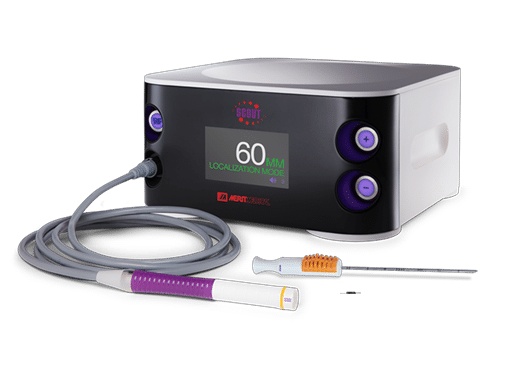
Consider SCOUT, Merit’s radar localization system. A breast lesion visible on imaging may be difficult to feel during surgery. Someone has to mark its location. Wire localization creates a physical connection to the target, but also a scheduling connection between radiology and the operating room.
SCOUT uses an implanted reflector and a detector that gives the surgeon audible and visual guidance. The reflector can be placed before surgery, including at biopsy. That opens up the schedule. A product that looks like a navigation instrument is also a way to make two departments less dependent on the same morning.
There is a revealing detail in the product brochure: the reflector’s body measures four millimeters. Its practical significance reaches well beyond those millimeters. Merit’s opportunity lies in understanding the work around the instrument, including the appointments, equipment, and people required to use it.
The factory behind the procedure
Merit sells to hospitals and physicians through direct sales teams and distributors. It also supplies other medical-device companies through its OEM business. Those customers buy components, finished devices, coatings, and pressure-sensing technology. A supplier can participate in a procedure even when another company’s name gets the attention.
Manufacturing is part of the explanation. Merit’s early expertise included injection and insert molding. Its sensor business grew from an effort to develop pressure sensing for an angioplasty inflation device. These capabilities let the company work below the level of the finished product, where material choices and production methods shape performance.
The economics include repeat purchases of disposable devices, alongside equipment such as localization consoles. Think Education adds physician-led courses and clinical instruction. For a hospital evaluating a new technique, the useful package includes an instrument, a reliable supply, and people who can explain how to use it.
“Understand. Innovate. Deliver.”Merit Medical’s stated mission
That three-word mission is easy to print. The harder part is keeping the feedback loop short enough that a clinician’s complaint reaches somebody who can change a mold, a component, or a kit.
Buying a place at the next procedure
Some capabilities arrive through acquisition. In 2024, Merit paid $105 million for the EsophyX Z+ device and related assets from EndoGastric Solutions. The device provides a minimally invasive treatment option for gastroesophageal reflux disease. Later that year, Merit acquired Cook Medical’s lead-management business for $210 million, plus assumed liabilities.
Lead management concerns the wires connecting pacemakers or implantable defibrillators to the heart. Removing or replacing them requires specialized tools. Merit bought a portfolio already built for that task, then began integrating it into its existing operations and sales network.
These transactions illustrate the cost of entering an adjacent procedure. The invoice buys technology and customer relationships; integration determines what those assets earn. For a smaller manufacturer, the transferable idea is to build around an existing customer’s next problem. Copying the acquisition budget is another matter.
More products can mean more friction
A growing catalog brings its own complications. In its November 2020 Foundations for Growth presentation, Merit described manufacturing-site closures and product-line transfers. It proposed simplifying its portfolio, improving shared services, and reorganizing operations with help from Boston Consulting Group.
That is a useful correction to the comforting idea that more products automatically make a better company. Merit's own program treated complexity as work to be removed. Its factories and support functions needed attention alongside new devices. The documented change was operational; attributing it to one private revelation would make the story tidier than the evidence.
There was also a costly compliance problem. In October 2020, Merit agreed to pay $18 million to resolve federal allegations involving improper payments to healthcare providers. It entered a five-year corporate integrity agreement. The Justice Department explicitly stated that the claims were allegations and that liability had not been determined.
For anyone borrowing Merit’s customer-focused approach, that history supplies a boundary: clinical education and customer support require disciplined oversight. Close relationships need controls as well as enthusiasm.
The next chapter has a different signature
Martha Aronson became president and CEO in October 2025, succeeding Lampropoulos. Her background includes Medtronic, Hill-Rom, and Ecolab. The transition puts an established global operator in charge of a company whose identity was closely associated with its founder.

Merit reported approximately $1.516 billion in 2025 sales, up 11.8%. In the second quarter of 2026, revenue reached $418.8 million, up 10%. Those are reported growth figures, which include influences beyond organic demand. The third-quarter results are scheduled for October 29, 2026.
Its position remains product-specific. SCOUT competes for localization decisions; vascular products face alternatives from established device makers. Approval, reimbursement, training, and procurement still govern adoption. An elegant tool cannot bypass them.
The lesson to copy is an order of attention: watch the procedure, identify the awkward step, improve the tool, then make its delivery dependable. It works when the improvement matters enough for a clinician and a purchasing committee to change their habits. That brings us back to the syringe. An ordinary object can contain a surprisingly large business, provided somebody notices what is wrong with it.