The object at the beginning of Haemonetics’ story was a bowl. A disposable centrifuge bowl, to be precise. It could separate blood into components, making a complicated biological resource more useful. Jack Latham invented it in 1968 and founded Haemonetics in 1971. The machine around the bowl mattered. So did the part that would be used once, discarded, and needed again.
- Equipment gets Haemonetics into the workflow. Disposables keep it there.
- A plasma customer that planned to leave now plans a U.S. rollout.
- Hospital expansion brings new opportunities and expensive miscalculations.
A bowl with consequences
There is a business model hiding inside that engineering decision. Hospitals and collection centers need durable equipment, but each procedure also needs fresh supplies. Connect the two and a sale can become a relationship measured in procedures. Add software, training and service, and the customer is evaluating an operating system for a clinical task.
Haemonetics now sells into two broad settings. In Apheresis, its customers collect plasma and other blood components. In MedSurg, they manage blood, assess clotting and perform interventional procedures. Those became its two reporting segments in 2026. The distinction is useful: one side helps collect a resource; the other helps clinicians use, preserve or manage it.
The company reported $1.334 billion in fiscal 2026 revenue, down 2% from the preceding year. That decline included the effects of a departing plasma customer and the sale of its whole-blood product line. A business can change shape while its top line barely tells you what happened.
Down 2% year over year, amid customer and portfolio transitions.
The customer who came back
Consider CSL Plasma. In April 2021, it notified Haemonetics that it would not renew its U.S. supply agreement for the older PCS2 collection system when the contract expired in June 2022. This was a commercial setback. It also exposed the limit of recurring revenue: the recurrence depends on someone continuing to choose you.
By October 8, 2026, the relationship looked different. CSL announced that it expected to finish rolling out Haemonetics’ latest plasma platform across its U.S. collection centers by the end of 2027. It arranged a transition with Terumo BCT, whose Rika system it was using. CSL cited collection-network efficiency. That is the public explanation; the announcement does not reveal every calculation behind the decision.
Older PCS2 agreement
New platform rollout planned
Expected U.S. completion: end of 2027. An announced plan, not completed installations.
The newer platform is NexSys PCS. Its Persona technology tailors collection to the donor; Express Plus targets procedure time. In February 2026, the FDA cleared Persona PLUS, another iteration supported by a randomized trial involving more than 30,000 donations from nearly 3,000 donors. The scale matters because a collection improvement must survive the variability of actual people.
Haemonetics’ alternatives include Terumo’s Rika and Fresenius’ Aurora platforms. The competitive question is practical: how much usable plasma can a center collect, with what donor experience, staffing burden and reliability? A gain in yield can disappoint if the rest of the operation cannot absorb it. The unit of comparison is the collection center’s working day.
The blood you already have
In an operating room, the problem changes. Cell Saver Elite+ recovers blood shed during suitable surgical procedures, washes it and makes the processed red cells available for return to the same patient. The original Cell Saver arrived in 1974. Its enduring proposition is wonderfully concrete: some of the blood a patient needs may already be nearby.
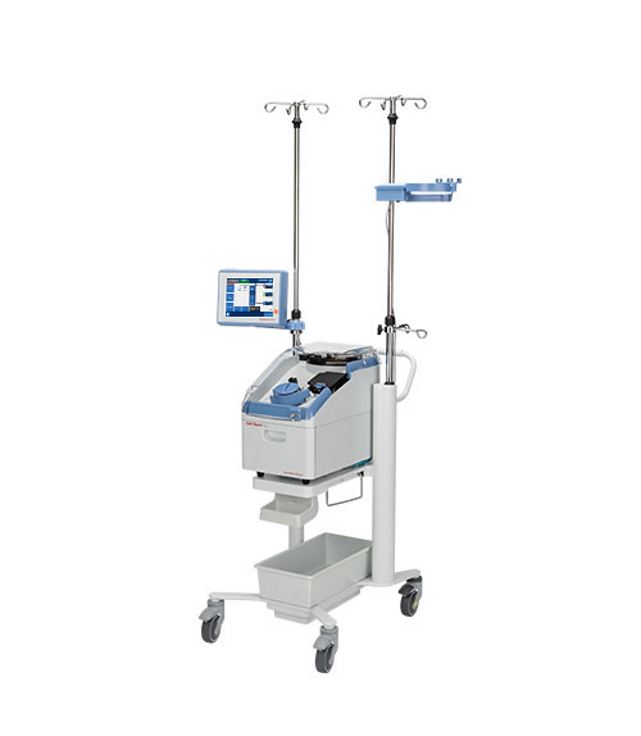
Other products work on information. TEG 6s assesses clotting behavior, while TEG Manager makes results available through the hospital network. SafeTrace Tx and BloodTrack address transfusion management and blood-product workflows. These solve different problems, but share a concern with decisions made between a biological sample, a screen and a patient.
The software also explains why integration belongs in a medical device story. Haemonetics and Epic developed an implementation playbook for SafeTrace Tx, aligning project plans and intersystem workflows. A useful result must reach the people who can act on it. That requires interfaces and implementation work, even when neither appears in the product photograph.
Buying a place in the procedure
Haemonetics has bought its way into adjacent clinical tasks. OpSens added sensor-guided cardiovascular wires. Attune Medical brought esophageal cooling technology, including protection during radiofrequency cardiac ablation. The April 2024 Attune deal required $160 million upfront, plus contingent consideration. This was a substantial bet on a particular procedural need.
The financial record supplies a corrective. In fiscal 2026, Haemonetics recorded a $77.2 million impairment of Attune-related intangible assets, citing lower revenue projections, changed market conditions and weaker operating performance. An impairment is an accounting reduction in asset value, rather than a fresh cash payment. It still tells you that the earlier expectations no longer held.
April 2024
Fiscal 2026
Another purchase points toward vascular closure. Haemonetics acquired Vivasure in January 2026 with announced upfront consideration of €100 million, subject to adjustments. On October 19, it announced FDA approval of PerQseal Elite for large-bore arterial procedures. The device uses an absorbable patch to seal the opening from inside the vessel. The U.S. approval should not be confused with its broader European indications.
Measure the whole job
Latham’s old insistence on execution remains relevant. In an early-1980s address reproduced in the company’s 2011 report, he put it plainly:
“It will always be imperative that we make and do everything right the first time.”Jack Latham · founder
The company’s stated culture emphasizes quality, accountability, teamwork and learning. Its products make those demands tangible: equipment, sterile supplies, software and trained people have to work together. Each creates another dependency.
The transferable lesson is to measure the whole job before improving one part. For a plasma operator, that means testing yield alongside time, staffing and donor experience. For a hospital, it means evaluating the clinical workflow alongside the purchase. Haemonetics’ recent history shows both the appeal and the limits: a customer can return, an acquisition can disappoint, and a disposable bowl can leave a remarkably long trail.