A needle has two careers. First, it is a useful instrument: delivering medicine, collecting blood, making treatment possible. Then the procedure ends, and the same small object becomes a disposal problem. The patient has received what was needed. The clinician still has something sharp in hand. Sol-Millennium Medical Group has built much of its identity around that awkward change of employment.
Look at its Sol-Guard pull-button blood collection set. After collection, a finger activates the mechanism and the needle retracts into a protective casing while still in the patient’s vein. A lock keeps it there. The cleverness lies in the timing: protection begins during withdrawal, rather than becoming another task afterward. A remarkably small movement carries a rather large responsibility.
- Safety shields and retracting needles address the hazardous end of a procedure.
- Manufacturing, regional distribution and purchasing agreements turn designs into supplies.
- A needle-free investment extends the business beyond improving the needle.
The last step is the design brief
Sol-Millennium designs, manufactures and distributes healthcare consumables. Its catalogue reaches from insulin syringes and pen needles to blood collection, infusion products, wound care, veterinary supplies and protective equipment. The audience includes hospitals, laboratories, distributors and healthcare professionals. These are products for recurring clinical work, where familiarity matters and an extra motion can be a nuisance.
The safety mechanisms vary. Sol-Care safety syringes allow manual retraction into the barrel after medication delivery. Safety needles use shields that cover and lock over the sharp. Some offer audible confirmation. Low dead space products address medication left behind inside the device. Each feature answers a different problem; a satisfying click cannot, by itself, establish accurate dosing or eliminate every injury.
The pull-button collection set makes the design philosophy unusually visible. Red Dot’s 2022 record credits Sol Millennium in Hangzhou as manufacturer and the Swiss R&D center in Lugano as designer, naming Dario De Zolt and Matteo Laganà. It describes one-finger activation and irreversible locking. The FDA recorded a substantially equivalent decision for the device in August that year. The company also reports iF recognition.
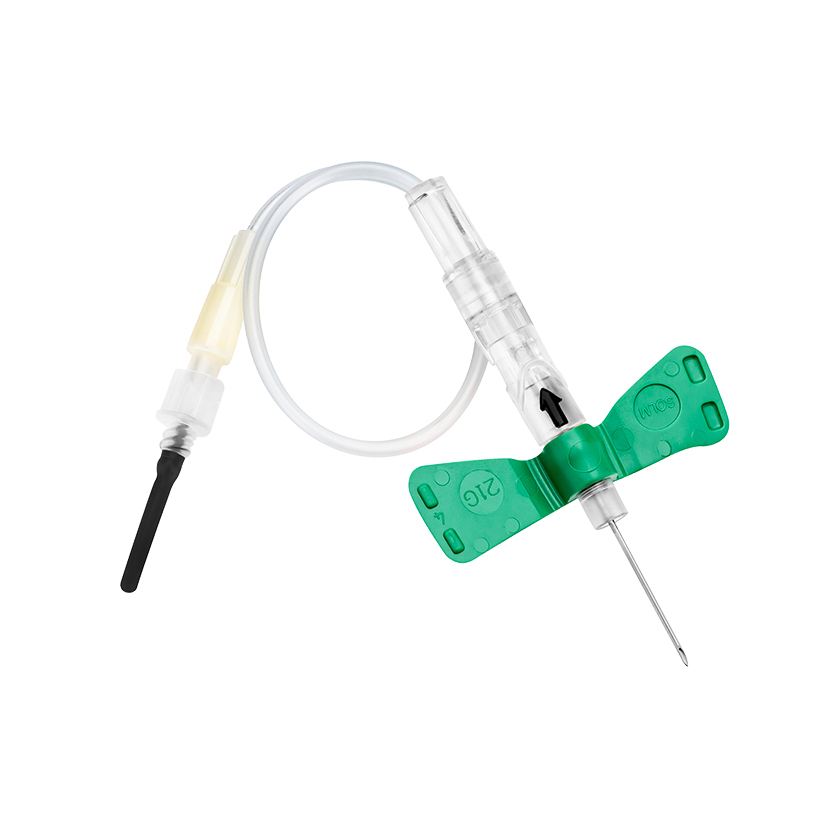
Alternatives include BD’s safety needles, B. Braun’s Sterican Safety and Terumo’s SurGuard3. For a buyer, the interesting comparison is specific: how does this mechanism fit the procedure, the operator’s hands and the disposal routine? The catalogue is no substitute for a local evaluation. A safety feature that requires activation depends on that action happening correctly. Compatibility, instructions and staff training belong in the purchasing conversation alongside the device itself.
A mold maker’s inheritance
The company’s published history begins in 1982 with Lin Zuoqian’s expertise in precision plastic mold manufacturing. The medical business starts in Shanghai in 2007. NuGen’s public announcements identify Liang Lin as its founder and CEO. Those two dates describe different beginnings: an industrial foundation, then a business devoted to medical devices.
That distinction helps explain the company’s position. Its expertise includes the unglamorous work of making physical objects repeatedly, alongside clinical product design. Sol-Millennium describes itself as vertically integrated, with research activity in Asia and Europe and an international sales network. Its stated development approach includes collaboration with frontline healthcare professionals. That gives designers a route to understanding how a product behaves in an actual working hand.
Expansion came through acquisitions as well as invention. In 2009, buying Inviro Medical and Medica Brazil opened North American and Brazilian markets; an EMEA office was established in Poland. A Swiss R&D center followed in 2015. Corporate headquarters moved to Chicago in 2019. The map reflects a business that must both make a device and get it into distinct healthcare systems.
The purchasing door matters, too
In 2021, Sol-Millennium says it supplied more than two billion syringes and needles for worldwide COVID-19 vaccination programs. Treat that as the company’s reported supply figure, rather than a count of patients or proof of market share. It nevertheless shows the scale at which a modest disposable object becomes essential infrastructure.
In September 2022, the company announced a Premier group purchasing agreement for safety and standard hypodermic needles and syringes. Eligible Premier members could access negotiated terms from October 1. The mechanism is commercial rather than clinical: it gives participating buyers a purchasing route. An award recognizes a design; an agreement helps put the product within reach of procurement teams.
The business model rests on selling consumables through regional sales operations and distribution channels. Repeated procedures create repeated demand. The advantage must survive a less romantic examination: availability, product selection, pricing and dependable quality. A manufacturer can make an elegant device and still have considerable work to do before it earns a place in the supply cupboard.
Safety promises meet the paperwork
In March 2024, the FDA issued Sol-Millennium a warning letter addressing regulatory clearance and quality-system issues. The agency also cited postmarket signals of product-quality problems. Sol-Millennium’s response emphasized the regulatory question around needle-and-syringe combinations and said it was taking corrective action. In May, a recall involving fixed-needle syringes instructed distributors to quarantine affected inventory and notify customers.
The subsequent record matters. On December 22, 2025, the FDA issued a closeout letter saying the violations in the warning appeared addressed after evaluation of corrective actions. It also made clear that sustained compliance remained the company’s responsibility. For customers, the lesson is practical: evaluate the current, specific device and its regulatory position. Neither an old warning nor a design trophy tells the whole story.
The needle maker’s needle-free wager
Sol-Millennium’s relationship with NuGen adds an intriguing turn. In September 2024, Sol-Millennium Medical HK Limited and Nature Health completed an aggregate C$10 million investment in NuGen through secured convertible debentures. NuGen develops InsuJet, a needle-free insulin delivery system. The securities carried 12% annual interest and a five-year term. This was capital going into NuGen, not money raised by Sol-Millennium.
“We want to replace the needle with InsuJet™!”Liang Lin · September 2024
Lin became NuGen’s CEO in January 2025. In August 2026, NuGen proposed acquiring Sol-Millennium Canada under a non-binding letter of intent. September brought a loan agreement for up to C$1.3 million from Sol-Millennium HK, with staged advances and 6% annual interest. The proposed acquisition remained conditional in those announcements; a signed loan is not a completed merger.
The copyable idea is modest: study the handoff everyone treats as an afterthought, then build a route for the improvement to reach its users. It works only if manufacturing, clinical practice and regulation support the design. Sol-Millennium’s unusual next question is whether the best improvement to a needle might eventually be removing it from the procedure.