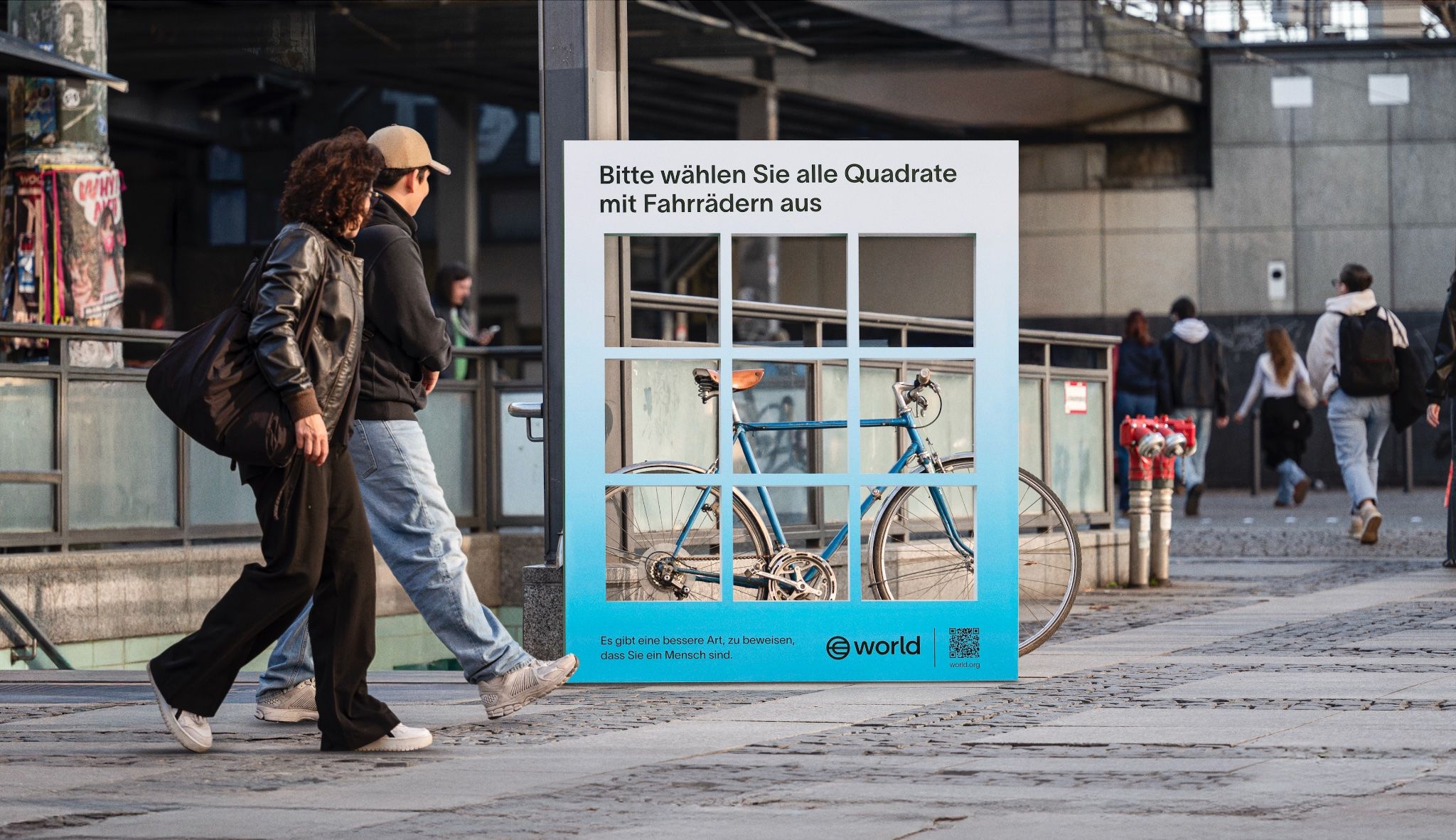
A CAPTCHA is an argument disguised as a chore. The machine shows you nine squares, asks for the traffic lights, and waits while you prove you belong on your own side of the screen. In April 2025, that familiar annoyance escaped the browser. Giant grids appeared around bicycles, hydrants, road signs, and cars in Berlin, Buenos Aires, and Singapore. The almost-touching square - torment of hurried humans everywhere - was there too. Eliza Chiang was the client lead.
The campaign, called Real World Captchas, advertised World ID, a way to establish that a user is a unique human without handing over personal information. The underlying subject is cryptography, biometrics, identity, and the awkward social contract of an internet filling with capable machines. The public experience was much simpler: a joke you recognized before you had finished crossing the street.
That gap between technical complexity and immediate understanding is Chiang's territory. Based in Seattle and working at Tools for Humanity, the contributor behind World, she operates close to the chief marketing officer and has appeared in campaign credits as a senior manager, client lead, and brand director and business leader. The titles vary with the project. The work keeps returning to the same challenge: give an invisible system a human-sized form.
The serious business of a good joke
World's marketing problem is unusually delicate. The product addresses a growing question - how can a service distinguish a person from a bot? - while asking the audience to think about privacy, verification, and artificial intelligence all at once. Explain every mechanism and the message becomes homework. Explain too little and the promise sounds magical. Real World Captchas found a third route. It began with an irritation already stored in everyone's muscle memory.
The physical grid made the old system look faintly absurd. It also created room for the alternative. At the base of each installation, a line offered “a better way to prove you're human,” followed by a route to World ID. The campaign did not ask strangers to begin with cryptographic protocols. It asked them to remember how many bicycles they had identified for a machine.
Months later, Chiang shared another campaign created with Iris. A walking robot billboard wandered through Seattle and Los Angeles, literalizing the bot problem with all the subtlety of a mechanical pedestrian. Her description was compact: “Ridiculous and fun.” It is also a workable creative brief. Ridiculous earns a glance. Fun earns a retelling. The underlying question arrives after the smile.
“Not all bots are this easy to spot, unless you have World ID.”Eliza Chiang
A career built under the interface
Before the giant grids, Chiang worked on infrastructure of a different kind. In 2021, she received executive oversight credit on an Accenture report prepared for the Canadian Wireless Telecommunications Association. Connecting Canadians during COVID-19 examined how wireless and wireline networks carried work, education, commerce, and ordinary connection through a year when daily life migrated online.
Telecom infrastructure is most noticeable when it fails. So is identity infrastructure. Both sit underneath a person's immediate task, quietly deciding whether the call connects, the payment clears, or the account opens. Moving from communications strategy to a network concerned with human verification is not a leap between unrelated worlds. It is a shift from one invisible layer of digital life to another.
Her public record also contains a more literal education in experience. From 2016 through 2020, Chiang served as Executive Director, Experience Design for Fashion Heals for SickKids. She co-led a 13-person team responsible for service and experience requirements for more than 400 participants and guests. The initiative partnered with Toronto Fashion Week, Mercedes-Benz, and Holt Renfrew, and raised more than $1 million.
An event is a system that must pretend not to be one. Guests see a room, a sequence, and a feeling. The team sees arrivals, cues, partners, requirements, and a clock that refuses to negotiate. Good experience design makes all that machinery disappear. The skill travels well. A global campaign has more time zones and media plans, but the audience still encounters one moment at a time.
Craft is a verb
Chiang's profile begins with three words: “Elevating craft at World.” It also links to two design portfolios, Studio Keale and Studio Fritz. The latter is a small Seattle furniture studio devoted to solid wood, fitted joints, and traditional Danish and Japanese joinery. Its methods are intentionally slow. Pieces are adjusted as wood and structure change. Nails, screws, and CNC shortcuts are left aside.
The furniture is not a footnote to the technology work. It clarifies what “craft” can mean in an operator's vocabulary. Craft is the fit between pieces. It is attention paid before the finish. It is knowing that the visible line depends on a hidden joint carrying its share of the weight.
A campaign has joints too. The product promise must fit the cultural reference. The agency's idea must fit the client's responsibility. A joke about CAPTCHA must land without making privacy sound frivolous. None of these connections are glamorous on their own. Together, they determine whether the object wobbles.
The product may be digital. The proof still has to meet a person somewhere.
Chiang's earlier honors make this attraction to construction less surprising. She won a University of Toronto engineering enrichment competition in AutoCAD in 2013. She also won Scotiabank's Why We Bank: Future Leaders Challenge. One prize concerned drawing objects precisely. The other concerned imagining financial services. Her later work has lived between those instincts - building the idea and designing the way someone meets it.
Three bridges into a new category
Real World Captchas is one of several credited World campaigns that begin with a piece of culture rather than a technical diagram. Unwrapped borrowed the annual ritual of personalized music recaps. Its point was privacy: many digital products can summarize a user's year because they know a great deal about that user. World ID's proposition is different. It is designed to confirm uniqueness without building the same personal portrait.
Místico vs. Los Fraudes took another route. The campaign cast the Mexican lucha libre figure Místico against fraud, using a masked hero to dramatize authenticity in an age of AI. Chiang was credited as Brand Director & Business Leader. CAPTCHA, recap, wrestler: three familiar doors into one unfamiliar room.
This is practical category design. When a product has no obvious shelf in the public imagination, the marketer can spend years asking people to learn new language. Or the marketer can build a bridge from something they already know. The bridge must be sturdy enough to carry the idea without distorting it. It must also be interesting enough that someone chooses to cross.
The operator in the credits
Creative credits are long for a reason. The giant grid on a street corner requires strategy, production, design, photography, post-production, media, approvals, and people who can keep an international team pointed at the same sentence. The client lead appears near the bottom of the list, but the role runs through it. That person carries the business question into the creative process and carries the creative answer back through the business.
Chiang's own account offers a small window into how she evaluates people. In a public recommendation for a younger colleague, she remembered wanting to hire him immediately. The qualities she chose to emphasize were kindness, insight, eagerness, feedback seeking, and contribution to a team's culture. They are not the vocabulary of the lone genius. They describe a person who improves the system around the work.
Her Ivey Business School education, consulting work, event leadership, and design portfolios make for a profile with several surfaces. The consistency lies in coordination. Reports coordinate evidence. Events coordinate people and time. Furniture coordinates material and force. Brands coordinate what a product does with what a person can understand.
The internet's identity problem will not be solved by a billboard. Chiang's campaigns do not pretend otherwise. Their task is narrower and necessary: create a moment in which the problem becomes visible, the audience recognizes itself, and a technical alternative earns attention. The machine asks for traffic lights. The operator asks what the ritual reveals. Then, with care and a little mischief, she puts the answer on the street.
Follow the work
Eliza Chiang on LinkedIn ↗ Tools for Humanity ↗ World ↗ Studio Fritz ↗ Studio Keale on Instagram ↗ Real World Captchas ↗