A physicist leaves the lab
Before Alex Blania asked millions of people to look into a camera, he spent part of his youth aiming at a target. Growing up in Germany, he competed in Olympic archery, then karate. His own verdict on those sporting years is admirably economical: “Ambition outsized talent.” There are worse qualifications for starting a company. The important part is knowing that the target remains some distance away.
Today, Blania is the co-founder and CEO of Tools for Humanity, the company helping build World. Its signature device, the Orb, photographs a person’s eyes to help establish that they are a unique human. It is a conspicuously physical answer to a problem created online. Somewhere between a laboratory instrument and an object a film director might place in a spaceship, it asks an awkward question: how much machinery does it take to establish something that seems obvious?
Blania arrived at that question through physics. He studied physics and industrial engineering at Friedrich-Alexander University Erlangen-Nuremberg, then worked on theoretical physics research at the Max Planck Institute for the Science of Light and Caltech’s Institute for Quantum Information and Matter. His research explored applying deep learning to quantum systems. AI was already part of his work before it became the reason for his company’s existence.
The turn came in 2019, when entrepreneur Max Novendstern contacted him about a project with Sam Altman. Blania left academia and joined the effort. The company dates its founding to that year; the network would take several more years to launch. His education had supplied a way of approaching difficult technical questions. Running this particular experiment would require manufacturing, distribution and, eventually, appearances before lawmakers.
One person. One place in the count.
The early Worldcoin proposition had an appealing simplicity: distribute a new digital currency widely, giving people a stake in the network. The complication arrived almost immediately. A giveaway to every person needs a way to stop one person collecting it repeatedly. An email address proves very little. A thousand email addresses can belong to the same pair of hands.
In the project’s 2021 introduction, Blania and Altman framed the difficulty around proving unique humanness while withholding personal information. The distinction matters. A service might need to know that someone is a real individual without needing their name, address or entire browsing life. World’s approach uses the iris as the starting point for a uniqueness check, then cryptography to let that person present a proof online.
A simplified view of World’s intended verification flow.
Building the Orb followed from that decision. In his explanation to a Kenyan parliamentary committee, Blania said the team had examined different approaches and found existing equipment inadequate for the image quality and security it wanted. So it built hardware. This is the inconvenient portion of a technology pitch: once the solution involves a manufactured object, somebody must assemble it, move it and arrange for people to stand in front of it.
The engineering is inseparable from the ambition. An identity network that depends on visiting a device has a geography. Its reach depends on where those devices are placed, who operates them and whether people feel comfortable approaching them. For Blania, a working prototype could only begin the job. The rest would unfold in shops, public spaces and conversations far from a physics department.
A queue is a very public experiment
Worldcoin launched on July 24, 2023. The release brought the World ID software development kit, a tradable WLD token and plans to expand Orb operations across more than 35 cities in over 20 countries. Blania’s language at launch was concerned with access, privacy and inclusion. Those are attractive ambitions. Once a line forms outside a verification location, they also become practical obligations.
Kenya made that difference visible. Addressing a parliamentary committee after the launch, Blania said demand had increased thirtyfold practically overnight. He acknowledged that the team could have handled the increase and the queues better. He also conceded that it should have explained more clearly who it was, what it was doing and why it wanted people to verify their humanness.
That admission is a revealing moment in his public story. The explanation had become part of the product. Someone considering an iris scan is entitled to more than a diagram and an assurance that the mathematics works. They need to understand the exchange, the choices available and what happens afterward. A network built around individual humans encounters individual questions.
“we could have done a better job”
Alex Blania / on managing launch demand in Kenya, 2023
The scrutiny continued elsewhere. In December 2024, Bavaria’s data protection authority ordered corrective measures, including a compliant deletion procedure, explicit consent for certain future processing and deletion of particular records collected without a sufficient legal basis. The authority said the company intended to appeal. These were specific regulatory demands, with consequences beyond the elegance of the underlying design.
Blania’s task therefore runs along two tracks: make the technology function and make its operation accountable to the people it concerns. Progress on one does not settle the other. For a founder accustomed to technical problems, public consent introduces a different kind of difficulty. People can understand a proposal perfectly well and still choose to decline it.
The coin gets a smaller part
On October 17, 2024, Blania and Altman appeared onstage in San Francisco with a shorter name for their project: World. The coin remained, but the network’s identity now made more room for proof of human. The event also introduced updated hardware, new World ID features, Mini Apps inside World App and the launch of World Chain.
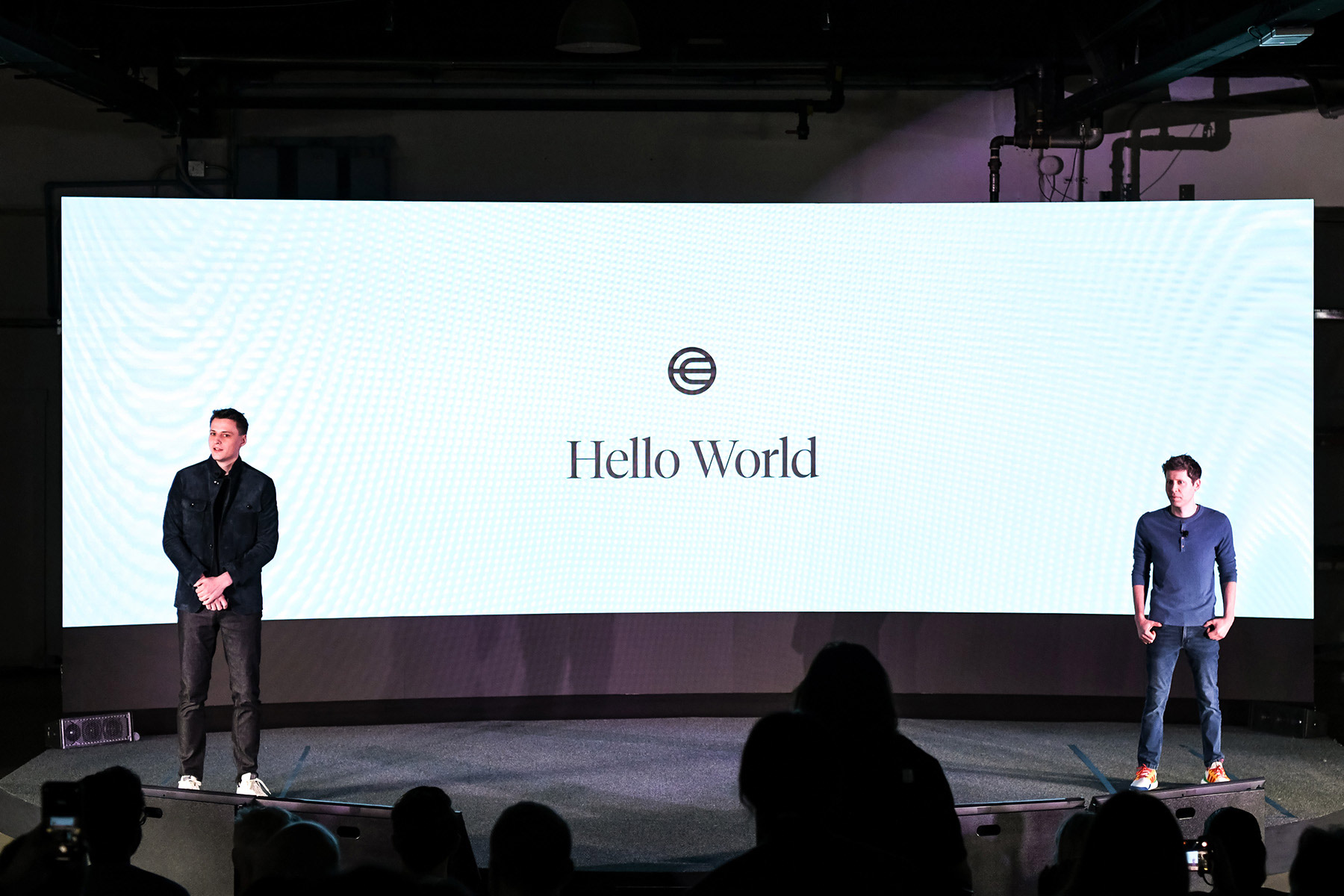
A change of name can be an expensive exercise in stationery. Here, it also described an expanding argument. The original distribution problem had become a proposition about everyday internet use. If software could convincingly imitate people, a credential establishing human uniqueness might have uses beyond receiving a token. Blania was asking developers and platforms to find those uses.
The new Orb addressed the physical bottleneck. World said its design contained 30 percent fewer parts and could be assembled twice as quickly as its predecessor. These are less glamorous details than a prediction about the future of civilization. They are also the details that determine how many devices can leave a factory. Even a planetary mission has a parts list.
The privacy design was evolving too. The October hardware announcement described images being sent to the user’s phone and then deleted from the Orb. World’s cryptographic architecture aims to support uniqueness checks without exposing a person’s identity to the services using the proof. Those design choices address the central tension in Blania’s proposal: a system intended to protect people online begins by asking them for a biometric interaction offline.
From dating profiles to boardroom calls
By 2026, the applications were becoming more concrete. At its April Lift Off event, World announced an expanded Tinder relationship, work with Docusign, and tools connecting proof of human to AI agents. The product question had moved closer to familiar experiences: the dating profile, the document awaiting a signature, the automated request arriving at a website.
Concert Kit supplied a particularly legible example. Artists could reserve some tickets for people presenting World ID, while retaining their existing ticketing platform. Thirty Seconds to Mars committed to a pilot for its 2027 tour. The appeal is easy to grasp without knowing anything about cryptography. A person in a queue would quite like the other people in it to be people as well.
Agents complicate that picture in a useful way. A person may want software to browse, shop or complete work on their behalf. World’s AgentKit, still described as a beta in October 2026, lets people delegate proofs to agents. The question becomes whether a real person stands behind an automated action. Blania’s network has to accommodate the tools people willingly use, alongside attempts to abuse a service.
The latest turn brings him into banking and finance. In an announcement dated October 18, 2026, World described Blania unveiling its offering at Money20/20 in Las Vegas. It named Bain Capital, OpenExchange, Outtake, Pantera Capital and VanEck Funds as initial design partners. The offering brought together an identity app, agent tools and World ID for Zoom.
The Zoom integration gives the proposition a visible form: a human badge during a meeting, supported by verification tied to the participant. World announced availability in the Zoom Marketplace that October. A board meeting or financial conversation is a different setting from an early cryptocurrency signup. It places Blania’s experiment inside routines where a convincing impersonation could carry real consequences.
The last step belongs to people
World reported more than 18 million Proof of Human holders in October 2026. Its dedicated identity app was available in more than 150 countries. These figures describe different things: verified people and software availability. Neither alone establishes how often a credential will prove useful. Blania’s next challenge is to make the proof worth returning to after the first encounter with an Orb.
Company-reported snapshots. Bars use rounded lower bounds. These count verified people, not app downloads or active users.
Recognition has followed him along the way. He appeared among the innovators on the 2025 TIME100 AI list. His own public biography also lists him as a co-founder of Merge Labs, while continuing to identify Tools for Humanity as the company he leads. Yet the most distinctive thread in his career remains the move from studying complex systems to trying to build one that ordinary people will use.
There is a temptation to treat this story as a debate settled by whichever side has the sharper slogan about AI. Blania’s work is subject to more pedestrian tests. Can someone reach a device? Do they understand what they are agreeing to? Can they exercise their rights? Does the resulting proof help them do something they actually want to do?
Those questions bring the project back to its human scale. The founder who once competed at archery now works with a target that keeps moving: software grows more capable, platforms change and regulators ask for revisions. His proposed answer remains a peculiar object and a credential on a phone. Whether that answer becomes ordinary will depend on millions of people deciding it belongs in their lives.
Keep the conversation going
- The public biographyBlania’s projects, education and early interests
- The company behind the OrbTools for Humanity
- Back to ErlangenFAU alumni interview, November 2024
- A conversation about proof of humanWatch on YouTube / a16z, April 2026
- World ID enters banking and financeWorld announcement / October 2026
- The Orb and the questions around itTIME feature / May 2025
- The privacy rulingBavarian data authority / December 2024 / PDF
- Inside the World networkProduct news, engineering and project updates