Consider the small indignity of calling your bank. You opened the account with an identity document. You signed into the app. Now a voice asks you to prove yourself again. The institution has met you, but its systems keep losing the introduction. Uniken built its business around the space between those encounters.
- REL-ID connects identity, device security and transaction approval.
- The buyers are enterprises, especially banks; customers encounter the software inside their services.
- Uniken became Ditto in March 2026, with reusable identity at the centre of its pitch.
The interesting question is what happens after a check succeeds. Can the result help secure the next interaction? A document check, a login and an instruction to move money establish different things. Treating them as unrelated purchases leaves a bank assembling the answers. Uniken’s proposition is to connect them.
A lab in search of a market
The story reaches further back than the company’s usual 2013 founding date. In Pune, Sanjay Deshpande and fellow founders Prakash Salvi, Nanjundeashwar Ganapathy and Nilesh Dhande began an earlier venture in 2003. Deshpande had worked at Infosys and Tata Research Center. He wanted India to export intellectual property as well as skilled labour.
The lab explored a surprisingly wide territory, including operating systems and renewable energy. Commercial security became a route to market. By 2010, Deshpande described a secure banking product called TruBank, powered by REL-ID, bought by State Bank of India and Bank of India. This was research finding a customer with something concrete to lose.
The early constraint was commercialisation. In founder interviews, Deshpande discussed the difficulty of winning customers willing to try unfamiliar technology and recruiting talent drawn to larger employers. His answer stressed flexibility. The useful lesson is modest: a patent needs a buyer, and a research organisation needs people prepared to stay for the engineering.
The space between the checks
REL-ID’s architecture joins controls often discussed separately. Temenos lists it for authentication, transaction signing and mobile threat defence. Its description includes checking whether a device is compromised, securing communications and controlling access to services. The software can be embedded through SDKs, placing those checks inside an institution’s own applications.
For a customer, that can mean approving an action in a familiar app rather than negotiating another password ritual. For the institution, the important distinction is between recognising an account holder and authorising a particular instruction. A cryptographic signature can bind approval to a transaction; a successful login alone answers a narrower question.
This puts Uniken at an intersection: customer identity management, identity proofing, authentication and application security. Its differentiator is the connection between them. A buyer comparing products should therefore inspect the complete journey. A specialist document checker and a combined security platform may enter the same procurement discussion while solving different portions of the problem.
There is evidence of institutional engineering behind the proposition. Uniken announced a SOC 2 Type II audit in April 2024, completed with Johanson Group LLP. It also introduced palm vein authentication for in-person interactions that year. The palm is an amusing reminder that “omnichannel” includes a person standing at a counter.
A new name for portable trust
On March 17, 2026, Uniken launched Ditto. The announcement put reusable identities and privacy-preserving proofs at the heart of the new brand. The ambition is straightforward: let a customer establish something about themselves, then reuse that assurance without repeatedly exposing the underlying personal information.
“There is no room for doubt in identity security.”
Gonzalo Alonso, CEO · Ditto launch, March 2026
Its branding agency, Blend, describes a commercial shift toward a cloud-based identity platform aligned with Europe’s regulatory direction. It also says the Uniken name had limited meaning in the intended markets. That is a specific reason to reconsider a brand: the old introduction no longer described the business being built. Blend says Uniken remains a back-end enterprise identity.
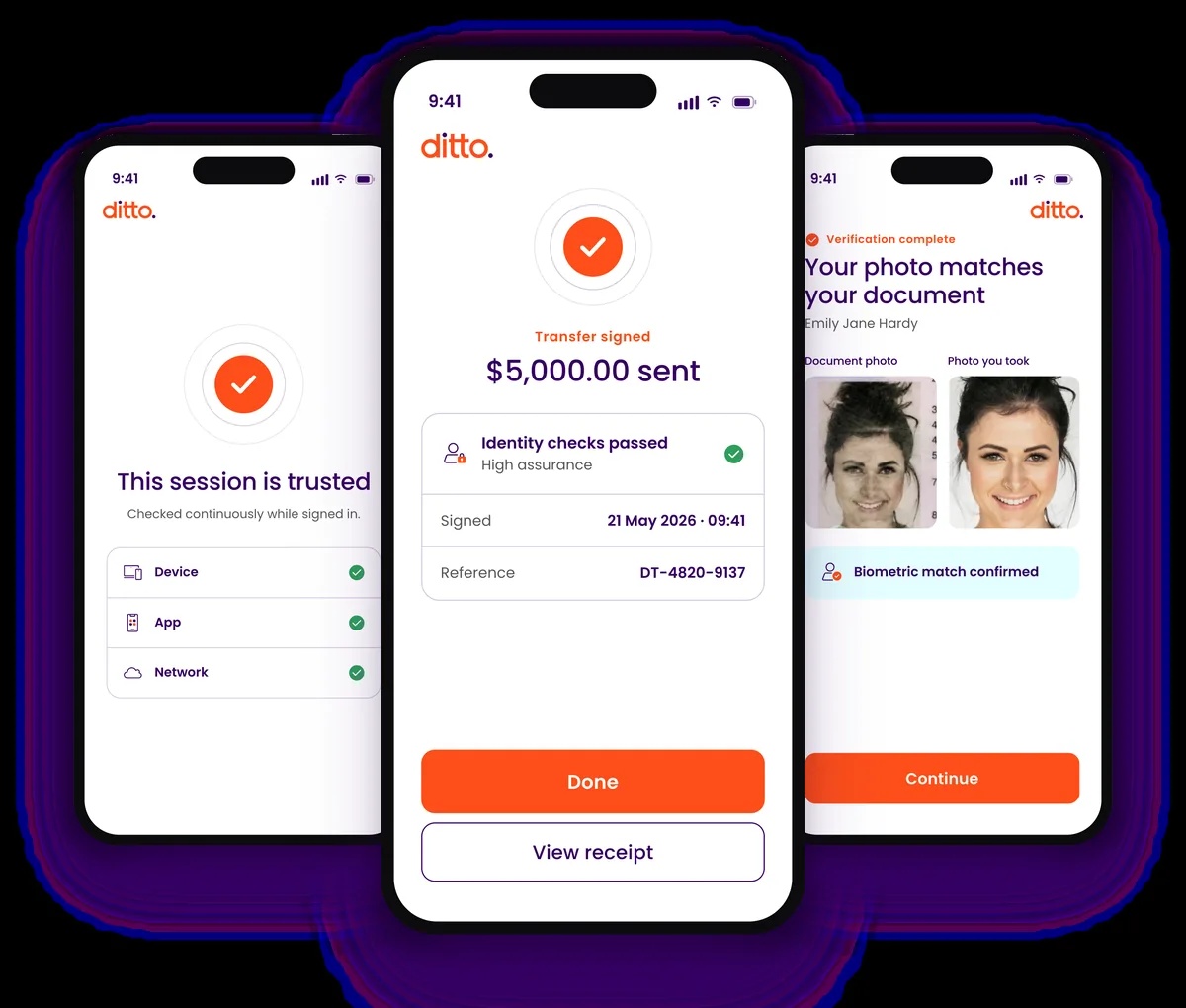
The current product family makes the divisions explicit. Verify handles documents, facial matching, liveness and identity binding. Authenticate provides device-bound login, stronger checks when risk rises and transaction signing. Protect watches the device, application and communication channel. Ditto ID brings the capabilities together. The intended continuity runs from opening an account to recovering it.
In September 2026, Ditto announced Product Leader recognition in KuppingerCole’s identity verification assessment. Its account of the report emphasised the link between verification and high-assurance authentication. That is the thread connecting the new name to REL-ID’s older concern: what happens between encounters.
What the buyer actually buys
This is enterprise software, sold directly and through partners. Temenos provides a visible route into banking infrastructure; Ditto also names Infosys Finacle, LTIMindtree, Mellon and Orion Innovation in its ecosystem. The distribution matters. Security embedded in another platform can reach customers who never learn the security supplier’s name.
The financing has supported that outward push. A November 2018 announcement reported a $10 million investment for global expansion. In April 2026, Spanish reporting described a further round of approximately $15 million led by Talipot, alongside expansion into Spain.
Today’s pricing offers a combined platform or individual modules, tailored to scale. Cloud, hybrid and on-premises deployment options make architecture part of the purchase. Buyers should cost the integration and operating model alongside the licence: the app work, the policies and the process for a customer replacing a trusted device.
The question worth copying
The practical takeaway is to follow one customer through onboarding, login, payment approval and recovery. Mark every place they must start proving themselves again. Then ask which evidence can safely carry forward, and which action deserves a fresh check.
For a pilot, choose one ordinary action and one difficult exception: signing in, for example, followed by recovering access after a lost phone. That pairing gives a buying team a more revealing demonstration than a smooth login on its own.
That approach depends on working integrations, usable recovery and appropriate assurance. Cryptographic proof establishes particular facts; it does not settle every question about a customer’s intentions. Uniken’s story is useful because it makes the handoffs visible. For a bank, those handoffs are engineering decisions. For the person on the phone, they are the difference between being recognised and beginning again.