At GoPro, an email address that failed a check could mean something wonderfully ordinary: a customer had made a typo. Carla Gutierrez, a fraud and payments manager quoted in a published customer account, described using Ekata’s manual review tool to investigate those errors. A machine had found a problem. A person could decide what kind of problem it was. Somewhere between those two steps sat a sale worth saving.
- Ekata checks identity relationships and usage patterns to help businesses assess risk.
- Its customers include merchants, lenders, payment providers and marketplaces.
- Mastercard bought it in 2021; the technology now sits within Mastercard Identity.
That little distinction explains Ekata better than a page of artificial intelligence vocabulary. Fraud prevention has two expensive errors: admitting a fraudster and refusing an honest buyer. Ekata sells businesses more evidence for navigating both. Its expertise lies in identity data, machine learning and the unglamorous work of fitting risk signals into decisions that must happen quickly.
A phone number with a complicated social life
The raw ingredients are familiar: name, email, phone, physical address and IP address. Ekata’s Identity Engine combines two kinds of evidence. The Identity Graph examines whether details are valid and how they connect. The Identity Network examines patterns in how those details appear in digital interactions. An identity can look tidy in a database and behave strangely in the world.
An Ekata guest article published by partner Provenir offers an illustrative example: a valid phone linked to an owner might also appear alongside 50 email addresses in 30 days across more than 15 businesses. Those are different observations. The second supplies context the first cannot. Ekata turns such connections into attributes, scores and risk indicators for a customer’s own decisioning system.
connect?
Validity + relationships
being used?
Patterns + activity
The directory grows up
Ekata’s ancestry makes sense once you see the problem. Its roots run back to Whitepages, the directory business founded by Alex Algard. A 2020 executive interview dates Whitepages’ formal B2B API operation to 2012 and the Ekata brand to June 2019. That helps untangle the three birthdays that appear in company records: predecessor, business operation and independent brand.
When Whitepages split in 2019, the consumer business kept its familiar name. The enterprise identity operation became Ekata, led by Rob Eleveld, with Algard as chairman. The commercial question had changed from finding someone’s details to helping another business judge an interaction. Mastercard announced its purchase in April 2021 at an $850 million enterprise value. Its annual filing records a June 9 closing and $861 million in adjusted cash consideration.
The customer your rules almost lost
Consider Upgrade, the lender. Some applicants had little credit history, making them difficult to verify through traditional methods. Fraud analytics leader Ying Min Pang sought additional identity evidence, heard recommendations from colleagues and tested Ekata’s data. In Mastercard’s account, back-testing supplied encouraging results. Upgrade used the Account Opening API to sort applicants by risk and adjust how much verification each needed.
fewer false fraud flags
more frictionless verifications
Results from one customer case study, published by Mastercard. Outcomes depend on the deployment.
The reported outcome was a 21% reduction in falsely flagging good customers and a 60% increase in frictionless verifications. These are customer-specific results. They nevertheless point to an appealing business proposition: additional data can sometimes remove an obstacle instead of creating one. The customer gets through; the lender preserves an opportunity it might otherwise have lost.
Leave room for a human
The product range follows the decisions. Account Opening API supports signup risk assessment. Transaction Risk API feeds payment risk workflows. Address Risk and Phone Intelligence examine particular attributes. For ambiguous cases, the manual review product formerly called Pro Insight is now Identity Review 360. It brings scores, positive and negative signals, identity matches and distance maps into a reviewer’s workspace.
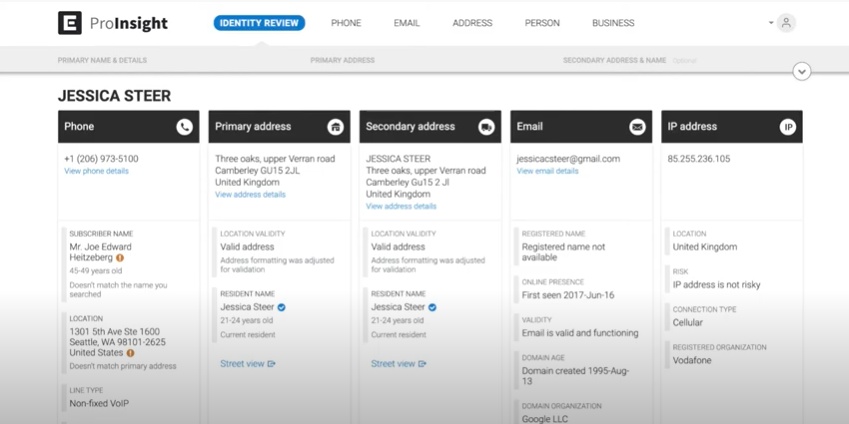
GoPro’s typo example belongs here. A warning deserves interpretation. Ekata’s business model gives enterprises both automated data access through APIs and software for analysts. Buyers pay for the scope they contract; API volume and product selection influence the economics. A useful budget includes integration work and reviewer time alongside the software bill.
“it may be because the customer made a typo”
CARLA GUTIERREZ / GOPRO
Milliseconds have a memory bill
There is a less photogenic side to this business. A Redis case study describes Ekata’s database handling an average 150,000 to 200,000 calls per second, with customer latency commitments below 100 milliseconds. These are internal database calls, not a count of shoppers. The infrastructure has to keep up while a checkout waits.
Redis reports that memory tiering let Ekata use 30% of its previous DRAM requirement without sacrificing latency, saving hundreds of thousands of dollars annually. That detail reveals the engineering bargain beneath the product: identity evidence must arrive fast enough to be useful, at a cost that makes repeated checks commercially sensible.
Where the evidence goes next
Today, Ekata’s website leads to Mastercard Identity. In September 2025, Entrust announced an expanded partnership incorporating Mastercard Identity insights powered by Ekata into onboarding. The market includes overlapping alternatives such as Trulioo and large risk-data providers. Entrust also demonstrates how verification platforms and identity data suppliers can work together.
Distribution still matters. Visa’s 2025 product bulletin listed Ekata among third-party services for which Decision Manager would end support. A useful capability needs an available route into your workflow. The practical lesson is to test that route and the evidence together: compare false positives, abandonment and fraud outcomes on your own applicants. A score earns its keep when it helps you make a better decision about the person waiting.