The small change is where a digital project can become a very large nuisance. A label needs rewriting. A new screen needs a familiar button. Someone on the client’s team wants to update a page and discovers that the knowledge lives elsewhere. Elever has built part of its agency pitch around that unglamorous moment: the work should remain useful when the people who designed it are no longer sitting beside you.
The studio’s public offer brings together design systems, user interfaces, websites and brand identity. Its About page adds a more pointed ambition: clients should receive the tools, training and understanding to manage their digital work themselves. For a business that sells creative expertise, promising to reduce dependence on that expertise is an interesting way to introduce yourself.
Elever calls itself a distributed global digital product partner. Its website names Samrat Sharma as principal and gives 2023 as its founding year. The company’s language repeatedly returns to longevity, stable foundations and working alongside a client’s team. Read together, those statements suggest a particular buying proposition: hire help to make the product, but also to make the next round of work easier to own.
The exit is part of the offer
“Our goal is your independence,” Elever says. The line appears alongside promises about handoffs, transparency and maintainability. The studio says it will train a client’s team to take over if a partnership ends, and build systems that do not require its involvement in every small change. That is a service commitment with a practical object: the person left running the thing.
For a prospective customer, this turns the discussion toward what arrives with the finished design. A set of screens may explain how something should look. A usable component library can explain how the next screen should be assembled. Training can help a team understand which changes it can make confidently and which need a designer or developer. These are different deliverables, even when they appear in the same proposal.
The appeal is especially clear for a product team that wants outside expertise without surrendering everyday control. Elever’s offer appears suited to businesses building or revising a digital presence, and teams trying to give an existing product a more consistent visual and interaction language. Its public pitch addresses those needs through services and collaboration, with the client’s own product at the center of the engagement.
“Our goal is your independence.”
Elever, on its approach to client work
There is a useful discipline here for buyers: make the handoff tangible before the project begins. Ask what knowledge will be transferred, which files and systems will be delivered, and who on the receiving team will learn to use them. That is an implication of Elever’s stated approach, rather than a description of a particular engagement. Independence becomes much easier to evaluate when it has a delivery date and an owner.
A cabinet of buttons, with a business behind it
Elever’s website gives visitors something to inspect beyond an agency adjective. A design-system demonstration arranges buttons, badges, form inputs, scheduling elements, alerts and navigation into a working display. The ordinary pieces get plenty of attention. There are destructive actions and warning states, invoice statuses and progress indicators, alongside the cleaner shapes usually associated with a polished product screenshot.
This is a revealing choice of showroom. Interfaces spend much of their lives handling the ordinary: waiting, confirming, searching, failing, asking for another piece of information. By exhibiting those pieces together, Elever makes its advertised component-library service visible. Visitors can see the vocabulary from which a larger application could be assembled, instead of having to imagine what a design system might contain.
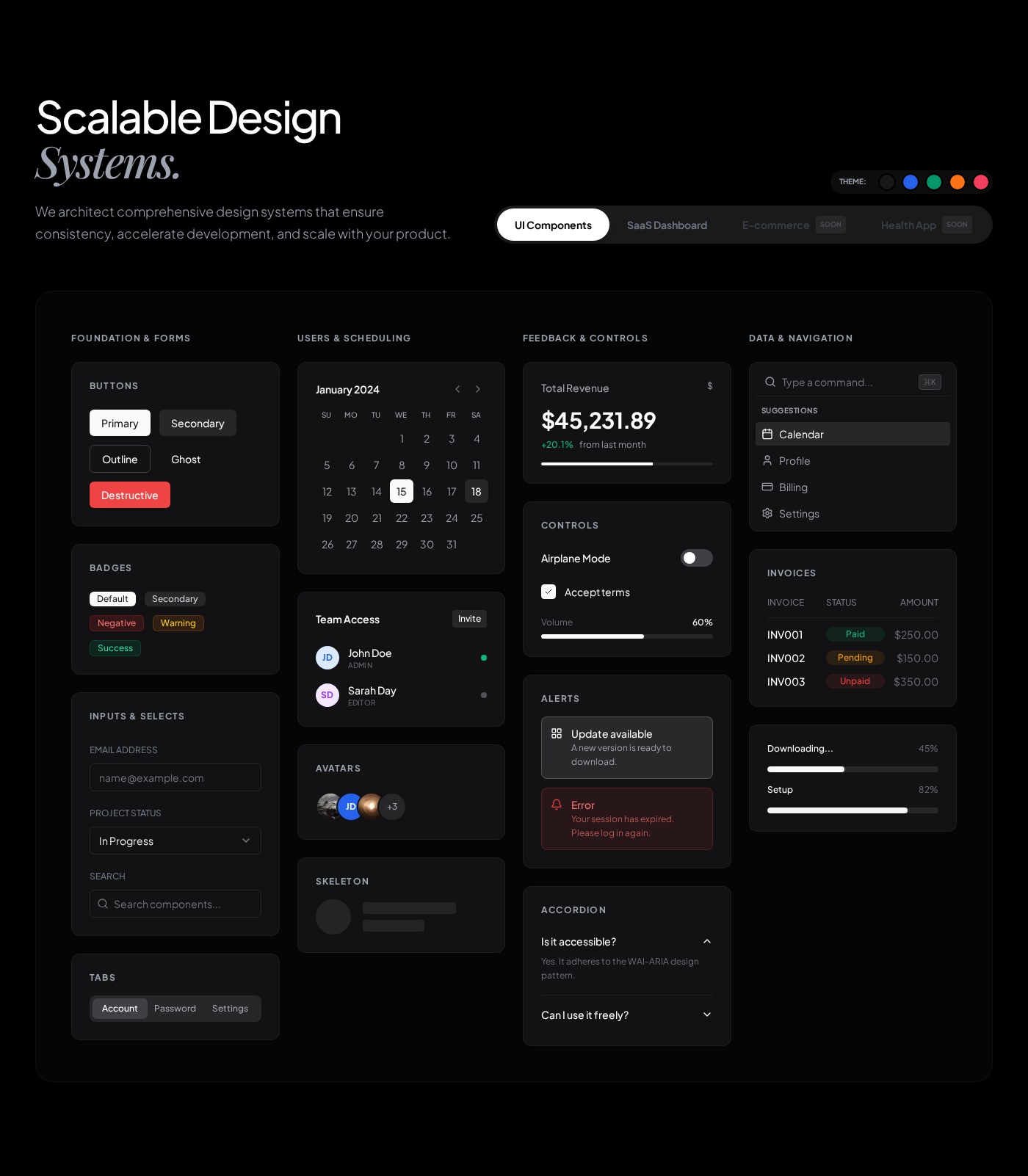
The distinction matters when reading the screen. A revenue number inside a demonstration dashboard is interface content. A familiar brand name inside a sample interaction is part of that display. Neither should be promoted into a claim about Elever’s own revenue or its customer roster. The useful evidence is the presentation itself: the hierarchy, the range of states and the way related controls sit together.
Elsewhere on the site, mobile examples show a different side of the same practice. A wallet interface, authentication prompts and other compact interactions put motion and feedback in view. Elever describes its interest in gestures, transitions and native-feeling mobile experiences. The demonstrations give a prospective buyer a starting point for discussing those choices, including when movement helps someone understand what just happened.
Four capabilities, one continuity problem
The featured service menu has four entries: design systems, UI/UX design, web design and brand identity. Elever’s corporate description also includes development. Its LinkedIn specialties extend further into content writing, video editing, social media management, search optimization and digital marketing. The website’s foreground, however, belongs to products and the interfaces through which people encounter them.
The combination addresses a familiar coordination question: how does a brand remain recognizable when it becomes a website, then an application, then a collection of new screens? Identity establishes visual choices. Interface design puts those choices to work around tasks. A design system makes recurring decisions reusable. Development turns the decisions into behavior. Elever groups these capabilities within one studio relationship.
A way to read the service mix, not a prescribed project sequence.
That breadth places Elever among service businesses a buyer might consider alongside an independent interface designer, a dedicated brand studio, a development agency or an internal product team. The relevant comparison is the work each arrangement can own. Someone buying a single visual asset has a different problem from someone coordinating identity, interface rules and implementation across a product.
Elever’s distinction is therefore best read as a combination of scope and operating promises. It offers several related disciplines and says the resulting work should be maintainable by the client. A buyer can test that combination against a concrete brief: which pieces need to agree with one another, which are already working, and where outside help would remove a specific obstacle?
The budget conversation starts before the coffee
Elever’s contact page asks for a name, email, company, project description and budget range in US dollars. The options are $1,000-$5,000, $5,000-$10,000, $10,000-$30,000, $30,000-$50,000 and $50,000-plus. These are the bands available to someone making an inquiry. They describe how the studio sorts a conversation, rather than the price of a defined website, application or design system.
Five selectable budget bands. Scope and a quote determine the actual engagement.
The business model is a service relationship: a company brings a project or product need, and Elever offers design and development work. Its About page favors sustained partnerships. The contact flow asks the buyer to describe goals and timing, which makes the brief part of the initial exchange. For readers considering an inquiry, the practical preparation is to identify the job before choosing the band.
For example, a useful brief could separate a visual refresh from changes to an application’s behavior, identify whether development belongs in the assignment, and state who will maintain the result. Those choices affect what a supplier needs to deliver. A reusable library, a working implementation and a training session each answer a different part of the buyer’s problem. Naming them early makes a budget discussion less abstract.
Global is a working arrangement
The studio website presents Elever as remote and global and offers English and Japanese language options. Its LinkedIn profile lists San Francisco as headquarters and Shibuya, Tokyo as another location. The website places the emphasis on a distributed practice. For a potential client, the relevant operational question becomes how the people involved will communicate, approve work and transfer knowledge across that arrangement.
Elever’s stated culture combines close collaboration with an interest in durable technical foundations. Its About page says it wants to work on core business challenges alongside the client’s team, while avoiding development driven by hype. These are company statements about how it wants to operate. They also provide useful subjects for a first meeting: decision-making, maintenance, training and the responsibility attached to each deliverable.
The independence promise has a condition built into it. A client needs someone able to receive the knowledge and use the system. A library will be less helpful if nobody maintains it; training needs a participant with time to learn. That is an editorial reading of the model, and a practical reason to involve the eventual operator before approving the final design.
Ask to see the next ordinary change
The most useful thing a reader can borrow from Elever’s positioning is a test. Before signing off on a digital project, ask the supplier to walk through the next ordinary change. How would the team add a screen, revise a message or reuse a component? Where would the instructions live? Which parts could the client handle, and which would still require specialist work?
That exercise connects the attractive surface to the less photogenic machinery underneath. It also fits the studio’s public emphasis on systems, maintainability and handoffs. The initial impression may come from an animated interface. The more consequential discussion concerns what the buyer can do with it after delivery, when the launch presentation is closed and the first request for a small change lands.