There is a particular kind of distance that can exist inside the same building. The packaging designer sits on one floor. The web developer sits on another. Between them is a hallway, which is only thirty feet long and somehow takes three weeks to cross. A bottle changes. The website does not. A campaign arrives with the right typeface and the wrong idea of what the product can actually promise. Everybody is nearby. Nobody is close.
This was the problem hiding inside The Clorox Company’s old creative arrangement. Clorox had not neglected design. Its internal creative lineage went back decades, and its digital group had been steadily taking more website work in-house. The trouble was the familiar corporate one: packaging and print belonged to one stream; digital and content belonged to another. Each could be competent and still produce a fragmented whole.
In 2018, Clorox gave the arrangement a jolt. The company combined the teams, unified their project-management operations, installed a cross-functional leadership group, and renamed the operation Electro Creative Workshop. The name came from an old family story. Before Clorox was Clorox, it was the Electro-Alkaline Company. Early bleach bottles advertised that they were “Made with Electricity.” A century later, the electricity had become organizational.
The work was divided by medium, not by problem
The first thing that failed was not taste. It was the handoff. A consumer does not experience “packaging” at 10 a.m. and “digital” at 2 p.m. She sees a Burt’s Bees display, searches the product, reads an email, and opens the box. The company’s creative organization had been divided according to the tools used to make those moments rather than the person moving through them.
Electro’s response was remarkably literal. It created 38 positions, changed 13 reporting relationships, promoted five people and moved 43 desks. The desk moves are the charming number. Strategy announcements tend to float several feet above the carpet; desk assignments touch it. Put a developer, a producer, a packaging designer and an account lead within swiveling distance, and “integration” stops being an abstract noun.
The rewire / 2018 organization changes
The rebuilt shop became broad enough to look like several agencies hiding in one address. It handles brand direction, advertising, packaging, print and experiential work. It also designs websites and user experiences, writes copy, produces photography and video, builds front ends and back ends, develops apps, runs CRM and email work, and supports ecommerce. A current Clorox recruiting description puts the organization at roughly 180 employees and contractors across Oakland and Durham.
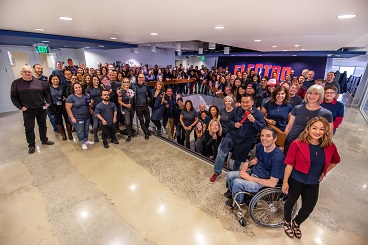
The client already knew the address. It still needed convincing.
An in-house agency has a sales problem disguised as an access advantage. Its customers cannot easily forget it exists, but they can treat it like a vending machine: insert brief, receive banner. Electro wanted a different relationship. Its leaders called the shift moving from “order-takers to order-makers.” The phrase is cute; the political task beneath it is serious. To influence a brief, creative people need to be invited into the room before the brief hardens.
So Electro marketed itself within Clorox, an exercise it called “invertising.” It clarified what the studio could do, rebuilt relationships with brand teams and asked for retained partnerships instead of isolated production jobs. By the end of 2018, the share of retained work had quadrupled and its internal revenue had risen 10 percent year over year. Those figures came from the agency’s own award profile, but they explain what changed minds: not a manifesto alone, but repeat work and visible output.
“We can get the work done 25% faster for 25% less investment.”Kerri Martin, then Chief Electrofier, describing Electro’s value proposition in 2019
That was the price argument, and it is more useful than a mystery invoice. The claim was comparative: one-quarter faster and one-quarter less investment than agency partners, at equivalent quality. Proximity strips out some briefing and translation. Institutional memory does not leave when a pitch ends. A packaging rule learned on Monday can show up in an ecommerce module on Thursday.
But cheapness was not the ambition. A cost center wins a budget discussion and loses the interesting work. Electro added strategy, account leadership and creative depth because it wanted upstream problems. Its internal customers are Clorox marketers and brand owners; the eventual audience is everyone buying Clorox, Glad, Kingsford, Hidden Valley Ranch, Pine-Sol, Fresh Step, Burt’s Bees and the company’s health-and-wellness brands.
Four lip balms walk into a board game
The 2025 Burt’s Bees holiday program for Target offers a tidy specimen. Holiday lip balm is not a blank creative canvas. It must read from an endcap, feel giftable, satisfy a retail partner, behave in a digital storefront and hold small cylinders without letting them rattle into oblivion. Electro developed five structures around a Game Night idea. One package unfolded into a playable board, with four miniature lip balms acting as pieces.
This is not a moon landing, which is precisely why it is instructive. Most brand work is a constraint puzzle. The useful agency knows the shopper, the retailer, the production limits and the brand codes, then finds one playful move that fits all four. The program later received a merit in the In-House category of the 2026 DIELINE Awards. The award matters less than the coherence: packaging, store display and digital presentation told the same small joke.
Give the internal team a name and a proposition. Organize around the customer journey, not software or substrate. Put account and strategy people beside makers. Track speed, cost, repeat work and business demand. Then advertise the capability internally until colleagues know when to bring it in.
Being inside is an advantage, not a complete strategy
Electro still works with Clorox’s lead agencies of record and other outside specialists. That is not an awkward footnote. It is the sensible boundary of the model. Internal teams have proximity and memory. External teams can bring a strange idea, rare craft or capacity that would be wasteful to keep permanently on payroll. The choice is not in-house or out. It is which work improves when the maker can see the business from ten feet away.
The model depends on enough steady demand to support many disciplines. It also depends on executive sponsorship, a clear intake system and trust from brand leaders. Remove those conditions and the grand workshop can regress into a crowded request queue. The 25 percent promise also travels poorly if an organization cannot measure comparable work, or if speed is purchased by overwhelming the team.
Electro’s own culture tried to guard against that regression. Its “Electrofesto” described the team as craftspeople, connectors, co-conspirators and “can-if thinkers.” Corporate manifestos are easy to tease because many deserve it. This one was paired with reporting changes, hiring and furniture displacement. The words had evidence underneath them.
There is evidence of a more human kind, too. After the 2018 Camp Fire, associate creative director Augustus Ang organized an art and experiences auction in three weeks. Electro’s makers supplied 135 lots: paintings, ceramics, jewelry, baked goods, a sailing lesson, a wine tasting and a Tahoe stay. The event raised $20,000 for relief. It is hard to fake a workshop culture when colleagues are donating wood carvings.
The org chart is part of the creative
The familiar mythology of advertising puts the idea in a bright room and the operations somewhere behind a gray door. Electro’s story scrambles that arrangement. The work changed because the system around the work changed: who sat together, who reported to whom, when strategists entered, how projects were retained, which capabilities stayed inside, and how the team explained its value.
That is why the best number in this story is neither 40,000 assets nor 25 percent. It is 43 desks. The number is small enough to picture. Forty-three people unplugging monitors, rolling chairs, carrying mugs and discovering a new neighbor. The company did not eliminate the hallway. It made crossing it unnecessary.