A fertilizer granule has an awkward assignment. It must arrive in the soil, release its nutrients at a useful moment, and give a plant something it can actually absorb. A great deal can go wrong between delivery and dinner. Elad Aharonson, who became president and chief executive of ICL in March 2025, has made that small problem part of a much larger business argument: there is money to be made by getting the timing right.
His route to the subject was unusual. Before crop nutrition came unmanned aircraft. Before fertilizer businesses in Brazil and North America came command positions in Israel’s artillery and Ground Forces UAV unit, followed by senior roles at Elbit Systems. The change in subject matter is considerable. So is the distance between watching a landscape from above and working out what its crops need.
Now he runs a company whose annual sales reached $7.153 billion in 2025. His decisions include acquisitions, mineral production and the less photogenic work of declining to spend money. Plants may reward patient attention. Shareholders tend to request a date.
Before the field, the view from above
Aharonson joined Elbit in 2004 and worked in senior program management roles involving unmanned aircraft. By 2009, he was vice president for UAV systems. In January 2011, he became executive vice president and general manager of the UAS division. His academic qualifications were an LL.B. and a bachelor’s degree in business administration from the Hebrew University of Jerusalem.
In 2015, he took charge of Elbit’s ISTAR division, the business covering intelligence, surveillance, target acquisition and reconnaissance. The remit brought together unmanned systems, electro-optics and intelligence capabilities. In an interview that April, he discussed the need to monitor wide areas while retaining the ability to examine small details and revisit earlier events. It was a managerial brief built around connecting technologies that had to work together.
He remained in that divisional leadership role until 2021. The record gives his later move to agriculture a useful perspective: he arrived after years managing technology businesses and international markets. There is no need to invent a childhood fascination with soil to make the transition interesting. The documented change of industries is quite enough.
- 2004Joins Elbit Systems
- 2011Leads the UAS division
- 2015Leads the ISTAR division
- 2021Moves to ICL crop nutrition
- 2025Becomes ICL president & CEO
A global business, one local grower at a time
In April 2021, Aharonson became president of ICL’s Growing Solutions business. Over the following years, its expansion included Brazil, India, China and North America. The products were agricultural, but the commercial challenge was familiar to anyone running an international business: customers in different places wanted different things, and a global organization had to supply them.
The acquisitions put specific addresses on that idea. In February 2024, ICL announced the purchase of Brazil’s Nitro 1000 for approximately $30 million. Its biological products were directed mainly at soybean, corn and sugar cane. ICL brought an existing customer base and research capabilities; Nitro brought biologicals expertise and manufacturing. Iris Guindani, one of Nitro’s founders, was to remain as head of operations.
That July, ICL acquired Custom Ag Formulators for approximately $60 million. The American company operated facilities in Fresno, California, and Adel, Georgia, making liquid and dry formulations. Their locations supported shipments to growing regions across the country. Aharonson’s explanation concentrated on the differing nutritional requirements of crops on the West Coast and in the Southeast. It was a refreshingly geographical account of growth: two factories, different crops, shorter routes to customers.
These deals help explain his promotion. When ICL announced him as its next chief executive in December 2024, it pointed to his development of specialty fertilizers and expansion into new territories. He succeeded Raviv Zoller on March 13, 2025, moving from one of the company’s businesses to responsibility for the whole portfolio.
The patient business of feeding a plant
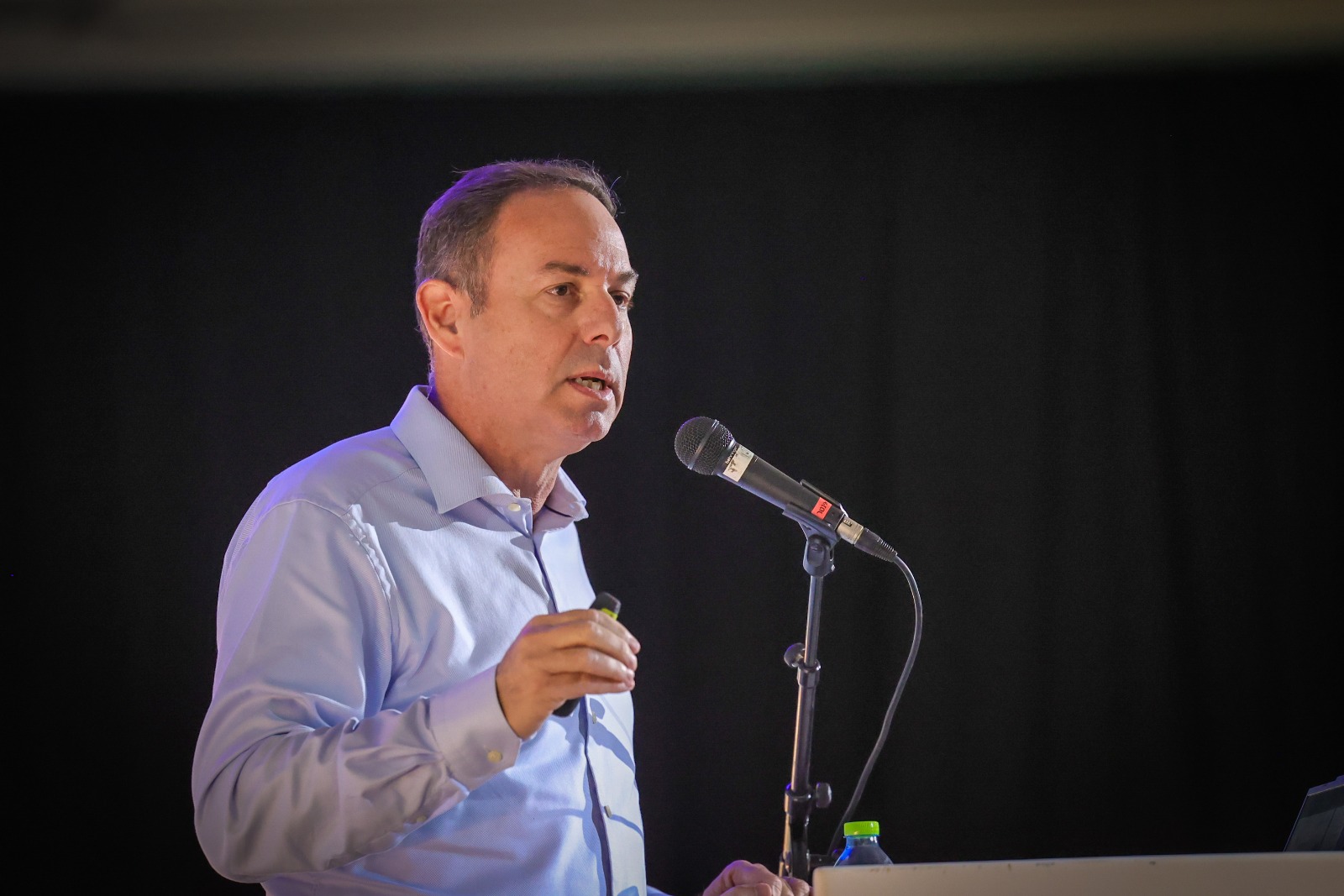
At a business conference in November 2025, Aharonson described controlled-release fertilizer in terms that an audience far from a farm could follow. A coating around the fertilizer regulates the release of nutrients over the growing period. The commercial attraction is tied to an agricultural problem: nutrients that fail to reach the plant are an expense without the intended return.
He used the appearance to set out two areas for growth: smarter fertilizers and functional food ingredients. One concerns how food is grown; the other concerns what happens during its manufacture and preservation. His argument followed food along its journey, giving an industrial company a connection to something rather more recognizable than a chemical specification sheet.
The explanation also reveals the practical appeal of the crop nutrition business. A fertilizer is bought for a result in a field, under particular conditions, with a crop that follows its own calendar. A product’s sophistication matters when it helps the grower. The plant has yet to develop an interest in corporate branding.
Buying the work that comes before the product
ICL’s 2025 move to acquire Lavie Bio’s assets extended that approach into microbial agricultural products. The package included people, a microbial bank and technology capabilities. An associated announcement described data assets, development programs and the MicroBoost AI for AG platform. This was an acquisition of research tools and accumulated work as well as commercial offerings.
It followed more than two years of collaboration between the companies on biostimulants. That sequence is worth dwelling on. The businesses had worked together before the acquisition, giving the transaction a history beyond the announcement. The objective was to combine Lavie Bio’s specialist capabilities with ICL’s research resources and access to farmers.
A microbial bank sounds less lively than it is. Its value lies in the possibilities it contains, and in the work required to turn those possibilities into dependable products. For Aharonson, bringing that capability into ICL enlarged what the company could develop alongside its established fertilizers. The test would come after the deal, through products that growers chose to use.
“Growth is not a slogan. It’s execution.”
Elad Aharonson, on the Bartek transaction
Why a fertilizer executive is interested in sourness
Food ingredients supplied another route for expansion. In January 2026, ICL acquired an initial 49.9% stake in Bartek Ingredients, alongside preferred debt, for approximately $90 million. The transaction was structured in stages, with arrangements for acquiring the remaining shares. The distinction matters: a planned full acquisition and a completed first stage describe different commitments.
Bartek makes food-grade malic and fumaric acids, supplying customers in food, beverages, confectionery and bakery markets. Such ingredients help manufacturers control properties consumers experience without necessarily knowing their names. A sweet can be memorable partly because somebody was extremely particular about its acidity.
The business brought acidulants expertise to ICL’s existing food ingredients activities. Bartek chief executive Andrew Ross described the fit in terms of global scale, technical knowledge and research capabilities. Aharonson presented the deal as part of the same strategy that supported specialty crop nutrition: expand in areas where ICL already had relevant experience and customers.
His public comment on the transaction was unusually economical: “Growth is not a slogan. It’s execution.” The sentence has the advantage of being testable. Integration, production and customer orders would provide rather more demanding punctuation than a celebratory announcement.
The projects he chose to stop
Acquisitions tell only part of the story. On the February 2026 earnings call, Aharonson explained ICL’s decision to discontinue lithium iron phosphate projects in the United States and Spain. His reasoning concerned competitive advantage: the company could continue supplying raw materials to customers in China without pursuing the next manufacturing step itself.
ICL was also reviewing its Boulby operations in the United Kingdom for a possible sale. These decisions sat beside investment in crop nutrition and food ingredients. Taken together, they make the strategy easier to understand. Resources were being directed toward selected businesses, while other projects lost their claim on future capital.
There is a useful tension here for an executive whose career includes advanced technology. Technical interest does not settle the investment question. On that call, Aharonson grounded the choices in the potential he saw and their fit with ICL’s capabilities. A project can have an impressive prospectus and still fail to earn the next cheque.
Specialty crop nutrition
Specialty food ingredients
U.S. and Spanish LFP projects
Boulby operations, United Kingdom
A bigger brief, with dates attached
By May 2025, Aharonson had also become a director of International Fertilizer Association Limited. That role placed him in an industry organization alongside his responsibilities at ICL. The company’s interests extended across borders, while his professional base remained Israel.
During his first full year as CEO, ICL reported first-quarter 2026 sales of about $2 billion and the establishment of a specialty fertilizer production facility in India. The figures were accompanied by an emphasis on local production serving regional customers. The idea that had supported the American formulations acquisition was still present at group level.
In August, the timetable became more explicit. ICL announced plans to realign its divisions at the beginning of 2027 and formalized Elevate, a cost program targeting more than $350 million in annualized savings by the end of 2028. Significant savings were expected to begin in early 2027. Those were future targets, with delivery still ahead.
The second-quarter results gave him a stronger starting position: sales reached $2.135 billion, against $1.832 billion a year earlier. Operating income rose to $266 million from $181 million. Prices and market conditions contributed to performance, so the improvement cannot sensibly be treated as one executive’s personal creation. It did give him room to pursue the next changes.
The interesting question about Aharonson’s move from aircraft to agriculture is how the decisions accumulate. He has expanded regional businesses, bought specialist capabilities, entered food ingredients more deeply and stopped projects elsewhere. Each choice narrows the distance between a broad corporate ambition and something a team must actually deliver.
The fertilizer granule still has its modest assignment. Around it sits a business of laboratories, factories, distribution partners and farmers, all dependent on the right material arriving at the right time. Aharonson’s next few years will be measured in how well that larger arrangement works. The crop, inconveniently, will keep its own score.