In June 2021, the problem at Esterhazy, Saskatchewan, was water. Salty water was entering two of Mosaic’s potash mine shafts faster than the company could pump it away. The older shafts, K1 and K2, were already scheduled to close. Now their timetable had become a safety question. Mosaic shut them nine months early. For a company selling the ingredients of future harvests, the immediate challenge was keeping an underground operation out of trouble.
Fertilizer sounds like a bag bought before planting. Behind the bag sits a system of geology, chemistry, machinery and transport. A weak link anywhere can reach the farm. Mosaic’s particular ambition is to operate across much of that system, from mineral deposit to the nutrients a grower spreads.
- Mines phosphate and potash, then turns them into crop nutrients.
- Sells through agricultural supply chains to customers in 40+ countries.
- Engineers nutrient granules; runs mines that take years and billions to replace.
01A mine is part of the meal
Mosaic mines, manufactures and distributes phosphate and potash fertilizers. Its customers include agricultural retailers, distributors and growers; it also supplies phosphate ingredients for animal feed. The company says it serves customers in more than 40 countries. Its job is practical: get plant nutrients into agricultural supply chains, in forms farmers can use when their crops need them.
The business began in 2004 when IMC Global combined with Cargill’s crop nutrition division. Mosaic inherited operating businesses, then bought and built more. Its 2018 acquisition of Vale Fertilizantes enlarged its Brazilian footprint. The final closing consideration included about $1.08 billion in cash and 34.2 million Mosaic shares.
Mosaic earns money selling physical products by volume, with prices and margins affected by fertilizer markets, input costs and freight. That makes it an agricultural inputs company with a miner’s balance sheet. OCP offers competing phosphate nutrition products; Nutrien is an alternative in potash. Mosaic’s combination of both minerals, manufacturing and Brazilian distribution gives it several ways to reach a customer. It also gives management several kinds of trouble to solve.
- 01MinePhosphate & potash
- 02MakeProcess & formulate
- 03MoveDistribute to farms
02The tiny engineering problem
Consider the fertilizer granule. Buying enough nutrients for a field and distributing them evenly are different problems. Mosaic’s MicroEssentials line combines nutrients within individual granules. The SZ formulation contains nitrogen, phosphorus, sulfur and zinc. The intended benefit is consistent distribution rather than leaving the placement of different nutrients entirely to a blend of separate particles.
Aspire applies that thinking to potassium and boron. It combines potassium with quick-release sodium borate and gradual-release calcium borate in each granule. K-Mag supplies potassium, magnesium and sulfur. These are specific formulation choices, giving retailers and agronomists something more precise to discuss than a generic promise of greener fields.
For a grower, the useful starting point is the field’s nutrient requirement and the local price. Mosaic publishes trial results and return calculators. Those are tools for scrutiny: compare treatments, inspect the assumptions and ask whether the extra crop value pays for the extra fertilizer cost. A result from another soil or season is evidence to investigate, not a guaranteed addition to next year’s harvest.
03The three-billion-dollar plumbing decision
At Esterhazy, Mosaic’s answer to the older shafts was K3. The company describes a roughly $3 billion project begun in 2009, reaching potash about 3,350 feet beneath the surface. K3 ore travels by conveyor to the existing K1 and K2 mills. The replacement changed the underground operation while retaining useful processing infrastructure above it.
Mosaic did not need to discard every working asset to escape the older shafts’ problems. It connected a new extraction system to mills it already had. Rising brine inflows accelerated the shutdown; the K3 timetable accelerated too. This was a decision driven by operating conditions, with safety and continuity colliding with the construction schedule.
There is a lesson other businesses can copy without buying a mine: identify the failing component, then distinguish it from the infrastructure still doing its job. Replacing a bottleneck can be smarter than rebuilding everything. But K3 also shows the condition attached to that advice. You need capital, years of preparation and assets worth connecting. A hurried replacement plan cannot recreate a decade of construction.
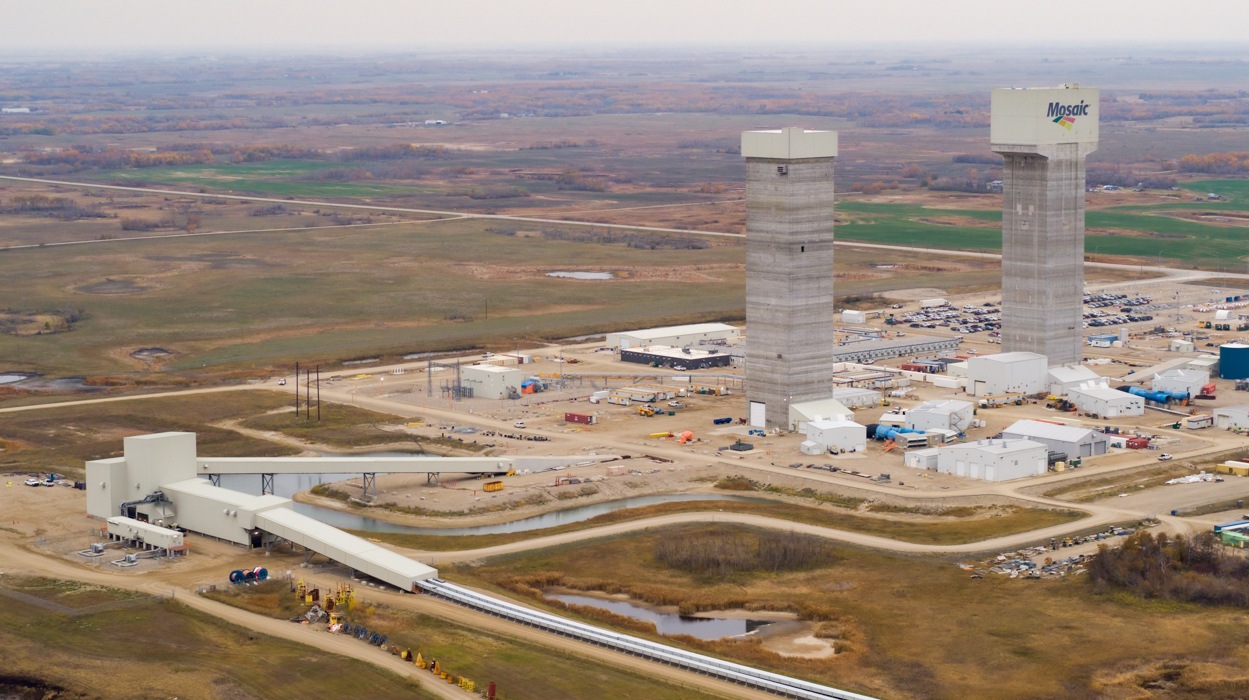
About $3 billion invested in the replacement project.
04A good product still needs affordable sulfur
Physical integration offers no immunity from economics. Mosaic reported $12.0524 billion in 2025 net sales and spent about $1.36 billion on capital projects that year. By the second quarter of 2026, sulfur availability and affordability were central problems. Sulfur is an input in phosphate fertilizer production. Owning phosphate rock does not eliminate the need to buy other ingredients.
The quarter produced $2.8 billion in revenue and a $273 million net loss. Mosaic reduced phosphate production and lowered its 2026 capital expenditure outlook to $1.2 billion. “We are focused on the things we can control,” chief executive Bruce Bodine said. The response was concrete: cut costs, conserve capital and keep the ability to restore production when conditions improve.
“We are focused on the things we can control.”Bruce Bodine / Q2 2026 results
05The bill after the bag
There is another cost a fertilizer price tag does not explain. In 2015, EPA and the Justice Department announced a settlement over alleged hazardous-waste handling violations at eight Mosaic Fertilizer facilities. It required a $630 million trust intended to grow to $1.8 billion for closure and care, plus $170 million in operational and waste-management improvements. The obligations extended well beyond selling another tonne.
That history belongs beside Mosaic’s environmental commitments. Land, wastewater and long-lived facilities remain responsibilities after a shipment leaves. The company’s stated mission, helping the world grow the food it needs, meets its harder accounting here: useful output and environmental obligations occupy the same industrial site.
06More value from what is already there
Mosaic is also looking beyond conventional mineral nutrition. It launched Mosaic Biosciences in 2023 to develop biological products that complement crop nutrients. In March 2026, it and Rainbow Rare Earths agreed to advance studies of recovering rare earths from phosphogypsum at Uberaba, Brazil. That is a development project subject to studies and approvals, rather than an operating rare-earth business.
The common thread is making existing resources more useful: combine nutrients differently, connect a new shaft to old mills, examine what remains after processing. Farmers can use Mosaic through their agricultural suppliers and evaluate its formulations against local needs. Anyone studying the company can borrow a sharper question: where, exactly, does a useful resource stop becoming useful? At Mosaic, the answer might be inside a granule. Or 3,350 feet down.