A fertilizer granule has a scheduling problem. Release its nutrients too quickly and the plant cannot use them all. Release them too slowly and the plant goes hungry. The chemistry matters, but so does the appointment. ICL Group sells a product built around that distinction: Osmocote, a coated fertilizer that meters nutrients over time. It is a useful introduction to a company whose business stretches from underground minerals to the small, stubborn problems of growing and making things.
- ICL turns potash, phosphates and bromine into agricultural, food and industrial products.
- Its specialty businesses sell application knowledge alongside ingredients.
- A discontinued battery expansion exposes the limits of moving into an adjacent market.
The granule that keeps its appointment
Inside Osmocote, water penetrates a coating and dissolves nutrients. Those nutrients then pass through the coating into the growing medium. Temperature influences the release rate. ICL offers different formulations and lifetimes because a nursery growing one crop through a short season has a different problem from a grower keeping another in a container for a year.
That gives the buyer something more specific to evaluate than a bag’s nutrient content. The question becomes whether the release pattern fits the crop, the growing medium and the temperature. A warmer environment accelerates release; a cooler one slows it. The printed longevity is conditional. A grower who ignores that condition can buy the correct nutrients and still get the timing wrong.
This is where ICL fits in the market: partly a supplier of essential raw materials, partly a specialist helping customers make those materials perform. Commercial nurseries, farmers, agricultural distributors and turf managers occupy one side of its customer base. Food formulators and industrial manufacturers occupy others. The common thread is chemistry put to a particular job.
The revenue model is straightforward: sell physical products to businesses, directly or through distribution, with technical support helping customers select and use them. Much of the expertise lives in agronomy, formulation and manufacturing. A useful product has to perform repeatedly in a greenhouse, food factory or industrial process, where an attractive demonstration is only the start of the purchasing decision.
Geography does some of the work
The company’s industrial roots precede its corporate birth. Dead Sea predecessors were producing potash and bromine in 1931; the State of Israel established ICL in 1968. Privatization began with a Tel Aviv listing in 1992. Its present portfolio reflects decades of consolidation and acquisitions, rather than a single founder’s invention.
Resources give that portfolio a physical foundation. Concentrated Dead Sea brine supplies bromine. Potash and phosphate operations supply agricultural nutrients. At Boulby, in Britain, ICL mines polyhalite and sells it as Polysulphate, a fertilizer containing sulfur, potassium, magnesium and calcium. The operation describes its production sequence with pleasing directness:
“Mine it, Crush it, Sell it”
ICL Boulby, on Polysulphate
For all the laboratory work elsewhere in the group, this product’s distinguishing feature begins with the deposit itself. An analyst can copy the spreadsheet; a competitor cannot order another Boulby from a catalog. Yet access to a mineral is only the beginning. Extraction, shipping, permits and a customer’s willingness to pay still determine whether the resource becomes an advantage.
The burger has a chemistry problem
Consider a plant-based burger. Its manufacturer needs a mixture that holds together during cooking and delivers an acceptable texture. That is an ingredient problem before it is a branding problem. ICL’s ROVITARIS portfolio addresses plant-based food formulation; JOHA and BEKAPLUS products address functions including texture and stability in other food applications.
In 2023, ICL and Plantible Foods introduced a ROVITARIS binding solution using Plantible’s Rubi Protein, extracted from lemna, the aquatic plant also known as duckweed. The collaboration illustrates a practical division of labor: combine a partner’s ingredient with formulation expertise and access to food manufacturers. The customer buys a system intended to work inside a recipe.
Industrial buyers have equally concrete requirements. ICL supplies flame-retardant chemistry for electronics, construction and transport, along with bromine-based water-treatment products. Here, too, performance has to survive the customer’s production process. Its competitors consequently change by application: Nutrien and Mosaic in potash, for example; Prayon and Innophos in specialty phosphates. There is no single rival across the whole portfolio.
A factory plan meets a different market
The temptation is to assume that another use for phosphate means another attractive business. In August 2023, ICL celebrated groundbreaking for a planned $400 million lithium iron phosphate battery-material plant in St. Louis, supported by an announced $197 million Department of Energy grant. Aleees was its technology partner. The proposed output was 30,000 metric tons annually.
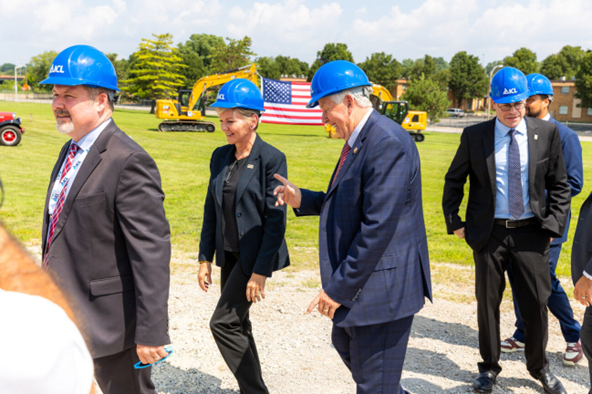
By its February 2026 results announcement, ICL disclosed that it had discontinued its LFP projects in St. Louis and Spain. Its filing attributed the change to a review of shifting market dynamics and government-policy changes. The disclosed explanation concerns the commercial setting; it does not establish a first technical failure.
Keep the accounting straight. The $400 million was an announced project budget. It is not a documented loss. ICL also disclosed approximately $122 million in strategy-related adjustments covering several activities, including the LFP exits. Assigning that entire sum to the battery project would turn a useful cautionary story into a misleading one.
Capital has its own price. In June 2026, ICL priced $800 million of senior unsecured notes due in 2036 at a 6.036% interest rate. Intended uses included refinancing, capital spending and acquisitions. This is the financing machinery behind an industrial portfolio: lenders and shareholders support assets whose useful lives can outlast the market assumptions that first justified them.
The customer gets a seat on the org chart
Meanwhile, ICL has been adding to food ingredients. In January 2026, it acquired 49.9% of Bartek Ingredients, together with preferred debt, for approximately $90 million. Bartek supplies malic and fumaric acids. The transaction includes arrangements for purchasing the remaining shares. This expansion sits close to customers ICL already serves.
In August 2026, management announced a structure planned for 2027: Nutrition Solutions, Industrial Products, Growing Solutions and Essential Minerals. The distinction makes its priorities visible: customer applications alongside upstream resources. Second-quarter sales reached $2.135 billion, but higher sales alone cannot prove the strategy. Growing Solutions reported rising sales and lower segment EBITDA in that quarter.
The lesson another business can borrow is a method: identify a capability, find a measurable customer problem, and test the economics of the proposed solution. It requires repeatable performance and customers willing to pay for it. Where demand, policy or costs move faster than a factory can respond, even familiar chemistry can lead into unfamiliar trouble.