In January 2003, Karsten Temme had a problem familiar to anyone who has started a business before looking old enough to run one. Customers saw a kid. Over the telephone, he could at least postpone that discovery. He was a University of Iowa graduate student, the founder of a wireless internet company, and already learning that a customer's timetable bears little resemblance to a university's.
His company, X-Wires Communications, had started the previous August. It served Coralville and rural communities around Iowa City, with a customer base of roughly two to three dozen. The scale was modest; the obligation was immediate. “You can't tell a customer ‘no’ because you have to go to class,” he said. It is a useful early portrait of Temme: an engineer discovering that a functioning invention still needs someone to answer the phone.
The idea followed a spring-break day shadowing wireless entrepreneur Jim Shelby. Temme and his student business partners won a business-plan competition and then an engineering startup award. Before a laboratory became his workplace, a customer's missing internet connection had given him a reason to build. Years later, his work would return to farmers and another awkward gap between a resource and the people who needed it.
The trumpet was part of the education
Temme came to Iowa from Casper, Wyoming. He studied engineering, played trumpet in the Hawkeye Marching Band and continued learning French. He also helped design parts for the Mars rover. A curriculum can be a map; his reads rather more like a crowded noticeboard. There were useful things to learn in several directions, and he appears to have taken the invitation seriously.
One undergraduate project applied artificial intelligence to predicting fluid flow. His interests crossed departmental lines long before he made a business out of crossing the boundary between engineering and biology. The trumpet is a particularly pleasing detail. A person can spend the week investigating how systems behave and still have to turn up, find his place and play in time with everyone else.
He earned bachelor's and master's degrees in biomedical engineering at Iowa, followed by doctoral training in the joint bioengineering program spanning Berkeley and the University of California, San Francisco. Those qualifications explain the technical preparation. The rural internet business helps explain the commercial direction: a new capability becomes interesting when somebody can actually use it. That distinction would matter a great deal once his raw material was alive.
A friendship, then a question about corn
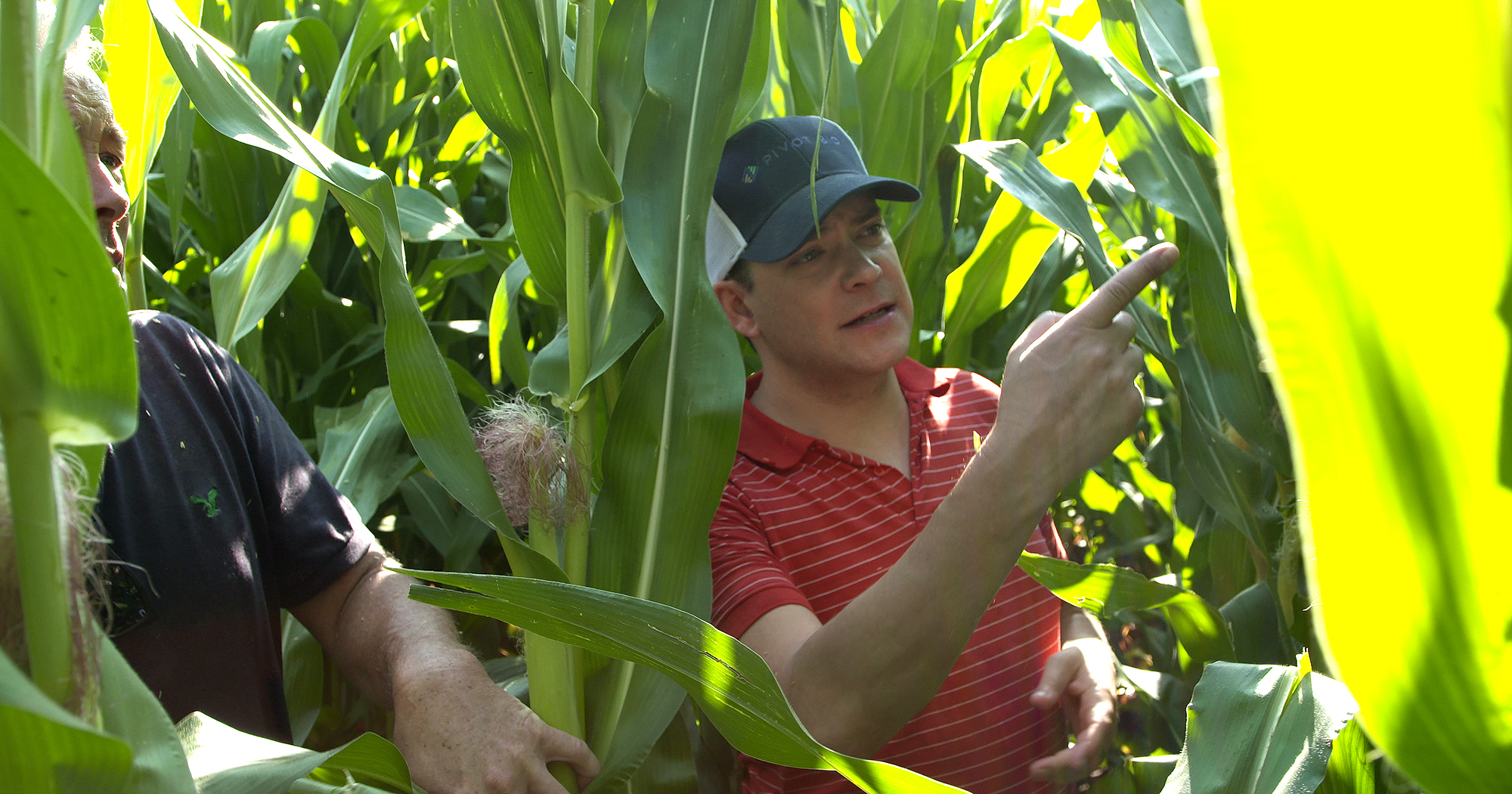
Temme and Alvin Tamsir became friends as graduate-school lab partners in the mid-2000s. Their partnership grew through long hours of experiments. By the time they were considering a company, the friendship had already survived a setting where a good idea does not oblige an experiment to cooperate. They founded Pivot Bio in 2011, with grant support and a question about how cereal crops might get their nitrogen.
“What if corn could fertilize itself?” was one of the questions Temme recalled on the company's tenth anniversary. It is the kind of sentence that fits easily on a slide and then occupies years of other people's lives. Their attention went below ground, toward the relationship between a plant and the microbes living around its roots. The business would depend on making that relationship do more useful work.
In Christopher Voigt's laboratory, Temme had studied nitrogen fixation through the tools of synthetic biology. The scientific question was whether an extensively studied biological system could be understood well enough to rebuild it. An engineering approach asks how the parts connect, what controls them and which behavior can be changed. Here the parts were genetic, the system microbial, and the eventual customer was trying to grow a crop.
The factory moves closer to dinner
Nitrogen is abundant in the air, but crops cannot simply take atmospheric nitrogen gas and turn it into growth. Certain microbes can convert it into forms plants can use. Pivot Bio's approach works with microbes associated with crop roots, changing their genetic regulation so they keep producing nitrogen even when fertilizer is present. The company places the nutrient-making activity close to the plant that needs the nutrient.
That geography is the central idea. Industrial fertilizer travels to a farm and has to remain available until roots can take it up. Rain and other conditions complicate that journey. A microbe living alongside the roots offers a different route. It receives carbon from the plant and supplies nitrogen in return. Think of it as shortening a delivery schedule by putting production near the customer, except the customer has leaves.
Temme's language often brings the science back to farm economics. In a 2019 essay, he described his surprise at learning that fertilizer spending could exceed a farm's expected profit or loss. A grower pays for an input, and losing some of it has consequences on the balance sheet as well as in the environment. That is a practical reason to care about where nitrogen is made, when it becomes available and how much reaches the crop.
The word “biological” can sound soft and reassuring. The work behind it is exacting: finding suitable organisms, understanding their behavior and making a product farmers can apply. Temme has spoken about identifying microbes that both fix nitrogen and have a strong relationship with a particular crop. The appealing simplicity of the idea sits on top of an inconvenient amount of biology. Corn has no obligation to appreciate an elegant diagram.
The second experiment happens on a farm
A laboratory result can establish possibility. A farm asks whether that possibility can survive planting schedules, different soils and an operating business. Pivot Bio's first commercial offering focused on corn, and the company spent its early years developing it. The step from an experiment to an agricultural input required a product that could fit into work already happening on the ground.
One answer was application at planting; another was putting microbes directly on seed. Temme described the seed approach in 2022 as a way to make the product more convenient. Ease of use matters in a season when a farmer has several jobs competing for the same suitable weather. A clever addition that demands another awkward operation must earn its place. A product that fits an existing operation has a more promising introduction.
By 2022, Pivot Bio reported use on more than three million acres. In 2023, that figure exceeded five million acres of corn, according to a later interview with Temme and CEO Chris Abbott. Acres are a useful measure here because the technology has to leave the bottle. A sale records a transaction. Acreage gives some sense of how far a laboratory proposition has travelled into ordinary agricultural work.
The company also needed research and customer support beyond its California base. Its 2023 impact report describes more than 400 university-led and on-farm trial locations, with more than 20 university collaborators. In February 2024, it opened a 36,000-square-foot customer success center in Ames, Iowa. Such infrastructure is less photogenic than an ingenious test tube. It is where questions about implementation get a place to land.
The founder changes chairs
On August 29, 2023, Pivot Bio announced that Chris Abbott would become CEO and Temme would move into the chief innovation officer role. Abbott had served on the board since 2018. The announcement paired the leadership change with reported fiscal-year revenue above $100 million and growth of more than 60 percent. These were company figures, and they described a business with a different set of demands from the one founded in 2011.
A founder's role can change as a company accumulates customers, facilities and commitments. In Temme's case, the change gave his title a more explicit connection to inventing what comes next. There is no need to invent a private drama around the handoff. The public record shows a scientist who had led the company through its early commercial years taking responsibility for its future ideas.
In a 2024 conversation, Temme described farmers asking how microbial nitrogen fitted with the rest of their fertility program. He also talked about working with other companies on the next constraints growers faced. Once a product enters a farm, it joins a collection of tools, practices and decisions. Its usefulness depends partly on how well it gets along with its neighbors. Apparently even a microbe needs to network.
“What if corn could fertilize itself?”Karsten Temme, reflecting on Pivot Bio's beginnings
An acre in 2050
Temme's current work includes what Pivot Bio calls the Future Acre, a look at what agriculture could be in 2050. His remit involves inventors, entrepreneurs and researchers across organizations. The long horizon suits a technology that must be developed, tested and adopted in growing seasons. A date on a distant calendar is easy to announce. Making something useful before that date arrives requires nearer, less glamorous decisions.
He has also become a public translator of the work. A TEDxBoston talk released in February 2025 used a leaking fuel tank to explain fertilizer loss. It is a serviceable analogy: people who have never managed a cornfield can still understand paying for something that disappears before doing its job. His TED Countdown appearance in Nairobi followed in June, with the talk reaching YouTube in March 2026.
The international stage expands the conversation, but his earlier comments about Iowa offer a practical check on it. He has said the customer operation in Ames puts the company close to growers, agricultural research and talent. He has also linked his first internet business to his understanding of the farmers Pivot Bio serves. The route back to Iowa is part of how he explains the business, rather than merely a pleasant alumni footnote.
There is a consistent question running through this career: how does something reach the place where it can do useful work? Early on, the thing was an internet connection. Later, it was nitrogen. Now it includes ideas moving between researchers, companies and farms. The destinations have changed, and so has the size of the enterprise. The customer still needs a working answer. Class can wait; the crop has a schedule.