In a converted facility in Natick, Massachusetts, bacteria are doing a job that has belonged to chemical plants since 1913. They pull nitrogen out of the air. They hold it. They hand it to a tomato plant's roots at the exact moment the plant needs it, and not a moment before. No smokestack. No 1,000-degree reactor. No river turning green downstream.
This is Kula Bio. The company sells what looks, at first, like an unremarkable jug of liquid. Inside is a single strain of supercharged microbe that behaves like a fertilizer factory you can pour through an irrigation line. Farmers have been waiting a long time for something this boring-looking to be this radical.
"Moving the factory to your field."
— Kula Bio's own description of the whole ideaA miracle that leaks
Synthetic nitrogen fertilizer fed the 20th century. The Haber-Bosch process took nitrogen from the air and made it usable, and crop yields exploded. It is, by most honest accounts, one of the most important inventions in human history. It is also a mess.
Making it burns enormous amounts of fossil fuel - a couple of percent of global energy goes into it. Spreading it is worse. Plants take up only a fraction of what gets applied; the rest washes into groundwater and rivers, feeds algae blooms, and off-gasses as nitrous oxide, a greenhouse gas far stronger than CO2. The fertilizer that built modern agriculture is also one of its largest pollution problems. Awkward, for a miracle.
The cheapest fertilizer factory is the one that builds itself in your soil.
— The bet Kula Bio is makingA leaf that wasn't a leaf
More than a decade ago, Harvard chemist Dan Nocera built something he called a "bionic leaf." It used electricity, water and CO2 to feed engineered microbes that produced fuel - an artificial version of photosynthesis. It was a beautiful piece of chemistry looking for a purpose.
The purpose turned out to be dirt. Working with Harvard synthetic biologist Pamela Silver and a small founding team, Nocera realized the same trick - feeding microbes a carbon-rich energy source so they work harder and longer - could be pointed at Xanthobacter autotrophicus, a nitrogen-fixing bacterium that has been quietly pulling nitrogen from the air for millennia. The science left the lab in 2018 and became a company. Bill Brady signed on as founding CEO to turn peer-reviewed papers into something a farmer in Iowa would actually buy.
Xanthobacter has fixed nitrogen for millennia. Kula Bio just gave it a battery and a job.
— How the technology works, more or lessMicrobes with a battery
Here is the clever part. Left alone, these microbes fix nitrogen for only hours before they run out of energy. Kula Bio's process converts part of each microbe's own mass into a bioplastic that acts like an internal battery. Charged up, the bacteria live and work for weeks. And because they release nitrogen only when the crop signals demand, there is essentially nothing left over to run off into a stream.
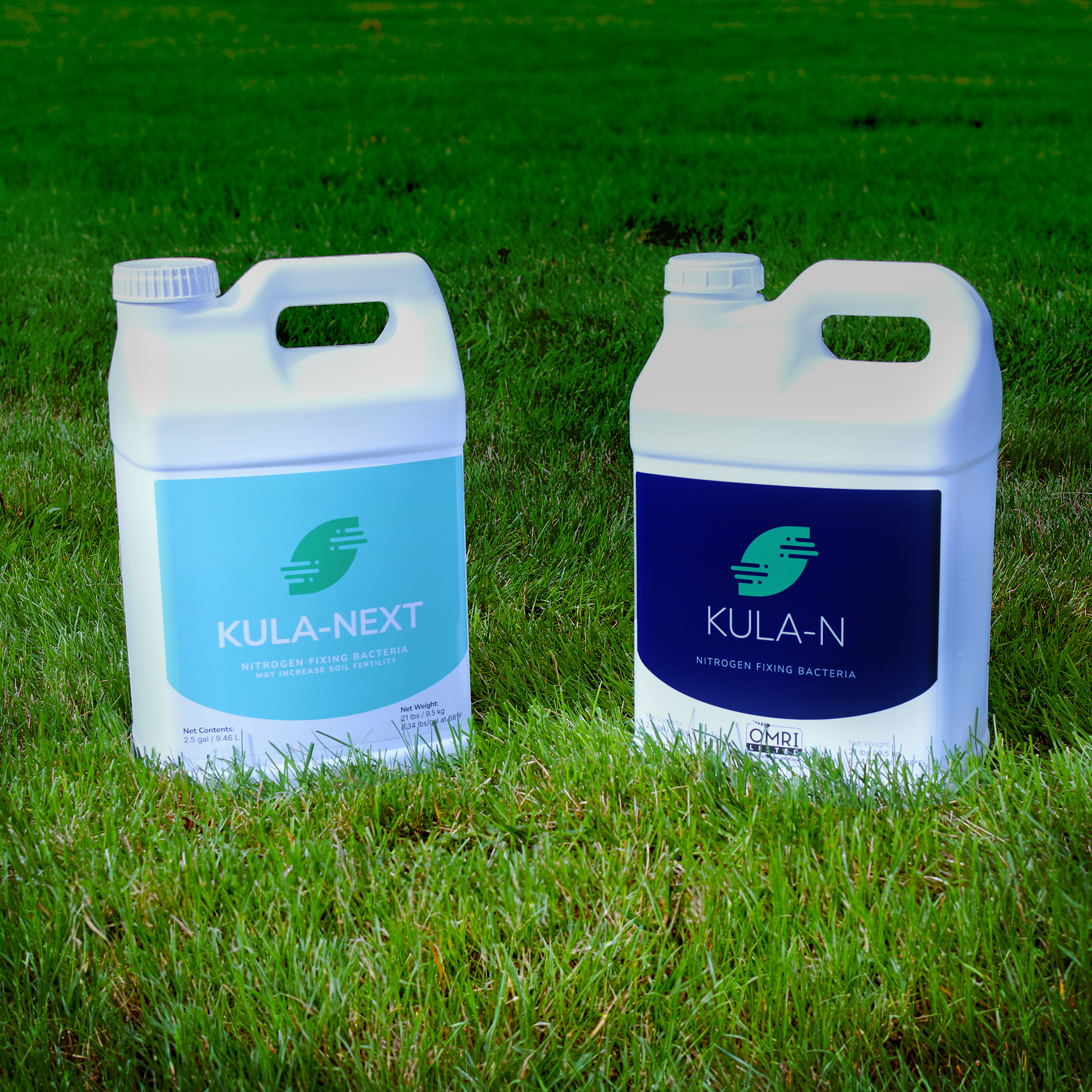
The product line is refreshingly plain-spoken. Kula-N is the flagship: a liquid, organically certified, not genetically edited, crop-agnostic nitrogen source applied through standard irrigation at the root zone. Kula-NSP is a shelf-stable powder for organic systems. Kula-Next and Kula-NextSP are tuned for conventional production. The math is easy to remember: every 2 to 8 ounces of product makes roughly one pound of nitrogen, right where the roots are.
Numbers a soil scientist double-checks twice and a marketer wishes were rounder.
The short, busy life of a long-shot idea
Kula Bio milestones, 2018-2025
What the fields said
A clever idea is worth nothing to a farmer until it survives a real growing season. Kula Bio ran third-party replicated field trials across different geographies, soil types and crops. The headline result: Kula-N can replace as much as 80% of a farm's nitrogen use. Not in a greenhouse. In the ground, under weather.
The trust shows up in the order book and the org chart. By late 2025, more than 25 farmers were buying product, and the company recruited Geraldo Mattioli - former president of Yara North America, one of the giants of conventional fertilizer - to run commercial. When someone from the incumbent industry crosses the aisle, it tends to mean something.
Following the money
Kula Bio disclosed funding by round
Total raised across rounds: roughly $66M+. Series A-1 amount per public reporting; not officially confirmed by the company.
Third-party trials. Real soil. Up to 80% of the nitrogen - replaced.
— The line that turns skeptics into customersBetter choices, fewer compromises
Kula Bio frames its mission plainly: reimagine traditional crop solutions so farmers get better choices. Not a guilt trip, not a downgrade. The pitch to a grower is that biology can do the chemical's job - reliably, at a competitive cost, without the runoff and without the carbon bill. Sustainability that doesn't ask the farmer to eat the loss.
The roots stay academic in the best way. Harvard's research underpins the patents; Dan Nocera still sits on the board. Greentown Labs, the cleantech incubator, hosted the early years. It is a company that talks like a science department and ships like a manufacturer.
"As global demand for regenerative agriculture solutions continues to surge, Kula Bio is positioned to lead the transition toward more sustainable and efficient farming practices."
— Harrison Yoon, CEOThe factory you never see
Nitrogen is non-negotiable. Crops need it, the planet needs more food, and the cheap way of making nitrogen is quietly expensive - in fuel burned and water fouled. The companies that win the next decade of agriculture will be the ones that keep the yield and drop the side effects. That is a narrow path, and most contenders fall off one side or the other.
Kula Bio's competition is real - Pivot Bio in microbial nitrogen, and the entire synthetic-fertilizer establishment from Yara to Nutrien to CF Industries. But the company is betting that the most durable fertilizer plant is one that never gets built at all, because it grows itself in the soil each season.
Five things worth knowing
- The company began as an artificial "bionic leaf" that made fuel from sunlight, water and CO2 before it ever made fertilizer.
- Each microbe carries an internal bioplastic "battery," which is why it lives for weeks instead of hours.
- The active ingredient is a single rugged strain of Xanthobacter autotrophicus that shrugs off swings in heat, cold, pH and salinity.
- Kula-N is organically certified and not genetically edited - rare for a high-tech nitrogen product.
- Founder Dan Nocera is a Harvard chemistry professor; he still sits on Kula Bio's board.
Back in Natick, the bacteria keep working. The jug on the shelf still looks unremarkable. But somewhere a tomato plant is getting exactly the nitrogen it asked for, exactly when it asked, and the river downstream stays clear.
The factory didn't get cleaner. It disappeared into the soil. That was always the point.
Find Kula Bio
Watch & read more: search "Kula Bio" for interviews and a product demo, the AgFunder Series A report, and the Climate Tech Distillery deep dive.