Twenty days after Edward Dowling became chief executive of Compass Minerals, the company announced it was terminating its lithium project. On January 18, 2024, he had taken charge of a minerals producer with ambitions in the North American battery market. By February 7, the lithium development team was being disbanded. For an incoming boss, it was a brisk introduction to the difference between an interesting resource and an investment worth making.
The chronology matters. Further investment had already been suspended in November 2023, before his appointment. Dowling did not arrive, discover a spreadsheet and single-handedly reverse the company. He had been a director since March 2022. The decision became one of the earliest public tests of how he would run a business he already knew from the boardroom.
He offered a fairly unromantic explanation. Regulatory risks had increased; the commercial landscape had changed. Together, those changes made the projected returns inadequate for the investment. Lithium could retain its possibilities underground. Above ground, Compass had a business to operate.
Three degrees, one persistent problem
Long before that decision, Dowling had spent years studying what happens between a mineral deposit and a useful product. A former U.S. Navy petty officer, he earned his mining engineering bachelor's degree at Penn State in 1982, followed by a master's in mineral processing in 1987 and a doctorate in the same field in 1998. The qualifications span sixteen years. His academic training reached well into his working life.
Those dates give his later corporate biography some texture. The executive who would oversee capital allocation had first trained in the technical discipline of recovering value from material. It is tempting to turn every educational choice into a prophecy. Here, the connection is more modest and more useful: he acquired a detailed vocabulary for the operations he would eventually be asked to improve.
In March 2000, a technical conference in Nashville listed him as a luncheon speaker on the gap between developing technology and putting it to commercial use. His subject included the awkward fate of processes that succeed in a laboratory and fail in practice. By then, his biography credited him with more than fifty articles emphasizing process engineering and operational improvement.
That old speaking engagement is an unusually good clue to the work that has occupied him. A promising process needs people who can build it, people who can use it and a business capable of supporting it. A conference lunch is a civilized place to discuss their disagreements. A mine makes the disagreements considerably more expensive.
Iron, diamonds, gold. Then salt.
Dowling's career moved across commodities whose public images could scarcely be more different. At Cleveland-Cliffs, he was executive vice president for operations from 1998 to 2004. At De Beers, he served as executive director for mining and exploration from 2004 to 2006. He then became president and chief executive of Meridian Gold, serving from 2006 to 2007.
Alacer Gold followed: president and chief executive from 2008 to 2012, then chairman from 2013 to 2020. The sequence includes both the work of running a company and the different responsibility of overseeing its management. His board experience also includes Teck Resources, Polyus and Copper Mountain Mining. He now chairs Wesdome Gold Mines as well as leading Compass.
The mineral names make a colorful résumé. The roles underneath them are less decorative. Operations, exploration, executive management and board oversight place different demands on the same industrial system. Dowling has worked in each. It helps explain why his appointment at Compass brought a mining and processing background to a company whose most familiar product is something a road crew spreads before bad weather.
Operations
Mining & exploration
President & CEO
President & CEO
President & CEO
A winter that refused to cooperate
The first months at Compass supplied a reminder that managers do not control their customers' weather. In May 2024, Dowling described the impact of one of the mildest winters in more than twenty-five years. A company selling highway deicing salt has a distinctly practical interest in winter behaving like winter. Unused inventory is an expensive souvenir of the forecast.
Compass announced changes to production and inventory, corporate cost reductions and the indefinite suspension of dividends. There were workforce reductions too. These were consequential decisions for employees and shareholders, whatever their logic on a cash-flow statement. The aim was to generate cash and reduce debt while adjusting output to the business actually arriving.
By the end of fiscal 2024, the company reported a net loss of $206.1 million, including significant non-cash impairments. Salt sales volumes had declined 18 percent. Yet annual adjusted EBITDA per ton in Salt improved 20 percent, to approximately $24.50. The two measures tell different parts of the same difficult year: less volume, better adjusted earnings per ton, and substantial damage still visible in the accounts.
Dowling called the change getting “back to basics.” The phrase can sound like an executive's comfortable retreat into familiar language. Here it attached to specific choices about inventory, operating rates, staffing and where money would go next. The test would be whether the remaining businesses could perform better with that attention.
The cost of changing your mind
There was another retreat. Compass announced in March 2025 that it was exiting Fortress, its fire-retardant business. When Dowling had first taken over, fire retardants still featured in the company's growth plans. Its later exit shows why this period resists a tidy story about a leader arriving with a perfect map. The route changed as the business confronted its options.
Fiscal 2025 also involved deliberately curtailing mine operating rates to release cash tied up in inventory. Total reported adjusted EBITDA fell 4 percent to $198.8 million. Compass separately explained that changes in acquisition-related contingent consideration affected the comparison. It is a useful reminder to read an industrial turnaround beyond a single headline number: inventory can release cash while reduced operating rates pressure current earnings.
The narrowing continued in 2026. Compass agreed to sell its sulfate-of-potash business in Wynyard, Saskatchewan, and the transaction closed on March 1. Its rationale was that the core Ogden operation could serve its North American business. The transaction brought $23.3 million in cash proceeds at closing, after specified deductions, and also produced an accounting loss. Selling an asset can simplify a company without making the accounting pretty.
“There is more work ahead in our mining operations”
Edward Dowling, August 2026
The border reaches the loading dock
Dowling's public conversations also show how quickly a mineral business becomes a logistics business. In a November 2025 interview with Mohit Jaju, he discussed tariffs and the complications they created around Compass's supply chains. Exemptions under the United States-Mexico-Canada Agreement helped its core products, but secondary effects still reached incoming supplies.
His discussion moved from policy to purchasing: a shift from single-source arrangements toward multiple suppliers, uncertainty delaying investment, and the uneven ability to pass costs through to customers. Higher-value industrial products and bulk municipal contracts do not offer the same room to change prices. A tariff debate conducted in percentages eventually arrives as a purchasing decision or a bid.
The aspiration he expressed was policy consistency, alongside constructive engagement between company leaders and policymakers. Known risks can be planned for; a moving set of assumptions complicates investment. It is an operational argument, concerned with what a company can order, promise and build. The minerals may be ancient. Their delivery schedules remain thoroughly modern.
Better numbers, unfinished work
By June 30, 2026, net debt was $660.3 million, down from $745.9 million a year earlier. The net leverage ratio fell from 4.3 times to 2.8 times. That ratio compares net debt with trailing twelve-month adjusted EBITDA, a non-GAAP earnings measure. It reflects both the debt burden and the earnings used to support it.
Less debt. More breathing room.
The quarter still carried a $5.7 million net loss. Plant Nutrition improved, while mining production costs were taking longer to improve than expected. Dowling acknowledged the additional maintenance and labor costs. The figures offer evidence of progress and a reason to keep asking questions. They do not support declaring the job finished.
In August, Compass promoted Brandon Risner to chief operating officer, putting mining, packaging and production facilities under his oversight. Dowling emphasized Risner's operating experience and ability to build teams. The appointment gives a practical expression to the company's priorities: a named executive responsible for the plants and mines where the next improvements must happen.
A career returns to the classroom
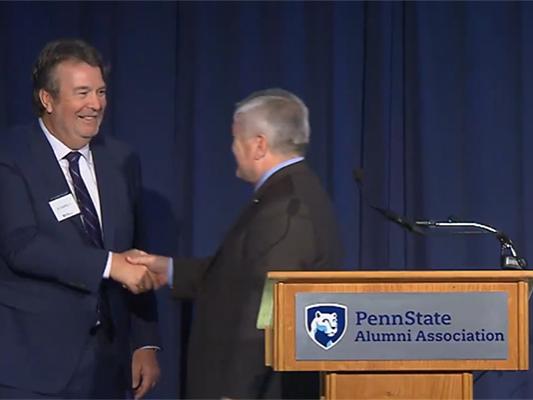
There is a quieter line through Dowling's career: his continued connection to the university where he studied. Penn State named him an Alumni Fellow in 2017. The award involves an invitation to return and share professional experience with students, faculty and administrators. He has also supported facilities in its College of Earth and Mineral Sciences and its Veterans Center.
Earlier recognition included the Robert H. Richards Award in 2004 and the Daniel C. Jackling Award in 2013. In 2026, the Mining and Minerals Education Foundation lists him as its American Mining Hall of Fame inductee. Those honors sit alongside a working agenda still occupied by maintenance bills, inventory and production costs.
The continuity is appealing. In 2000, his conference subject was the gap between a promising idea and a useful commercial application. At Compass, the same question has acquired larger numbers and a shareholder register. Which projects justify the money? Which operations deserve more attention? After a career spanning diamonds and gold, Dowling is spending his time on the decidedly earthbound business of making salt pay.
Continue the conversation
- Edward Dowling at Compass Minerals
- Edward Dowling on LinkedIn
- Penn State Alumni Fellow announcement
- American Mining Hall of Fame profile
- Listen: Dowling on tariffs and supply chains
- Compass Minerals fiscal Q3 2026 results
- The 2000 TMS conference program
- Wesdome board biography
- Compass Minerals website
- Compass Minerals on X
- Compass Minerals on Instagram
- Compass Minerals on Facebook
- Compass Minerals on LinkedIn