Precision has its own dialect. Architects speak in constraints, engineers in tolerances, consultants in deliverables. Artificial intelligence arrived with a noisier vocabulary: transformation, acceleration, disruption. Eileen Canady’s job is to keep those languages from talking past one another. As chief marketing officer of BST Global, she works in the practical middle, where an ambitious technology claim must eventually become a useful decision inside a project-based firm.
That middle ground suits her. Canady studied English at the University of Delaware, concentrating on business and technical writing, then earned an MBA in finance and marketing at the University of Tampa. The combination reads like two personalities sharing one desk: the attentive editor and the commercially minded operator. One asks whether a sentence is clear. The other asks whether the idea will travel, persuade and survive a budget meeting.
Her career has made a long argument for keeping both. Across more than 25 years in B2B marketing and sales leadership, she has moved through financial services, global customer experience and enterprise software. At JHS Capital Advisors, she worked in strategic development and marketing. At SYKES Enterprises, she became senior vice president of global marketing and helped overhaul the brand, tying awareness to retention and client acquisition. In 2018, that work brought her a Silver Stevie for Marketing Executive of the Year.
“I have learned that it’s important to set a goal and make a plan, and then work that plan.”Eileen M. Canady
A career built for translation
Canady joined BST Global in 2019 to lead global marketing and sales. The Tampa software company serves architecture, engineering and consulting firms, businesses that live by projects and therefore accumulate a peculiar abundance of data about time, resources, risk and margin. Marketing this sort of software requires more than polish. The buyer knows that a missed forecast can become a delayed project, an exhausted team or a wounded profit line. Adjectives wilt quickly under that scrutiny.
In June 2024, BST promoted Canady to chief marketing officer and added her to its executive management team. Her remit stretches across product marketing, research, competitive analysis, go-to-market planning, brand management, events, demand generation, public relations and the company’s digital presence. It is a list long enough to require its own project manager. The common thread is coordination: connecting what a product can do, what a market needs and what a person can understand.
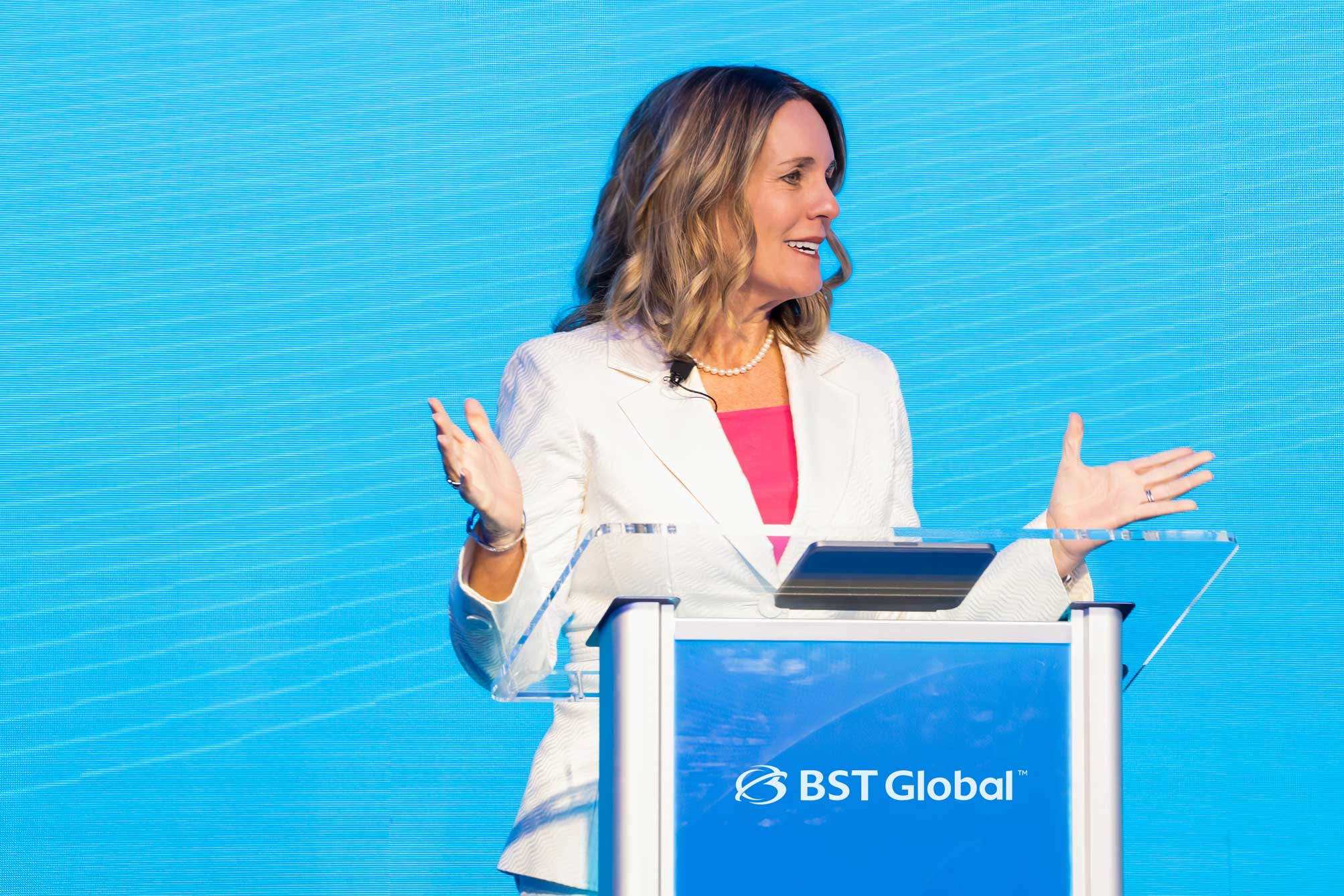
The promotion also put a public marker on work already underway. Two months before the announcement, BST had convened 15 senior technology leaders from architecture, engineering and environmental consultancies for its first AI Summit. Canady later carried lessons from that room to the American Council of Engineering Companies’ fall conference in New Orleans. Her session title, “The AI Imperative: A Trailblazer’s Perspective,” sounded urgent, but the premise was grounded: gather practitioners who are preparing for a data-driven future, listen to what they are actually doing, then return the insight to the wider industry. The pattern avoids a familiar trap in corporate thought leadership, where a company announces the answer before anyone has properly described the question. Canady’s version begins with the room. The event supplies experience; research supplies proportion; marketing supplies a form others can use. Each part disciplines the others.
Her own maxim is almost defiantly unmagical: set a goal, make a plan, work the plan. In earlier advice to marketers, she put discipline above the glittering abundance of channels and tools. A message needs consistency; a campaign needs measurement; a plan needs reassessment. The principle now fits AI as neatly as it once fit brand work. Novelty attracts a crowd. Discipline decides whether the crowd builds anything.
The Canady translation loop
find the signal
test the meaning
work the plan
make it usable
The distance between belief and readiness
The useful tension in Canady’s current work appears in a pair of numbers. In BST Global’s 2025 survey of the AEC industry, 80 percent of respondents said AI would reshape the industry. Only one in five felt ready. Enthusiasm, in other words, was four times more common than confidence. The finding turns a fashionable topic into an operating question. If leaders believe the change is coming, what keeps their firms from being prepared?
When Canady discussed the findings on the Engineering Influence podcast, the encouraging pattern was not a particular firm size or an extravagant technology budget. Progress followed leadership support and a strategic approach. Firms getting value aligned AI with business goals, saved time, reduced errors and won more work. That frames adoption as management before machinery. Data governance, workforce skills and client expectations belong in the same conversation as models and software.
Canady also serves as executive director of BST Global’s AI + Data Consortium, which brings industry participants into research about those questions. Her role is part convener, part translator. She helps move knowledge between survey tables, executive discussions, event stages and the people responsible for actual projects. The route matters because an industry does not change when a statistic appears. It changes when enough leaders can connect that statistic to Monday morning.
The microphone as an operating tool
The Trailblazers, BST Global’s podcast, gives that method a voice. Canady interviews technology and innovation leaders from firms including Arcadis, WSP, AtkinsRéalis, Stantec, Arup and GHD. The subjects can be technical: digital twins, data foundations, AI governance, new business models. Yet her guests repeatedly arrive at human questions. Who gets trained? Where does judgment sit? How do you move quickly without making trust disposable?
Hosting is a revealing form of leadership. The host has to prepare deeply, then resist showing all the preparation. She sets the conditions, asks the precise question and leaves room for an answer to become more interesting than the script. Canady’s public work has long favored this shared-author approach. She has advised B2B marketers to partner with clients on thought leadership and to give employees a platform for their own credible, concrete stories.
“With many tools at our disposal, discipline is the driver of results.”Canady on the soft skill behind effective marketing
There is a cheerful anecdote from her SYKES years that makes the theory tangible. For a summer community event, the company turned an office parking lot into a makeshift drive-in cinema. The soft glow of the building’s branding supplied the backdrop. Families got a movie night; the company expressed its workplace character without delivering a lecture about culture. Marketing, done well, gives people something worth remembering before asking them to remember the logo.
Canady brings personal curiosity to her interviews too. Sharing a conversation with Populous technology leader Jonathan Nelson, she called herself a “sports (and esports) mom,” a small disclosure that made immersive design and next-generation venues less abstract. It is an editor’s instinct: find the detail that gives a technical subject a pulse.
A public life of useful adjacency
Beyond BST, Canady sits close to the institutions where the next generation of operators forms its habits. She serves on the advisory council for the University of Tampa’s Sykes College of Business and the advisory board for the University of South Florida Muma College of Business digital marketing program. She has also participated in Tampa Bay philanthropy through the Crisis Center’s Women in Action.
The university work is more than a résumé ornament. Technical marketing changes too quickly for a wall between classroom and company to remain useful. Students encounter new tools before organizations decide how to govern them. Executives know which skills remain valuable when the tool changes. An advisory table lets those two forms of knowledge irritate each other productively.
Her own learning has continued in public. In late 2025 and early 2026, she added leadership and professional coaching credentials. The choice fits a career increasingly devoted to convening people through change. AI may accelerate technical work, but adoption still arrives through meetings, incentives, uncertainty and trust. Software can offer a forecast. A leader still has to help a team decide what to do with it.
What the rest of us can steal
Canady’s career offers a compact playbook for anyone who must explain complicated work. First, build range. Learn the language of the craft and the economics around it. Second, make research social. A number becomes more useful when practitioners can challenge it, interpret it and connect it to experience. Third, let customers and colleagues speak. Their specificity carries a kind of credibility no slogan can counterfeit.
Finally, choose discipline over frenzy. Set the goal. Make the plan. Measure what happens. Revise without pretending the first version was sacred. This sounds modest beside the grand declarations surrounding AI, which is precisely why it may survive them.
AEC firms design the places where people live, work, move and recover. The stakes reward precision and punish theater. Canady’s contribution is to make the technology conversation proportionate to that reality: ambitious enough to explore a new model, sober enough to ask about the data, and human enough to pass the microphone. In an era intoxicated by artificial intelligence, her method remains stubbornly intelligent.