Kriste Goad gives the beginning of her business an unusually economical explanation: “the only reason I started my own agency is I was fired.” It is a sentence with very little room for a founder to arrange flattering lighting. A job ended, and an experienced person had to work out what came next.
The former reporter might appreciate its efficiency. There is an event, a consequence and a person who has something at stake. The sentence also leaves the interesting part unfinished. Losing a job does not explain how to win a client, hire a colleague or keep an agency functioning after the relationships inside it change. Those developments require a longer story.
Goad now leads fuoco, the Nashville marketing and communications agency whose name means fire in Italian. Her title, Chief Fire Starter, allows a little theatricality into a profession with more than enough spreadsheets. Behind it is a career spent learning how people make decisions, followed by the less comfortable experience of making consequential decisions herself.
An exit becomes an entrance
Her independence followed an acquisition at the agency where she worked. A noncompete complicated the available routes. Returning to an in-house position or joining a generalist agency did not appeal. She chose consulting, initially doing the work herself with freelance collaborators. In March 2017, fuoco began as a consultancy. In her later account, 2019 marked the move into employing an agency team.
The distinction is useful. A business can have a name before it has the shape people eventually associate with that name. A consultant makes promises about her own time and ability. An agency owner makes promises involving other people’s time and ability too. Success changes the substance of the job while leaving the business card looking reassuringly familiar.
Even the name arrived by an indirect route. Goad recalled a dream involving an RV and a Firebird. A friend suggested exploring another language. Her mother’s side of the family is Italian; fuoco provided a word she liked and a connection she could recognize. The name acquired a flame, and the founder acquired a title. An RV dream had done rather respectable work for an agency naming brief.
A consultant makes promises about her own time. An agency owner makes promises involving other people’s time too.
The move into ownership
The byline before the business card
Before clients and campaigns, there was a different ambition. Goad studied journalism at Auburn University and wanted to win a Pulitzer. Her early work involved government and politics. She moved from reporting into speechwriting for Tennessee’s governor, then through corporate communications and agency roles. Each move put her in a different relationship with the story being told.
A reporter asks what happened. A speechwriter has to understand what a speaker can credibly say. A communications professional considers what an organization needs people to understand. The skills overlap, but the obligations change. Her career crossed those boundaries before she became responsible for an organization of her own.
One trace of the reporting years has survived in an unexpected place. Nashville’s account of its metropolitan seal cites a January 24, 1994, Nashville Banner article by Goad. The subject was the city’s image and a push to update its seal. Decades later, a piece of her newspaper work remains part of the city’s explanation of itself.
It is a pleasingly modest artifact for someone who went into branding. Long before brand workshops, she was reporting on an actual civic symbol. A seal must carry meaning in a small space. An article must explain why anyone should care. Both give their makers reason to investigate the gap between what an institution intends and what people see.
A 2014 conference biography identified her as ReviveHealth’s chief marketing officer and described her as a self-taught marketer. That phrase gives the transition some texture. She had formal training in journalism and a working education in another profession. The job supplied the classroom. The people listening, reading and buying supplied the examination.
- 01ReportingFind the story
- 02SpeechwritingUnderstand the voice
- 03Agency leadershipWin and deliver work
- 04fuocoBuild the business
A company has to hold together
The most consequential episode in Goad’s account of ownership involves a partnership. The working relationship was productive for its first two years. Later, the partners stopped seeing eye to eye. She ended the partnership and described complete employee turnover afterward. An agency’s continuity had suddenly become a practical question involving the people who would do its work.
Goad found perspective through EO Nashville, where other entrepreneurs could recognize the problem from experience. That recognition matters. A founder can spend a great deal of time wondering whether a difficult situation is unique, or whether admitting it will make the company look fragile. Hearing that other owners have faced similar decisions can make it possible to discuss the decision itself.
Her account of rebuilding emphasizes explicit values and honest conversations with the people who come next. Those are simple expressions for demanding activities. A value has to mean something when two people disagree. An honest conversation has to include the part someone would prefer to postpone. Rebuilding requires turning agreeable words into working expectations.
The company name survives a departure more easily than the daily arrangements underneath it. Who decides? Who follows through? What happens when the work changes? An owner has to settle such questions while the work continues. There is no award category for a Monday that functions again, although some Mondays deserve one.
The entrepreneur network later became a place for Goad to take on responsibility herself. EO Nashville lists her as communications chair on its 2026-2027 board. The connection has moved from finding other owners who understood a difficult moment to helping the organization communicate with its own community.
The numbers and the machinery
There are conventional markers of progress in fuoco’s story. In 2022, the agency received an honorable mention for PRWeek’s U.S. Boutique Agency of the Year award. It reached No. 2,975 on the 2023 Inc. 5000. In 2025, it won the Agency of the Year award from Swaay.Health. Each recognizes the agency, including the people working alongside its founder.
2022PRWeek boutique agency
honorable mention
2,975fuoco’s rank on the
2023 Inc. 5000
2025Swaay.Health
Agency of the Year
Recognition is easy to display. Operations are harder to photograph. The unglamorous counterpart appears in Goad’s description of investing in management support: an operating-system implementer, a fractional chief operating officer and specialists in the software used to organize projects, people and finances. The work of building had reached the joints and fittings.
That is a familiar predicament for a creative business. The quality that wins work does not automatically arrange the resources required to deliver it. A convincing idea still needs a schedule. A promising project still needs someone to notice when its scope changes. The founder’s taste cannot be in every room at once.
The ranking and the machinery belong together. One describes a period of growth. The other describes the continuing effort to make a company capable of handling its commitments. A business has to do both, and the less photogenic part often determines how pleasant the impressive part will be for everyone involved.
Still asking questions
Goad’s podcast, How It’s Done, keeps her in the interviewer’s seat. A conversation with agency founder Joe Zappa, for example, explored content strategy, measurement and specialization. The subject is work, but the format makes room to investigate how people actually do it. A founder can learn from another founder without pretending they have identical businesses.
Podcasting also preserves a habit from her first profession: let someone else explain. A good question gives the listener access to an experience they have not had. Follow-up questions can expose the assumptions hidden inside a confident answer. The title of her show is appropriately practical. It asks for the method, not merely the announcement.
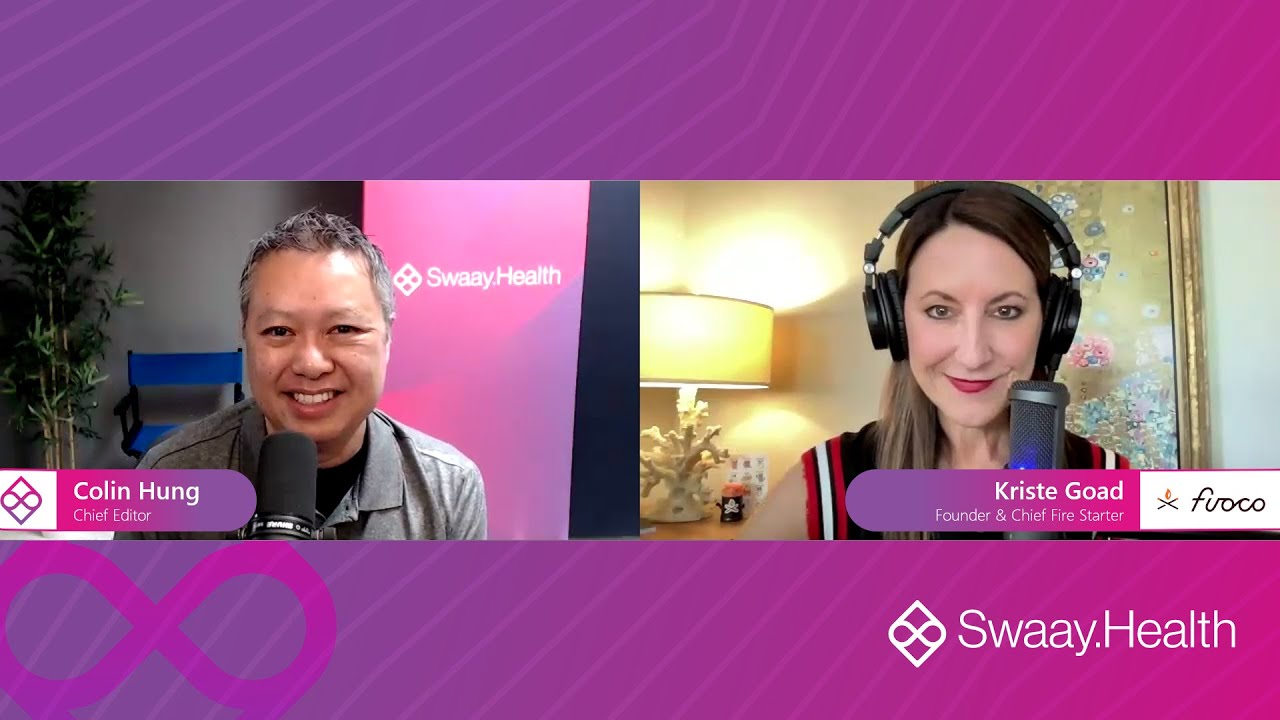
When she was asked in 2024 how she would direct a hypothetical marketing budget, she recommended a research study. An association, an industry voice or a publication could provide a useful partner. The resulting evidence could become the basis of a report and further work across several formats. The idea has a reporter’s fingerprints: find something worth knowing before deciding how to distribute it.
By 2026, she was discussing the coordination of trust, credibility and authority signals through fuoco’s Media Engine Optimization approach. The terminology is newer than the underlying challenge. An audience encounters an organization in several places. Those encounters need to support an intelligible account of who the organization is and why its claims deserve attention.
There is a human continuity underneath the changing tools. She keeps returning to questions about the audience, the evidence and the story. Software can make publishing quicker. It still leaves someone responsible for deciding whether the thing being published helps another person understand anything.
The Dolly rule
fuoco’s stated values include a reference that needs little explanation in Nashville: Be Like Dolly. The agency associates it with inclusion, kindness, sincerity and hard work. Its other values include curiosity and presence. The cultural reference gives an otherwise familiar workplace statement a face people can remember.
Goad’s own biography has room for pasta, craft beer and pop culture. In one short podcast episode about search, she began with a detour about redeeming coffee reward points for a venti mocha. The detail is small and useful. A person explaining a technical subject can also be a person pleased to have acquired an unnecessarily large coffee for free.
Community work also figures in the agency’s record. Its 2022 award announcement described support for a Nashville bike build with Can’d Aid, providing 75 bikes and helmets for first graders at Fall-Hamilton Elementary School. It also described opening the agency to a Social Justice Fellows program for teen girls. These are specific uses of an organization’s time and resources, alongside its client work.
The family connection returns here. Goad grew up around her father’s and uncles’ home-building businesses and later recognized herself as a builder. Her materials became colleagues, clients, relationships and ideas. Starting over meant assembling those materials again, with clearer questions about how they should fit. The fire in the name supplies the joke. The building supplies the work.