Eight returning interns were becoming full-time employees, and Ed Sparks wanted to welcome them. In July 2025, Grace’s chief executive shared the arrival of a new group entering its manufacturing and commercial leadership programs. Fourteen people were beginning three-year assignments. Eight had already spent time inside the company. For a CEO whose own chemical-industry career began with an internship, the occasion had a pleasing symmetry. The people at the start of the route were being greeted by someone who had taken a very long version of it.
Sparks joined W. R. Grace in April 2023 after a career running through Dow, DuPont and Chemours. His experience spans operations, research, technology, strategy and sales. Read those words quickly and they resemble the usual executive biography. Slow down, and they describe different working lives: making something, understanding it, planning its future and persuading someone to buy it. His route to the corner office passed through all of them.
The education after the degree
He studied chemical engineering at Tennessee Technological University, attending from 1990 to 1994. An internship at Dow gave him an early foothold in the industry. At DuPont, he began at the New Johnsonville titanium technologies manufacturing facility in Tennessee. The starting point matters. A manufacturing plant gives an engineer a particular introduction to business: whatever the plan says, the process still has to work.
Over roughly two decades at DuPont, his responsibilities widened across operations, technology, strategy and commercial work. The sequence makes for a less tidy origin story than the entrepreneur’s single flash of inspiration. There is no garage to photograph. There are, instead, different departments and the accumulated difficulty of understanding what each needs from the others. A laboratory result, a production schedule and a customer order may describe the same product while speaking almost different languages.
His qualifications also reached beyond the engineering degree. He trained as a Six Sigma Black Belt and earned supply-chain certification through APICS. In 2021, he completed Wharton Executive Education’s Advanced Management Program. These are useful particulars in a career otherwise easy to flatten into a succession of titles. Process improvement, supply chains and general management each address a different part of the same practical question: how does a good idea survive the trip through an actual company?
- 1990-94Chemical engineering
Tennessee Tech - 2015Chemours
Singapore assignment - 2018President
Chemical Solutions - 2021President
Titanium Technologies - 2023Chief executive
W. R. Grace
Selected milestones, rather than every change of title.
A new company, a different vantage point
When Chemours separated from DuPont in 2015, Sparks joined the new company as a regional business director in Singapore. He had responsibilities in both the North American and Asia-Pacific titanium technologies businesses during his career. Singapore added a geographic dimension to a professional life that already crossed functions. The same chemistry now sat inside a different regional business environment.
He subsequently established Chemours’ corporate strategy function. In 2018, he became president of Chemical Solutions, then went on to lead Fluoroproducts and Chemical Solutions. By March 2021, his responsibilities included Titanium Technologies. It was a return to the business in which he had started at DuPont, now seen from the president’s office.
Chemours credited him with a turnaround in Chemical Solutions involving changes to costs, the portfolio and pricing. It also described improvements to plant operations and the organization during his Fluoroproducts tenure. The assignment pattern is revealing: Sparks was repeatedly entrusted with businesses requiring operational and commercial decisions together.
There is an appealing lack of glamour in that combination. Pricing cannot repair every production problem. A better process cannot settle every argument about what customers value. Moving between those questions is a substantial part of running an industrial business. Sparks’s career suggests that breadth was part of his preparation for the CEO role, rather than a decorative addition once he arrived.
The paint has to cover the wall
At Chemours, titanium dioxide put him in a business tied to coatings and other everyday materials. In December 2022, while he was president of Titanium Technologies and Chemical Solutions, the company introduced its Ti-Pure Sustainability product series. Its first two grades addressed matters including material consumption, dispersion, durability and energy use. The announcement gave a technical shape to an otherwise rather elastic corporate word: sustainability.
“Our customers are hungry for sustainable solutions,” Sparks said at the launch. The practical proposition was that a pigment could help a customer use fewer resources or make a product last longer. Chemours also offered an environmental-footprint calculator for one grade. These were product claims and intended benefits, rather than proof that every customer had already achieved a particular result.
That distinction makes the episode useful. Sustainability becomes easier to examine when it reaches the formulation desk. How much material is needed? How long will the coating last? What energy does processing require? The questions have consequences for both performance and cost. A tin of paint is unlikely to thank an executive for his ambition. It is expected to cover the wall.
“Our customers are hungry for sustainable solutions.”
Ed Sparks, at Chemours, December 2022
April 2023: a new seat at Grace
Sparks left Chemours at the end of March 2023. The following month, Standard Industries named him CEO of Grace, succeeding Bob Patel. Patel moved into the newly created role of president of Standard Industries, Grace’s parent company. Standard had acquired Grace in 2021. Sparks was entering an established business whose ownership and leadership were already changing.
The appointment put him at the intersection of technical products, industrial customers and a larger private industrial group. Grace makes catalysts and specialty materials used across manufacturing. Its commercial work asks a leader to understand both the chemistry being sold and the process in which a customer will use it. Sparks brought experience on several sides of that relationship.
At his appointment, he spoke about products, technologies and services for global customers. His present remit at Grace likewise emphasizes working alongside customers on difficult problems and improving efficiency and performance. That is a fairly exacting promise. It asks the supplier to understand what happens beyond the point of sale, inside someone else’s operation.
In September 2024, Sparks and fellow Grace executives visited Standard’s New York offices for meetings and a lunch-and-learn session. CFO Michael Brown, operations leader Mark Cluff, Materials Technologies president Brenda Kelly and general counsel Anthony Yoo joined the discussion, moderated by Katie Zutter Butterfield. The gathering offers a small, concrete view of his working connections: finance, manufacturing, materials and law all in the same conversation.
Eight familiar faces at the beginning
The new hires Sparks welcomed in 2025 were heading to Lake Charles, Louisiana, Curtis Bay, Maryland, and Grace’s Columbia headquarters. The group included entrants to the inaugural Commercial Leadership Program alongside the Manufacturing Leadership Program. Operations and commercial work were again appearing side by side, this time as routes into the company.
“We are thrilled to have eight of our interns joining us full time!” he wrote. It is an ordinary sentence with an unusually good connection to his own beginning. An internship had been his first step into the chemical industry. Decades later, he was publicly marking the same transition for younger colleagues.
The emphasis on people has also appeared in his public work during 2026. In May, the Delaware Valley section of the American Institute of Chemical Engineers listed him as speaker for its 28th annual CEO dinner at Philadelphia’s Union League. In September, CHEMTREC featured him in its Nashville summit program with a keynote about workplace culture and an evolving risk landscape.
The connection between those appearances and his career is an editorial reading, but a reasonable one: an engineer who became a general manager is now addressing audiences about the organizations around the technical work. Equipment, expertise and procedures all depend on people applying them. The subject fits a career spent crossing the boundaries between disciplines.
The work outside the org chart
Sparks’s community involvement predates Grace. From 2011 to 2014, he served on the board and executive committee of the United Way of Southern Chester County and led a fundraising campaign that raised $1.2 million. He also developed and delivered training for participating agencies. Fundraising supplied resources; training addressed what organizations could do with them.
In 2025, he marked the Maryland Science Center’s fiftieth anniversary with a message supporting its science education work. Grace’s connection with the center stretched back more than 45 years. Sparks described the partnership in terms of encouraging future scientists, innovators and leaders. The setting was local, but the question connects to the industry’s future: where will the next generation encounter science closely enough to imagine working in it? His own path began with an engineering degree and an internship. These were earlier opportunities to kindle that interest.
He now serves on the boards of the American Chemistry Council and SCI Americas. His previous board roles include the National Association of Manufacturers and the American Coatings Association. Those connections reflect the same industrial territory as his operating career, extending his work beyond the boundaries of one employer.
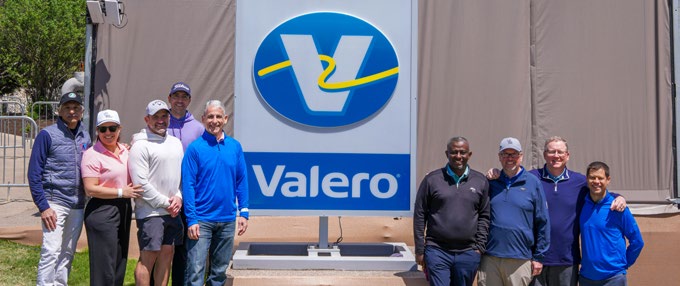
At the 2025 Valero Texas Open, Grace’s leadership team appeared together in a photograph accompanying a discussion of its long relationship with Valero’s charitable work. Sparks connected that relationship to a shared commitment to local communities. It was another setting in which the business relationship reached beyond the product itself.
The outline of his career is easy to state: engineering, industry leadership, chief executive. The interesting part is the distance between those labels. There was a plant in Tennessee, an assignment in Singapore, different business presidencies and, eventually, Columbia. Then there were eight former interns arriving for their first full-time roles. They were at the beginning of a route whose next turns would be their own.