At number 67, Durell Coleman began to run out of himself. A Stanford professor had asked him to list 100 problems he might want to solve. The early entries concerned the inconveniences of his own life. With a third of the assignment still to go, the territory widened: poverty, opportunity, the environment. The homework had an unexpectedly demanding feature. It required him to keep thinking after he had exhausted the obvious customer: Durell Coleman.
The exercise stayed with him. Today, Coleman runs DC Design, a consultancy working with nonprofits, foundations and governments on problems that include homelessness, economic inequality and mass incarceration. Based in Austin, he has taken an engineer’s training into institutions whose difficulties rarely yield to a better piece of machinery. A college’s enrollment process, a foster parent’s licensing experience, an organization’s strategic plan: these, too, can be designed.
There is a tempting version of this career in which the young inventor simply graduates to larger ambitions. Coleman’s actual route has more interesting furniture: a failed wind turbine, a laser cutter, illuminated wall maps and classrooms where the instructor has already appeared in the evening’s documentary. The expensive lesson running through it is about attention. An idea can survive a great deal of technical work while losing contact with the people who gave it a reason to exist.
A turbine without its conversation
Coleman grew up in Texas with an interest in invention. The early portrait preserved by Extreme by Design is appealingly specific: a former Stanford track captain who rode a skateboard to class. Mechanical engineering supplied one set of tools; a master’s in sustainable design, completed in 2011, broadened the questions he could ask with them. The ambitions were international, and the problems were tangible.
In Nicaragua, he spent two months talking with subsistence farmers while developing a small wind turbine intended to expand access to electricity. Those conversations complicated the tidy descriptions of poverty that travel so easily in reports. The people behind a daily income figure had particular routines, constraints and priorities. A useful renewable energy product would have to fit those lives.
Back at Stanford, he continued the project. Eventually, after four years of effort, he concluded that it had failed. His explanation is unusually uncomfortable for an engineer: he had stopped talking to the people he hoped to serve. The initial research had not granted him permanent understanding. Distance had accumulated between the design and its intended users.
“my design had failed but I had learned a lot”
Durell Coleman, reflecting on the turbine project
The admission matters because it gives his later insistence on participation a cost. He had already tried the alternative. There was effort, training and an admirable intention behind the turbine. None could substitute indefinitely for a conversation. His subsequent work kept returning to the place where the project had gone wrong: the gap between a designer’s confidence and somebody else’s experience.
The world, cut into acrylic
His next move was smaller, closer to home and rather easier to hang on a wall. Coleman made maps and lamps, and took on local design projects. The business then known as Designs by Dash offered a series of illuminated world maps. Travel had helped inspire them; engineering helped turn them into objects people could buy.
For the Dream Series, he drew landmasses in Adobe Illustrator and used a CNC laser to cut acrylic glass. He assembled the separate pieces by hand on backlit panels. The result sat in an agreeable borderland between manufacturing and craft. A machine could make the cuts; somebody still had to put the world together.
The 2013 Kickstarter campaign gives this chapter unusually concrete dimensions. Seventy-five backers pledged $13,740 against a $10,000 goal. The campaign ran from April 30 to May 30. Coleman used crowdfunding to acquire an industrial laser cutter and develop a contract design and prototyping business. He hired his first employee that year.
The maps make a useful interruption in the usual founder biography. They put an actual object between the aspiration and the consultancy. Coleman had to translate an idea into a repeatable process, ask people to pay for it and deliver something more substantial than enthusiasm. The scale was manageable enough to learn from. The laser cutter was equipment, but it was also a way back into making things after a long disappointment.
The instructor in the evening’s film
Teaching became part of his work in 2014. His audiences have ranged from corporate executives to school leaders and refugees working on challenges in their own communities. He has worked with executives from Sony, Oracle and Santander. The settings vary; the underlying interest in how people frame a problem persists.
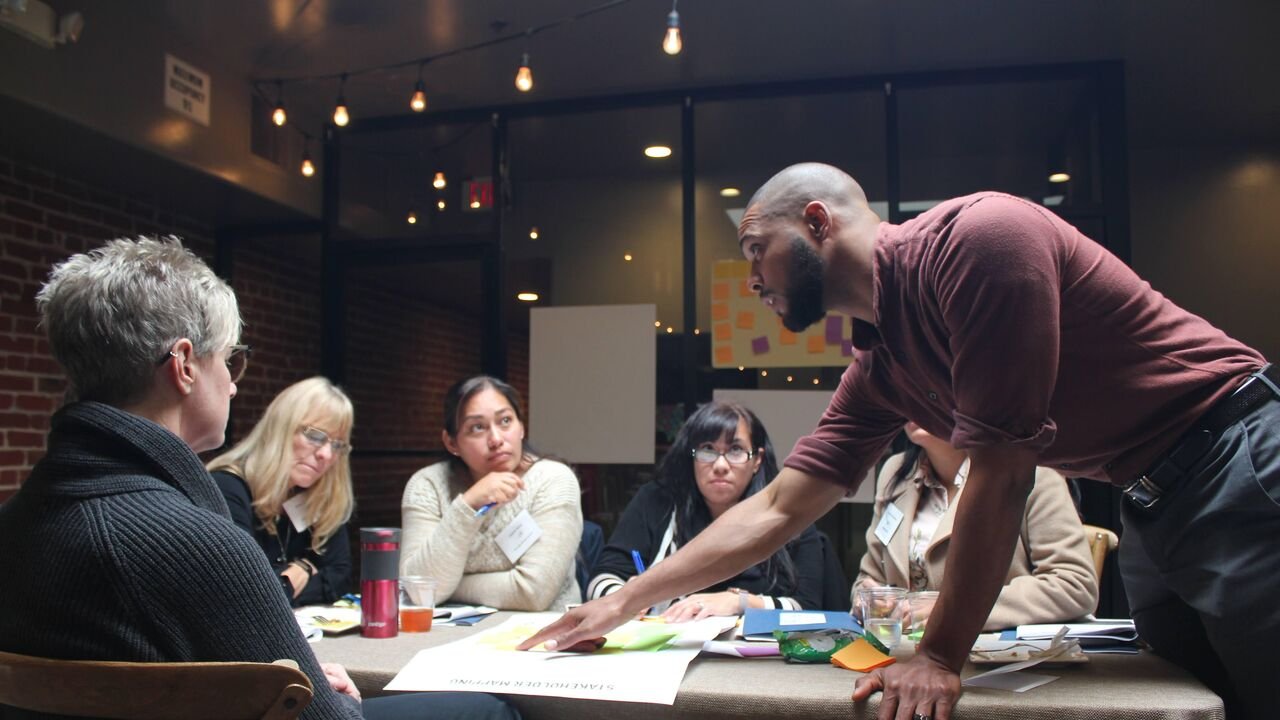
A week at Stanford in 2016 offers a closer view of the teaching. Coleman and Ariel Raz helped facilitate an experience for Mount Vernon’s Innovation Diploma group, comprising 22 students and four facilitators. The question concerned friendship and community among Stanford undergraduates. Participants went out to observe and interview people, then returned to interpret what they had learned and test their ideas.
For a class about making connections, the assignment had a useful inconvenience: other people were involved. Their reactions could disturb an elegant theory. Prototypes became ways to ask better questions, with the group moving between understanding and making rather than waiting to finish all the thinking before touching the materials.
One evening, the visitors watched Extreme by Design, the documentary featuring Coleman as a student. That is an unusual teaching aid: an earlier version of the person helping you, caught in the unfinished business of learning. It gives the instructor less room to pretend the method produces instant certainty. Students could see that the work had a history, including the awkward middle.
Stanford’s account of his subsequent teaching includes Multistakeholder Design for Social Impact and Design for Inclusion. Those course names describe a change in emphasis from the solitary inventor of childhood: more people, more perspectives, and a larger obligation to understand what happens when a proposal leaves the classroom.
When the brief becomes a workbook
At Mission College, DC Design was asked to help increase enrollment and retention among Black, Latino and Filipino men in Career and Technical Education programs. Some students had left classes or college; some described feeling unwelcome or discriminated against. The assignment called for understanding people with different relationships to the institution, including those who had never enrolled.
The team engaged 66 men in the Bay Area community and 19 college stakeholders. Its eventual deliverable was an interactive visual workbook, replacing the original strategic plan concept. It invited staff and other stakeholders to work through student experiences and examine existing systems. The change in format followed the research.
The distinction between a plan and a workbook is small enough to sound like a publishing decision. In this case, it expressed a judgment about how people inside the college might use the findings. A document asking its reader to participate makes a different demand from one that merely presents recommendations. The form of the answer became part of the answer.
The college used the work in discussions, employee onboarding and educational planning. Those uses give the project a practical afterlife beyond delivery day. They also show why Coleman’s engineering background can remain relevant without a turbine in sight. The thing being shaped is the passage from somebody’s experience to somebody else’s decision.
A system has people in it
Foster care provides another setting for that work. Coleman coauthored a 2021 paper with Johanna K. P. Greeson, John Gyourko, Andrew J. Ortiz and Sixto Cancel examining design thinking in Rhode Island’s foster parent recruitment and licensing processes. The project connected his practice to a specific administrative difficulty: attracting and supporting enough resource families.
The paper describes a state where licensed non-relative foster home capacity fell 12 percent between 2012 and 2017, while the number of children in foster care rose 7 percent. It used a descriptive case study and interviews with three people involved in the redesign. The researchers found promise in addressing the difficult points experienced by the people moving through the system.
That is a narrower, more useful proposition than a claim that a workshop can fix foster care. Recruitment and licensing involve sequences of encounters, requirements and decisions. Looking carefully at those sequences creates something concrete to investigate. It also makes collaboration unavoidable: Coleman’s name appears among a group of authors, just as the practical work crosses professional and institutional boundaries.
The list is still open
By 2015, Coleman and his team had chosen to concentrate DC Design on social impact. Its present services include community research, strategy, program design, implementation and evaluation. The firm’s stated mission is to eliminate multigenerational poverty and support Black, brown and low-income communities. That ambition gives the work a direction; individual projects supply the harder questions about how to proceed.
In 2026, the Aspen Ideas Festival named Coleman among its fellows. Stanford’s d.school published an alumni feature on July 14, returning to the assignment with 100 problems. Years after he first encountered it, the exercise still offers a compact description of his career: keep going past the concerns that arrive most readily.
The skateboard, the maps and the turbine belong to the same life as the strategic workshops. They keep the story grounded in a person who likes making things and has had to reconsider what making requires. Number 67 opened a larger field of questions. The people inside those questions keep changing the assignment.