John Long had a problem for anyone hoping to sell him money: he did not need any. His company, Avionté, was growing, its customers were staying, and he wanted to preserve the attention those customers received. An investor would have to offer something useful beyond a bank transfer. Kevin Frick, co-founder of Serent Capital, was on the other side of that proposition.
When Avionté announced Serent's investment in 2014, Long explained that he was looking for help growing the business while improving customer service. The numbers made his negotiating position understandable. In 2013, revenue had risen more than 36 percent, and customer retention exceeded 99 percent. This was a founder choosing a partner from a position of strength. The check needed a reason to be invited.
That situation gets close to the organizing idea of Frick's career. A business can already work and still need help becoming a larger version of itself. The hard part is establishing what help means, who will provide it, and whether the founder will still recognize the company afterward.
A buyer for something money cannot buy
Years later, Long recalled asking a prospective Serent partner how much the promised operating assistance would cost. He had encountered proposals in which outside help came with additional charges. Hearing that Serent's resources were part of the arrangement helped persuade him. His account gives an unusually practical definition of partnership: when the person with the capital offers help, inspect the invoice.
Long also described Frick's recurring preoccupation as chairman: delighting the customer. The emphasis extended into questions about the product, integrations, and what a staffing firm could accomplish through its software. This is a useful way to understand Frick's influence without confusing an investor with the people writing the code. He could press the question that the product team and management would have to answer.
“Kevin Frick, our chairman, his big thing is to delight the customer.”
John Long, Avionté founder
For a company that handles the working details of recruiting and staffing, the customer question reaches well beyond a pleasant sales meeting. Avionté's software spans front-office and back-office functions. Its usefulness depends on connections among tasks. An improvement that makes those connections easier can matter more than a feature that looks handsome in a demonstration.
The engineer who stayed for the operating questions
Frick's education began with electrical engineering at the University of Michigan, where he graduated summa cum laude. He later earned an MBA at Stanford's Graduate School of Business and was an Arjay Miller Scholar. The combination offers two different vocabularies for examining a business: how its parts work, and how its resources are allocated.
Before founding Serent, he became a partner at McKinsey & Company and led its West Coast private equity practice. His work there involved advising companies and their management teams. The assignment required entering an existing organization, understanding its constraints, and deciding which changes could improve the result. A consultant gets plenty of practice asking questions in someone else's conference room.
There is an early paper trail of his interest in technology deals. A spring 2004 issue of McKinsey on Finance identifies him as an associate principal in Silicon Valley alongside co-authors Bertil Chappuis and Paul Roche. Their discussion anticipated more technology consolidation, greater private equity involvement, and acquisitions that would require boards to think beyond the familiar friendly stock transaction.
That earlier work gives his later investment career a useful continuity. Technology companies change through products, ownership, and combinations with other businesses. Each route creates decisions about what to keep and what to integrate. Frick had been examining those decisions before Serent became the organization through which he would help make them.
Starting with founders who had already started
Frick and David Kennedy founded Serent in 2008. Fifteen years later, Frick described their original purpose as helping bootstrapped companies scale through practical operating involvement. In that anniversary reflection, he named partners Lance Fenton, Prital Kadakia, and Stewart Lynn, and described a firm spanning San Francisco and Austin. The founding idea had acquired colleagues and office space.
The choice of bootstrapped founders matters. These are people who have already had to make customers pay for something useful. Bringing in an investor introduces another relationship into a company whose habits were formed without one. Frick's stated approach asks those founders to believe that accepting support can help them extend what they have built.
The early fund was reported at $250 million in 2008. Its timing makes an arresting calendar entry, but the more revealing detail is the persistence of the original audience. Frick's 2023 anniversary message still put bootstrapped founders at the center. Staying recognizable over fifteen years is its own management problem, especially for a firm that advises other people about growth.
A construction job, conducted in software
CoConstruct offered another version of the founder's decision. Donny Wyatt had bootstrapped the construction software business for nearly thirteen years when it took investment from Serent in 2018. The plans were specific: more product development, broader sales and marketing, organizational development, and executive recruitment. Growth had a shopping list.
Wyatt's business served homebuilders and remodelers, people coordinating projects, clients, crews, and finances. Frick welcomed the opportunity to work with Wyatt and his team. The appeal of this sort of company is easy to grasp from the task itself. A building project contains many opportunities for an expensive misunderstanding. Software earns its place by helping people avoid them.
In February 2021, Buildertrend announced its acquisition of CoConstruct, backed by a growth investment from Bain Capital Tech Opportunities and HGGC. Serent reinvested in the combined business. The announcement put the combined network at more than 23,000 clients and more than $100 million in annual recurring revenue. Those are transaction-era figures, a snapshot of the scale the companies had reached.
Frick spoke about CoConstruct's understanding of the residential construction project lifecycle and looked ahead to supporting Buildertrend. The sequence shows how his work can follow a business through different ownership arrangements. A founder's knowledge of an industry becomes part of a larger organization; the investor's next task is helping that combination work.
The conference has a dress code, eventually
Frick also seems to enjoy getting the people in these businesses into the same room. After Serent's 2022 CEO and Director Summit in Austin, he wrote about discussing exit management with operating executive director Brendan Reidy. Amy Brandt and Will Clemens contributed ideas about customer-centered culture. Outside the conference, attendees headed into the Hill Country, where custom-fitted cowboy hats featured in the proceedings.
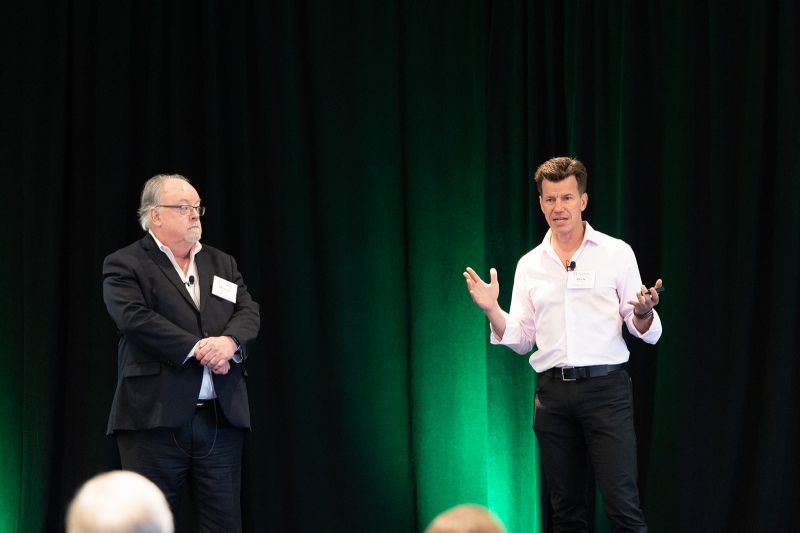
The mix is revealing: a discussion about selling companies, a discussion about knowing customers, and then a hat fitting. Professional gatherings promise an exchange of ideas. The useful ones also make it easier to call another executive afterward. Frick's enthusiasm for convening people appears in both his summit account and his description of what he enjoys outside the formal investment process.
His public biography offers a smaller gathering, too. He likes early mornings, catching up on email, and coffee with his wife and daughters. The daughters, he adds, are drinking milk. It is a cheerful correction to the usual executive portrait, in which every waking minute somehow advances a corporate objective. Sometimes the coffee meeting is a family meeting.
Who gets the credit?
As Serent has grown, Frick has publicly pointed toward other people. In March 2024, he announced John Caselli and Dexter Hopen's election as partners on behalf of his fellow partners. Both had spent more than a decade at the firm. Their advancement gave his language about building with people an internal example: a partnership can develop its own next generation.
His response to Serent's 2024 founder-friendly recognition followed the same pattern. He directed the credit toward the founders the firm supported and their determination to turn ideas into companies. Awards language often wanders toward self-congratulation. Frick's version returns to the people whose businesses make an investment firm's claims testable.
In a post reflecting on 2025, he made the division of labor unusually explicit: Serent itself does not build or sell the products; the people in its companies create the value. He put trust at the center of those relationships while acknowledging that it is difficult to measure. For an investor surrounded by measurable things, that is a consequential admission. The relationship still has to work when the spreadsheet is closed.
A larger fund, the same customer question
In July 2026, Serent announced the close of its sixth fund at $1.3 billion, bringing cumulative capital commitments above $5 billion. The firm described a Growth Team of more than twenty-five professionals and an expanding effort to help portfolio companies apply artificial intelligence. Frick characterized AI as a technology transition that could help founders improve customer value and competitive positioning.
The ambition has grown in scale, but its stated test remains familiar. Does a new capability help the company serve the customer better? An investor can finance the work, recruit people, and help organize decisions. Customers ultimately encounter what the business delivers. For Frick, the distance between those two points has supplied a career's worth of work.
Return to Long, the founder who did not need the money. That is a demanding place for an investor to begin. It requires a persuasive answer about what will happen after the transaction. Frick's answer has taken shape through staffing software, construction software, board work, and rooms full of executives comparing notes. The money opens the conversation. The usefulness of the partnership determines whether anyone wants to keep having it.