Before Mark Hoeing spent his days choosing investment managers, he helped invest in a company that would become PayPal. At Deutsche Bank, his direct investment team backed X.com, the online financial business founded by Elon Musk. The company merged with Confinity and eventually took the PayPal name. For Hoeing, the lasting attraction was the chance to watch investors and entrepreneurs build something together. A celebrated company can supply a career with a good dinner-party opening. His story becomes more interesting when he turns his attention to the investors sitting behind it.
Commonfund, he later learned, had supplied capital to venture firms involved in building businesses like that one. He was drawn toward the institution behind the investment partnerships. The path took him from participating in particular deals to examining the people who would make many deals. In an industry where the company founder often gets the portrait and the headline, Hoeing chose a career with more distance from the spotlight and a longer list of questions.
“I love the opportunity to compare and contrast firms.”
Mark Hoeing, Private Market Talks, August 2026
That sentence offers a useful way into his work. Comparison can sound bloodless, an exercise in arranging figures in adjoining columns. Here it concerns teams, their experience, their judgment and the businesses they hope to develop. Choosing a manager means handing over a series of future choices. The decision has to account for what those people will do after the introductory meeting is over and the carefully assembled presentation has been put away.
The distance between an institution and a company matters here. A fund manager selects businesses and works with their management teams. An allocator selects the manager and decides how that relationship belongs in a wider portfolio. Each decision passes some authority along, while leaving another responsibility behind. Hoeing’s experience on both sides gives his career a useful continuity: the subject changes from a company to a partnership, but the obligation to understand the people remains.
A lender’s beginning, an allocator’s vantage point
Hoeing began as a credit analyst and commercial lending officer at Citizens Financial Group. He later worked in direct private capital investing through DB Capital Partners, Deutsche Bank’s merchant banking subsidiary, and evaluated third-party managers in its private capital funds division. His Deutsche Bank experience included coverage of the Asia-Pacific region. Lending, direct investing and fund selection gave him different positions around the same table: assessing a business, committing capital and deciding whose assessment to trust.
He holds an undergraduate degree and an M.B.A. from Providence College. By 2005, his professional record places him at Commonfund Securities. In 2009, he became a director of the British entity now called CF Private Equity U.K. Limited. By 2014, he was writing as a managing director at Commonfund Capital. These are the steps of a career that accumulated responsibility over years, across markets and through different forms of investment.
Today he is President and CEO of CF Private Equity and heads its Buyout and Growth Equity practice. His responsibilities include the firm’s strategic direction and oversight of investment solutions across buyouts, growth equity, venture capital, real assets and sustainability. He also serves on investment and executive committees. The title is short enough for a business card; the job reaches from deciding where the firm is going to examining how its portfolios are assembled.
The company inside the country
In 2014, Hoeing and colleague Miriam Schmitter made a case for looking beyond the United States. Their discussion of global private equity considered Europe, Japan and Australia. They urged investors to examine individual companies rather than allow a country’s broad economic narrative to settle the question. Small and medium-sized businesses, they argued, could offer growth opportunities that the macroeconomic headlines obscured. Their memorable formulation was “company over country.”
The distinction is easy to appreciate outside finance. A national average tells you very little about the shop on your street. An entire economy may be moving slowly while a particular business finds new customers. That does not make the broad conditions irrelevant. It means another layer of inquiry is needed. Hoeing and Schmitter’s argument depended on finding managers with local knowledge, operating experience and an understanding of the legal setting in which they worked.
The same attention to differences appeared in a 2019 discussion of emerging markets. Hoeing moderated while venture colleague Aaron Miller interviewed BlueRun Ventures China founder Jui Tan. Hoeing described the importance of managers with a local presence and a global view, and resisted treating emerging markets as a single uniform opportunity. Geography supplied the starting point. The actual companies and the people who understood them supplied the investment work.
A specialist must explain the specialty
By September 2024, Hoeing was discussing sector specialization in an interview with ION Analytics. He argued for assessing a manager’s strategy and team alongside its record. He also acknowledged increased competition in middle market investing. The combination matters: liking a segment of the market does not settle the problem of choosing a firm within it. A smaller-company label can be printed on any number of presentations. Distinct knowledge is harder to reproduce.
A record is necessarily about things that have already happened. A new investment is necessarily about things that have not. The gap between the two leaves room for questions about how results were produced, what has changed and which capabilities remain useful. In Hoeing’s public discussions, sector expertise gives those questions a concrete subject. What does a team understand about its businesses? How does that understanding become a practical plan?
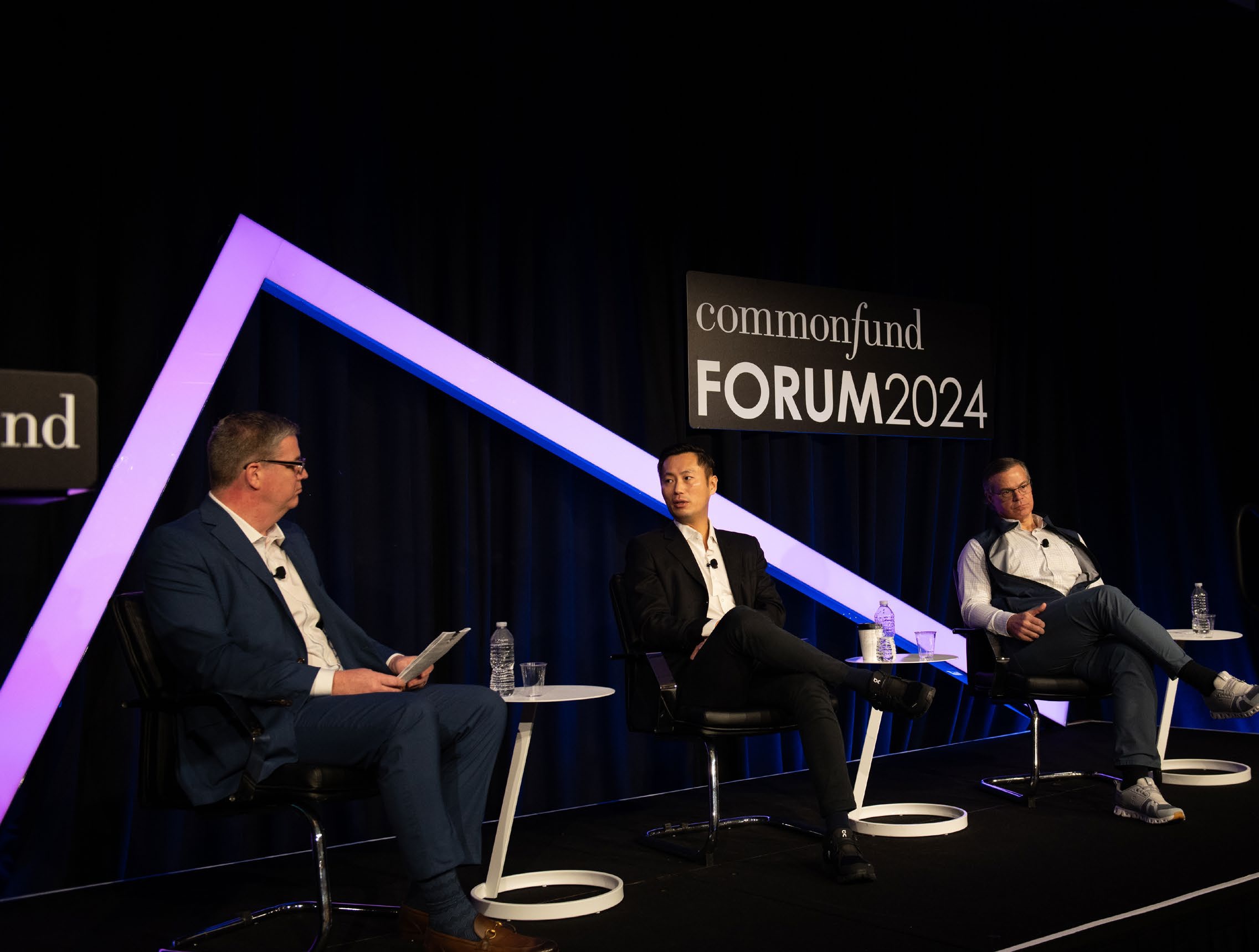
At Commonfund Forum that year, he moderated a panel with In Seon Hwang and Fred Sturgis. The software discussion with Sturgis, of Resurgens Technology Partners, brought the subject down to founder-owned companies. These were businesses whose owners had built a product and reached a point where further growth required help. Hoeing asked for examples, asked about operating expertise and asked how risks were managed. The discussion gave the abstract promise of company building a set of actual jobs to do.
A founder’s decision to sell a stake can involve a change in the way a business is run. New management, product work, sales and marketing are people’s responsibilities, with costs and consequences of their own. The investor therefore needs more than a view on the market. Someone has to carry out the plan. Hoeing’s questions kept pulling the conversation toward that practical work, where the investment case must make its living.
The route changes. The questions about people, price and the business remain.
The questions keep getting more specific
Hoeing’s public appearances have often put him in the interviewer’s chair. In July 2022, he interviewed Lauren Mulholland, a founding partner of MiddleGround Capital, for a manager spotlight. In 2019, he helped frame the conversation about China. In 2024, he asked specialist investors to explain their businesses. These are professional encounters, but they also reveal something about the form of his work: an investment team has to be understood well enough to be questioned.
The person doing the choosing needs to keep learning. Expertise on the other side of the table is useful only if the allocator can assess its relevance. A fluent explanation can make a difficult business sound simple; a useful question can restore the difficulty. The recurring attraction in Hoeing’s career is this opportunity to examine different firms. There is variety in the subject matter, coupled with repetition in the responsibility.
In August 2026, he joined Howard Beber on Private Market Talks. Their conversation covered manager selection, venture capital’s concentrated pattern of returns, continuation vehicles and the changing secondary market. It also considered founder-owned businesses and the infrastructure needed for AI. The list is broad, but the underlying problem is familiar. An attractive opportunity still requires a way to gain access and people whose decisions can be evaluated.
Patient clients, impatient questions
CF Private Equity dates its founding to 1988. Its clients include pension funds, endowments, foundations, family offices and investment advisors. Those institutions give the work a purpose beyond the deal itself. A pension portfolio and an endowment have commitments that extend into the future. They need an investment approach that connects the assets being bought with the obligations the institution expects to meet. The investor’s time horizon has a practical owner.
“Our clients are at the center of everything we do.”
Mark Hoeing, CF Private Equity
On the firm’s website, Hoeing puts clients at the center of the work. It is a plain sentence, and its usefulness lies in what it asks the investment process to remember. Access to a fund, an interesting company or a specialized strategy is only part of the job. The portfolio must make sense for the institution holding it. A good story about an investment cannot answer every question about its place in a client’s portfolio.
His recent public activity includes a fundraising discussion with Asante Capital’s Kelly Phelan, Wafra’s Gustavo Cardenas and GCM Grosvenor’s Stephen Cammock. His LinkedIn activity also shares colleagues’ work on venture capital and private markets. The pattern is a professional conversation conducted across firms and within his own. Capital allocation depends on relationships, but those relationships still have to withstand examination. Familiarity does not remove the need to ask another question.
Hoeing’s career began close to the individual business and moved toward the people entrusted to select and develop many businesses. The PayPal episode gives the story a recognizable name. The more enduring subject is the work that followed: comparing firms, finding expertise and judging how it might be used. Choosing who chooses is a peculiar responsibility. Its most important results arrive years after the meeting, when the presentation has long since stopped being interesting.
Continue the conversation
- CF Private Equity
- Mark Hoeing on LinkedIn
- Listen: Private Market Talks, August 2026
- Watch: sector specialization interview, September 2024
- Read: Commonfund Forum conversation, 2024
- Read: global private equity, 2014
- Read: emerging markets conversation, 2019
- Watch: Lauren Mulholland manager spotlight, 2022