Before 9Zero had drywall, it had a customer. Duncan Logan says the first member signed a twelve-month contract while the place was still being built. Someone had paid to join a community whose walls were unfinished. For a founder selling the value of being in the room, this was an unusually literal vote of confidence.
It also supplied a useful inconvenience. Logan and his colleagues could no longer design for an imaginary, conveniently agreeable member. There was a real person waiting to work, meet people and build a business. The first customer became a daily test of the proposition. A floor plan can look persuasive for weeks. A customer has questions by Tuesday.
This is familiar territory for Logan, the Scottish entrepreneur who founded RocketSpace in San Francisco in 2011. Uber and Spotify were among the companies that spent time there. In March 2020, he announced its closure. He now leads 9Zero, which he cofounded with Matthew Joehnk to bring the climate community together. The industry has changed. His interest in the room has survived.
A Scotsman leaves the farm behind
Logan grew up near St. Andrews, in a farming family. His route to California ran through Aberdeen and London, with derivatives trading at Swiss Bank Corporation along the way. Looking back, he remembers the trading floor as a concentration of people absorbed in the same pursuit. They shared an intensity, a vocabulary and a daily physical setting.
That memory offers a more personal explanation for his later businesses than a theory about commercial property. He had experienced a workplace where people pushed one another without being asked. Years later, he would describe RocketSpace and 9Zero as attempts to create that kind of concentration deliberately. The room had made an impression before he thought to sell membership in one.
Banking also irritated him. He felt more invested in the success of the bank and his team than the people around him appeared to be. At 24, he started his first company. CITYPRO International grew to $8 million in revenue over three years before its sale to ASAP Plc in 2000, where he became group managing director.
He joined MessageLabs in 2002, helping build the email-security business before its $700 million sale to Symantec in 2008. That was also the year he moved to San Francisco. These were distinct apprenticeships: the rhythms of finance, the obligations of running a company, the work of expanding a software business. The familiar startup campus came later.
His account of ambition has room for discomfort. In 2014, he talked about fearing a backward glance at a life in which he had tried too little or taken too few risks. He liked the freedom of being responsible for his own decisions, even when the results were unpleasant. “I hate the lows but I love the highs,” he said.
- 2002Joins MessageLabs
- 2011Founds RocketSpace
- 2020Closes RocketSpace
- 2024Opens 9Zero’s first hub
The furniture was the easy part
RocketSpace gave a physical address to his interest in ambitious company. Its services included workspace, events, introductions and help reaching people a young business needed. The practical promise was attractive: work alongside other growing technology companies while gaining access to investors, talent and established businesses.
There was considerable furniture involved. Logan described the regular rearranging as “a giant game of Tetris.” Fast-growing tenants are awkward objects to fit into a fixed floor plan. Their teams expand, their needs shift, and yesterday’s arrangement becomes tomorrow’s obstruction. Even the furniture had a recruiting function: a programmer deciding where to work would notice the surroundings.
The commercial model extended beyond the desk. By 2016, corporate innovation consulting accounted for half of RocketSpace’s business, with space and startup services making up the other half. Companies including AT&T, RBS and JetBlue wanted help understanding and working with startups. Logan had a concise description of his position between the two groups: “We’re a relationship broker.”
A large company could bring customers, distribution or a potential partnership. A small company could bring a product and the speed to test it. RocketSpace put itself between those needs. It was a business that required attention to people outside its own building, however much effort went into arranging the people inside.
& servicesCorporate innovation
consulting
A historical snapshot of the offering, not a measure of investment returns.
A room with rather famous visitors
On June 26, 2015, the guest list included UN Secretary-General Ban Ki-moon and Nancy Pelosi. A photograph catches Logan beside them at RocketSpace, with a podium announcing EntrepreneursUNite. For once, the introductions required rather less explanation than usual. The campus had become a setting where technology entrepreneurs and public figures could meet.
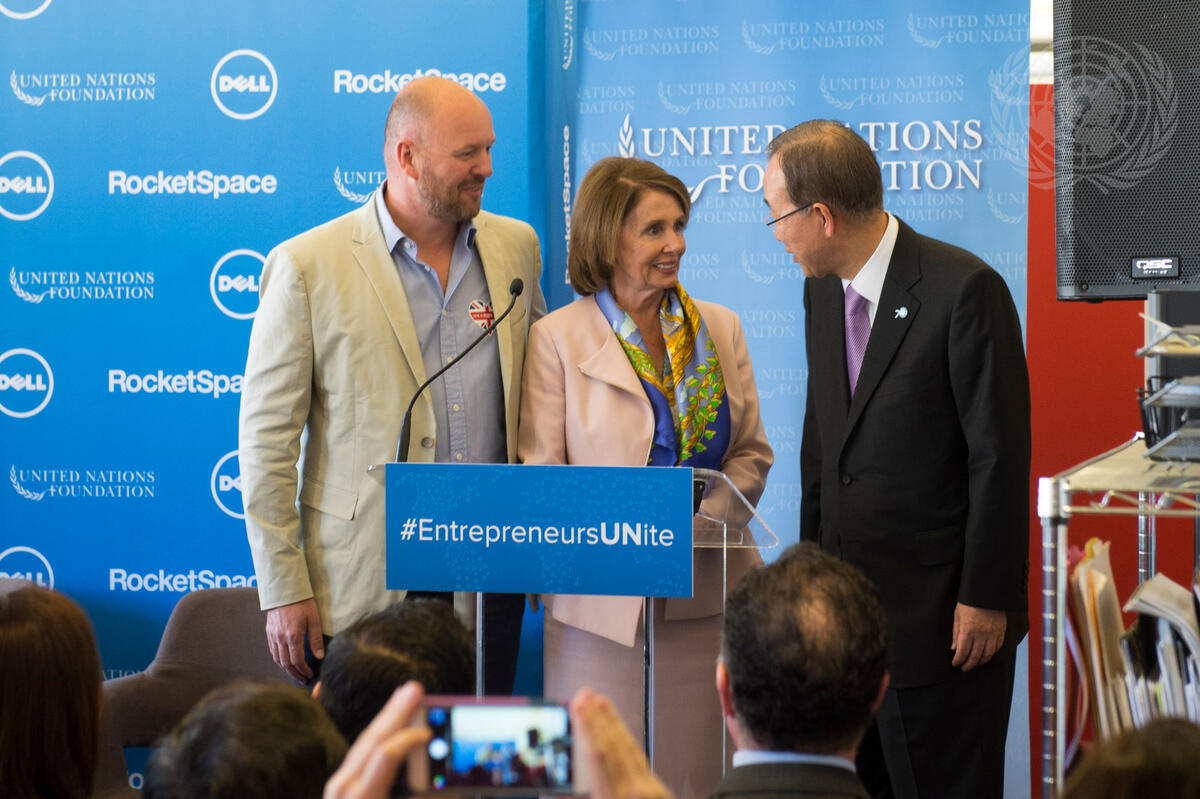
Access also had a quieter application. Through The Last Mile, Logan offered Kenyatta Leal a job before Leal had left prison. A Stanford entrepreneurship talk describes Logan recognizing that Leal would attract other offers and deciding to hire him early. It is a concrete example of opening a professional door to someone outside the usual recruiting circuit.
Logan’s own advice repeatedly returned to the team. In conversations about successful startups, he emphasized the founder’s attention to hiring. He also saw a quality filter as part of RocketSpace’s appeal: companies entering the campus had to be funded. Bringing people together involved decisions about whom to admit and what each might contribute.
The goodbye belongs in the story
The alumni names make RocketSpace easy to remember as a success story. Its ending makes the picture more complicated. On March 11, 2020, Logan published his farewell after nine years. He reported that 26 companies from its member and alumni community had passed billion-dollar valuations, and that more than 120 Fortune 1000 companies had been customers.
He also described mistakes. The training venture RocketU had not found its niche. Expanding in China had been a misstep. Competition with WeWork had been difficult. He placed the eventual unwinding at board level and in troubled investor relationships, while accepting responsibility as CEO. The letter held gratitude and failure in the same frame.
The distinction between serving successful companies and owning their success matters here. Logan regretted that RocketSpace had not invested in most of the startups he named. Their valuations could demonstrate the company it kept without guaranteeing its own financial outcome. A community business still has a balance sheet, investors and obligations that impressive neighbors cannot settle.
His goodbye thanked the team and the many people who had helped. It also took satisfaction in former colleagues going on to build companies and careers elsewhere. There is something revealing in that choice of consolation. Even while shutting the business, Logan was still following what the people from the room did next.
Another address, a different problem
In April 2024, Logan announced the opening of 9Zero’s first physical climate innovation hub in San Francisco, alongside a public beta for its digital hub. He and Joehnk had been working on the venture for less than a year, he wrote. The aim was to connect the different participants needed to move climate solutions forward.
He remembered Spotify and Beatport scaling almost side by side at RocketSpace. Could similar proximity help people working on climate? 9Zero brought founders, investors, engineers, scientists and other practitioners into its intended community. A digital component would extend the connections beyond one address, while physical locations would provide places for work, conversation and events.
The public character of the venture is brisk and commercially minded. Its manifesto promises useful colleagues, investors and somewhere to work late. It has little patience for talking about a problem indefinitely. Logan sees climate as a field in which businesses can create economic value while addressing environmental challenges. That ambition supplies the organizing subject for the new room.
By August 2026, 9Zero had hubs in San Francisco and Seattle. At a Seattle discussion, Logan argued for climate products on their price and performance, pointing to electric transport and China’s adoption of it. He treated the issue as one of competitiveness as well as environmental purpose. The customer, in this view, needs a persuasive reason to buy.
“I have a real passion for drones.”
Duncan Logan · 2016
What the next desk is for
Logan supplies a small example of the connections he wants. He recounts two strangers, Chris and Michael, meeting at a 9Zero hackathon, winning a $5,000 prize and becoming cofounders of YIMBY AI. Working together under pressure let each see how the other thought and responded when something became difficult. An introduction had turned into shared work.
There are harder decisions, too. He has described the discomfort of rejecting founders through 9Zero’s investment arm. Having needed someone else’s approval himself, he recognizes what a refusal means. Capital is finite; sympathy cannot determine every investment. The person arranging the room must sometimes disappoint someone who wants to enter it.
Away from these decisions, his older interviews offer less solemn details. He enjoys skiing, has described an ongoing struggle with golf, and once volunteered an enthusiasm for drones. On flights, he would sit and scribble ideas. These are recognizable habits of someone who can turn even time away from the office into another occasion for thinking about a business.
But the first member, waiting for the drywall, gives the clearest picture of his current work. A customer had made a commitment before the room was ready. Logan’s job was to make that commitment worthwhile, through the people, opportunities and everyday usefulness that followed. After all the alumni names and the public goodbye, he was back at the beginning: someone had said yes. Now there was a place to build.