Deutsche Telekom needed help making its 5G operations more sustainable. Somewhere beyond the company were businesses that might have an answer. Martin Garratt’s organisation helped turn the request into something those businesses could respond to, then put it through a network spanning six countries. More than 40 replies became 12 meetings. Three companies were invited to speak to senior staff.
There is a version of the technology story that ends when an ingenious person invents something. Garratt’s working life has occupied the awkward stretch that follows: finding a customer, getting a hearing, making an introduction useful enough to earn a second meeting. The figures in that telecommunications search describe a modest, consequential sequence. A large organisation had a problem. Smaller organisations had proposals. Someone had to arrange the conversation.
Garratt co-founded Cambridge Cleantech in 2011 and became its first chief executive. His subject was clean technology; his daily material was people with different priorities, budgets and ways of explaining themselves. He brought a planner’s training to a job in which the routes between institutions mattered as much as the institutions themselves.
AN INTRODUCTION, IN THREE STAGES
to senior staff
A Deutsche Telekom search through the Scale-Up network.
A planner finds another kind of map
Before Cambridge, there was Manchester. Garratt studied Town and Country Planning at the University of Manchester, with environmental issues forming part of his education. His professional biography also records a Bachelor of Planning and membership of the Royal Town Planning Institute. Those credentials place the environment near the beginning of his career, well before cleantech became the label on his business card.
Years later, introducing himself in a 2020 conversation, Garratt began with an unsuccessful effort to persuade his daughters to cut his hair. Some appointments are harder to arrange than others.
At IBM, his work included regional environmental management in the greater South East. Nottingham brought city centre management, followed by governmental liaison work at Boots. These were jobs concerned with how organisations operate in a place: the businesses already there, the public bodies around them and the arrangements that let different interests get something done.
He then led the Greater Cambridge Partnership for roughly a decade. The decisive turn came when the incoming coalition government’s closure of regional development agencies threatened its principal funding route. The partnership had recently examined the region’s cleantech sector and recommended a membership network. Garratt and his colleagues tested demand. A recommendation became a way forward.
In 2011, he and Hugh Parnell established Cambridge Cleantech, taking the chief executive and chairman roles respectively. Specialisation gave the new network a clear purpose: help environmental technology businesses grow through commercial opportunities. It offered an answer to a particular regional problem, while leaving plenty of room for the businesses involved to trade beyond the region.
The distinction matters in understanding Garratt’s career. He was building the organisation around the inventors. A business membership network has to keep proving its usefulness to people who have companies of their own to run. An interesting speaker may fill an evening; a suitable customer can change the following year.
Five minutes, then the questions
By December 2019, preparations for a London Cleantech Venture Day had drawn more than 100 applications. The selection was narrowed to 24 businesses. Their subjects ranged across accommodation, metering, hydropower and solar energy. The variety is a reminder that cleantech describes a commercial territory with many different products, rather than one invention waiting for its moment.
The Venture Day format brought that territory into a room with investors. At the January 2023 event, each startup had five minutes to pitch and another five to answer the panel’s questions. It is an economical arrangement, particularly from the audience’s point of view. For a founder, it requires years of work to acquire a short, intelligible explanation.
Garratt could see the resemblance to television’s investment competitions, with one small deficiency in the set dressing. “They don’t have a pile of cash on the armchair, unfortunately,” he joked. The useful action came afterwards, when investors followed up with businesses that interested them.
“We are keen to engage with the world.”
Martin Garratt, Transatlantic Business Forum, 2012
A January 2023 Cambridge Tech Podcast episode placed Garratt alongside two founders preparing for the event. Sean Moroney of Cambridge Electric Transport discussed urban transport and last-mile delivery. Andrew Terentjev of Cambridge Smart Plastics discussed materials and the difficult journey from laboratory work to commercial adoption. It was a compact illustration of the territory Garratt occupied: the network, followed by the businesses with specific things to sell.
The corporate side had its own requirements. In the Deutsche Telekom example, the energy question extended across a supply chain that included masts and vehicles. Cambridge Cleantech helped refine the request before circulating it. That detail is easily lost when networking is described as simply putting people together. A useful introduction begins with enough precision for each side to recognise why it should attend.
The network leaves town
Garratt was discussing international connections early. In March 2012, he spoke at a Transatlantic Business Forum about engaging with American counterparts. Cambridge Cleantech had already been in contact with Hong Kong and India, and he discussed further visits and joint ventures. A network with Cambridge in its name could offer a local point of entry and still look outward.
A closer extension followed in 2019, when Cambridge Cleantech helped establish Oxfordshire Greentech. In Garratt’s account of the Oxford-Cambridge Arc, the two networks gave universities, founders and established businesses more opportunities to work together. He described connections involving Cambridge, Cranfield, Oxford Brookes and Oxford. Geography supplied the neighbours; the network supplied occasions to meet.
One small result involved business students. In 2019, Cambridge Cleantech introduced Cambridge Judge Business School students to a shortlist of cleantech companies for the Wharton MIINT competition. They selected Oxwash, which took second place and received investment. It is the sort of episode that fits poorly into a founder mythology built around solitary breakthroughs. Several people did different jobs, and an introduction made the combination possible.
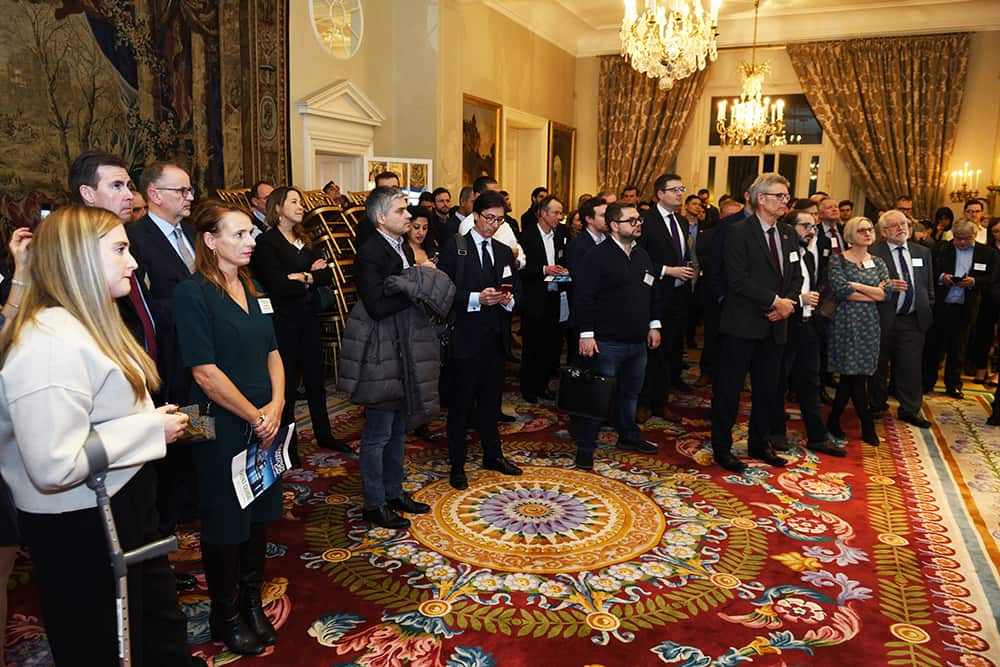
In February 2020, the setting was the French Residence in London. Choose Paris Region co-organised a programme with Cambridge Cleantech, Oxfordshire Greentech and KPMG London. Garratt joined Lionel Grotto and Jean Christophe Donnelier in opening an evening focused on links between London and the Paris region. More than 150 international investors, corporate representatives and startup participants attended the networking evening.
Alongside it, the buyer programme arranged 27 individual business meetings. Participating corporates included Bouygues, Capgemini, Schneider Electric and LafargeHolcim. The architectural setting made a handsome photograph. The practical purpose could be counted in appointments.
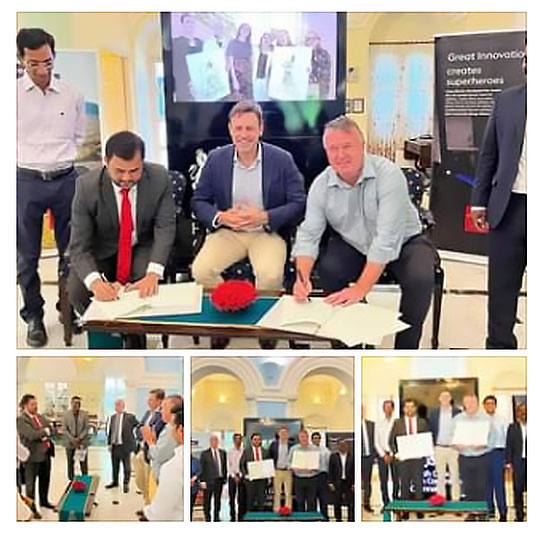
The international work also reached research institutions. In May 2022, Garratt was scheduled to introduce the UK cleantech sector during a Belgian economic mission event at Cambridge’s Maxwell Centre. In Chennai, he exchanged a collaboration agreement with M. Parvez Alam of Crescent Innovation and Incubation Council, supporting the development of cleantech communities in Tamil Nadu and the UK. Different rooms, similar work: giving people a reason to begin something together.
A shirt, a block of ice, a tenth birthday
Cambridge Cleantech’s tenth anniversary offered a less usual encounter. For its October 2021 conference, British Antarctic Survey and DressCode Shirts planned to reveal a climate-data shirt as it emerged from a melting block of ice. There are many ways to make an audience think about the environment. Few involve waiting for an item of clothing to defrost.
The design brought together Professor Ed Hawkins’s warming stripes, representing 70 years of Arctic temperature records, with a background of Antarctic temperature and carbon emissions data extending over 800,000 years. It was intended for display at the Bradfield Centre during the anniversary celebrations. A familiar object would carry a very unfamiliar timescale.
The installation belonged to the scientists and designers who made it. Its place in the conference programme gives a useful glimpse of the range of encounters the network could accommodate. Business development and scientific communication have different audiences, but both depend on making an idea understandable outside the circle that produced it.
Garratt’s own interests remained practical. In a 2020 interview, he highlighted energy storage, electrification and the circular economy. Storage, in particular, occupied a central place in his thinking about how cleaner power could be used. His focus kept returning to the relationship between a promising technology and the wider arrangements required to put it to work.
Leaving the chair for someone else
In 2023, Garratt handed the chief executive role to Sam Goodall, previously head of international projects. Sylvie Russell became chief operating officer. The announcement looked back over twelve years of the founding leadership and described the organisation’s results in the language of participation and business relationships.
THE NETWORK’S 2023 HANDOVER ACCOUNT
Reported organisational results across the founding leadership period.
Those measures suit the kind of institution he helped create. Events gathered people; introductions opened commercial discussions; pilots gave companies a chance to try working together. Responsibility was spread across founders, buyers, funders and the team arranging the encounters. Garratt’s role was to help the arrangement function.
The handover changed his title without immediately ending his participation. Later in 2023, a Cambridge Innovation and Sustainability Programme listed him as founder and executive adviser, speaking about developing a federation of sustainability-focused companies. That October, he was listed to chair the mobility pitching session at the Cleantech Venture Summit. His company directorship ended in April 2024; his public LinkedIn profile describes freelance advisory work in sustainability and smart cities across London, Cambridge and Oxford.
That is a fitting geography for this career. Garratt began by studying how places work and spent years helping the people within them find one another. Cambridge Cleantech gave that work a particular environmental and commercial purpose. An introduction may occupy only a line in a diary. For the people who need it, the next meeting can be the one that matters.
Follow the introductions
- Martin Garratt on LinkedIn
- Cambridge Cleantech: founders and team
- Read the career and founding conversation
- How the Deutsche Telekom search worked
- London and Paris meet at Venture Day
- The climate-data shirt installation
- The Chennai collaboration
- The CEO handover announcement
- Listen: Cambridge Tech Podcast, episode 17
- Watch: Garratt on the Cambridge ecosystem
- Professional biography: planning, IBM and Nottingham
- Garratt’s 2012 transatlantic remarks
- The Oxford-Cambridge connections, in his words
- A conversation about cleantech, careers and a haircut