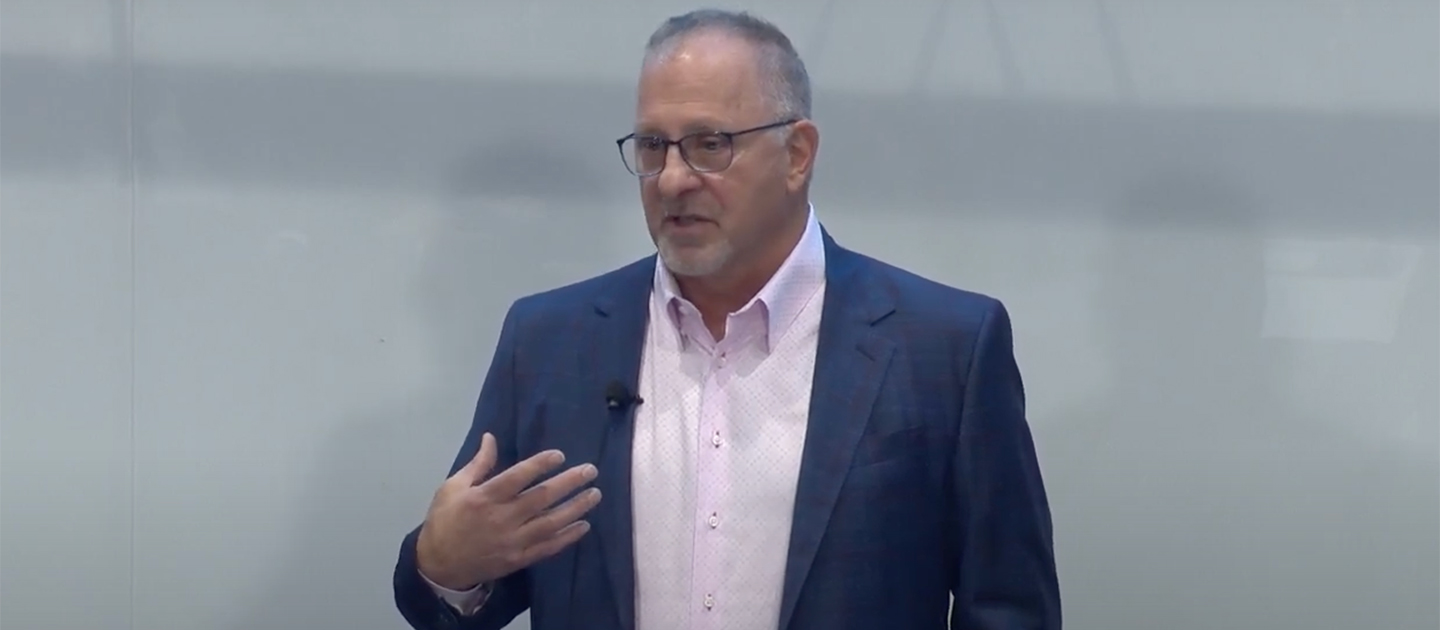
Doug Waggoner had something small to show a room full of transportation people: a program that could sort and find shipping records. He had asked ChatGPT to write it in Ruby. Then he asked for Python. At Northwestern’s April 2023 transportation lecture, the CEO of Echo Global Logistics was demonstrating a tool he could have built himself, given more time. The application took about three minutes to create and run, he said, with another five spent writing the prompt. Eight minutes, in a business where an unanswered request can sit longer than that.
The demonstration makes a useful introduction to Waggoner. He was interested in what the software actually did. It also came with qualifications: the models had biases and gaps. His proposed route from a promising pattern to a working business tool involved research, testing and engineers putting the result into operational systems. A clever screen demonstration was an opening move. Somewhere beyond the auditorium, someone still needed a shipment to arrive.
A neighbor’s career advice
His route into trucking began in 1980, after college, when his father’s next-door neighbor, a trucking executive, suggested an industry newly opened by deregulation. Waggoner had worked in construction; the working environment felt familiar. Decades later, he would describe himself as an introvert, comfortable with consensus rather than theatrical leadership. He also competed in aerobatics, had flown air shows, and wrote applications for pleasure. The office apparently did not exhaust his appetite for complicated machinery.
His formal qualification was a bachelor’s degree in economics from San Diego State University. The subsequent résumé moves between departments as readily as companies. At Yellow Transportation, from 1986 to 1998, he worked across sales, operations, marketing and engineering before becoming vice president of customer service. Each function offered a different view of the same shipment. A price, a promise and an actual delivery can look remarkably different from separate desks.
At Daylight Transport, he became chief information officer in January 1998, executive vice president that October, and president and chief operating officer in April 1999. USF followed: strategic marketing, then the CEO role at USF Bestway. Before Echo, he founded SelecTrans, a freight management software business. Software had already become part of his working life well before the current enthusiasm for AI.
“Micromanagers are only as good as their own bandwidth.”Doug Waggoner
The experienced hire gets an education
Echo was founded in 2005 by Eric Lefkofsky and Brad Keywell. Waggoner arrived as CEO in December 2006. The pairing brought a transportation veteran into a business whose founders saw an opportunity for technology in freight. It also brought him into a younger workplace with its own ideas about authority. Experience secured him the job; it could not settle every conversation once he was there.
By 2010, he was describing an adjustment in his management habits. He had come from corporate hierarchies and discovered that younger colleagues wanted practical help with their work, rather than a recital of anyone’s rank. “I’ve grown as a result of being around a lot of people that thought differently about things than I did,” he said. There is some comic justice in hiring a veteran to educate the room and watching the room return the favor.
That exchange matters because freight brokerage depends on people making decisions together. An executive can understand a market without seeing every obstacle on a representative’s screen. A representative can know a customer’s immediate problem without seeing the whole network. The company has to make those different kinds of knowledge useful to one another. A title can assign responsibility. It cannot do all the listening.
The growth chart has company
Echo’s early revenue figures show how quickly the scale changed. Its investor presentation records $33 million in gross revenue in 2006, $260 million in 2009, $1.173 billion in 2014 and $2.440 billion in 2018. These are gross revenue figures, including the transportation Echo arranges, rather than profit. Keeping that distinction clear makes the numbers more useful. They describe a rapidly expanding flow of business, with all the coordination that comes attached.
The milestones included an initial public offering in 2009 and the acquisition of Command Transportation in 2015. Growth came with new responsibilities: public investors, additional businesses and the work of making separate operations function together. A larger total on a chart is easy to admire. Bringing the pieces into a system that customers can use is a less photogenic occupation. It occupies rather more of a working week.
In September 2021, Echo agreed to be acquired by funds managed by The Jordan Company at an equity value of approximately $1.3 billion. The agreement offered shareholders $48.25 per share in cash, a 54 percent premium to the previous day’s closing price. Waggoner backed the return to private ownership as a way to fund growth and expand automation. The transaction changed the ownership structure around a business he had already led for nearly fifteen years.
Private ownership offered a different setting for the next stage of investment. In announcing the agreement, Echo emphasized resources and flexibility for its technology and data-science platform. That was a specific explanation for the deal, with an operational ambition attached. For shippers and carriers, the eventual value would have to appear in the service: better information, useful capacity and fewer awkward handoffs. The financial announcement began another stretch of work.
Keeping your place in a changing market
Waggoner’s explanation of freight cycles is grounded in the mix of work a broker handles. In a November 2024 discussion, he described Echo’s balance between spot freight and contracted business reversing with the cycle. A strong market could produce a mix of 60 percent spot and 40 percent contract. In the softer conditions he was discussing, that relationship had flipped. A business built to handle both has to keep its attention on both.
He argued for honoring contracts through those changes. A broker’s commitments do not become convenient simply because prices move. The logic is cumulative: how a company behaves in one part of the cycle affects its position in the next. This gives a long-serving operator something useful to think about beyond calling the next turn. There are promises already in force, customers already relying on them, and another market waiting on the other side.
His public conversations return frequently to supply, demand and the geography of available trucks. In March 2024, he pointed to declining truck numbers as one indication that excess capacity was coming back toward demand. The forecast was an assessment at that moment. Reading it as such preserves the distinction between an executive explaining the signals he watches and a timetable guaranteed to arrive on schedule.
The technology budget meets the inbox
By January 2025, Waggoner was making a case for continued spending during the freight downturn. He put Echo’s annual technology investment at upwards of $70 million and described eight AI projects in beta, testing or full deployment. One application identified price-quote requests in email and gathered pricing information. It was a decidedly ordinary workplace problem, which is precisely why it was worth examining.
His example was a representative who could recover 20 percent of the working day with an AI pricing tool. That was an illustration of possible time savings, rather than a reported company-wide result. He connected the recovered time to serving existing clients and finding new ones, and described automation as a way to handle greater volume without increasing staffing at the same rate. The ambition was measurable in people’s daily workload.
In his March 2026 outlook, the same argument had a narrower, concrete setting: around 60,000 daily emails concerning rate quotes and tracking alone. Waggoner described tools that could filter messages and retrieve information, alongside automated calls, texts and emails. The distinction between software and service becomes fairly porous here. Customers experience a delayed answer as a service problem, regardless of which system was supposed to produce it.
He also wrote about tightening capacity and his expectation of a more balanced market during 2026. Echo’s response included broader services, Mexico cross-border activity and the FreightSaver acquisition completed in 2025. The common thread was preparation: build capability while the market is difficult, so there is something ready to use when conditions change. Waiting has its own costs, even when they never arrive as an invoice.
daily emails about quotes and tracking alone
WAGGONER’S MARCH 2026 ACCOUNTA wider map to manage
On March 25, 2026, Echo completed its acquisition of ITS Logistics. The closing announcement put their combined 2025 revenue at approximately $5.2 billion. ITS brought capabilities including drop-trailer programs, dedicated capacity, container management, drayage and fulfillment. Waggoner described the transaction as part of a vision for a full supply chain solution. The ambition now extended well beyond matching an individual load with an available truck.
In September, Echo brought ITS and Roadtex together within its North American Supply Chain Solutions Suite. The announced network covered 8 million square feet of warehousing across more than 40 facilities, with next-day reach to 85 percent of the contiguous United States. Those are network claims, rather than a promise about every shipment. They show the breadth of the operating system Waggoner and his colleagues now have to manage.
Dave Menzel, Echo’s president and chief operating officer, described a combined offering spanning distribution, fulfillment, warehousing, temperature-controlled transportation, retail consolidation and parcel. This is where acquisition strategy becomes a customer’s practical question: can the next stage of the journey be arranged without starting the conversation again? More capabilities give a company more ways to answer. They also give its leaders more connections to make work.
Still willing to ask
On his public LinkedIn profile, Waggoner has written about curiosity as skills become easier to access through AI. He acknowledged using AI to help write the post itself. The admission suits the Northwestern demonstration: try the tool, show the work, and think about where the saved effort might go. It leaves room for an experienced executive to be a learner in public.
That is the thread connecting the career’s otherwise different parts. Freight operations supplied problems. Software offered ways to work on them. Younger colleagues supplied perspectives that his previous workplaces had not. Acquisitions enlarged the field of responsibility. None of those developments made the next decision automatic. They gave him more material to examine.
The eight-minute experiment remains a pleasingly modest scene to keep in view. A shipping record needed to be found. A program helped find it. An executive who could have left the demonstration to someone else wanted to see what happened for himself. After decades of responsibility, there was still a small task on the screen worth figuring out.