Before there was a platform, there was a favor. A friend of a friend needed help navigating a hospital in Seoul. Donkyo Seo knew the language, the city, and enough of the machinery to find the right clinic, secure the appointment, and explain what would happen next. Then came another request. And another. The pattern was less cinematic than most founder myths, but more useful: people were not short of hospitals. They were short of a capable person who could make a foreign system feel legible.
Seo stayed close to that problem. He did the work one hospital at a time, learning that international medical travel is a chain of small dependencies. A provider must be chosen. Records have to move. A date must suit both patient and clinic. Instructions need translation. Transport, lodging, payment, and follow-up sit just outside the appointment, waiting to become someone else's problem.
Himedi became Seo's answer: a medical-travel concierge connecting international patients with vetted providers in South Korea while coordinating the trip around the booking. Its software matters, but the company story is stubbornly physical. Someone still walks the clinic floor. Someone meets the staff. Someone checks whether a polished lobby is attached to a process that works.
Chapter one
An operator learns to see the handoffs
Seo's route to hospital corridors ran through several very different operating rooms. After graduating from Yonsei University in 2005 with a degree in computer and industrial engineering, he served as a platoon leader and intelligence officer in the Republic of Korea Army. He then joined Samsung Electronics, working on manufacturing systems in the semiconductor business. The common material was not medicine. It was coordination: people, processes, and information moving under pressure.
In 2011 he crossed the Pacific for an MBA at Dartmouth's Tuck School of Business. He also played rugby there, a biographical detail with the pleasing incongruity of a consultant arriving at a scrum. After Tuck came Bain & Company, where he worked as a management consultant, followed by a senior strategy role at Delivery Hero in Korea.
Semiconductors taught systems. Consulting taught decomposition. Delivery platforms taught the value of a clean handoff between scattered parties. By the time Seo focused on medical travel, he had spent a career studying the space between a request and its fulfillment.
The early Himedi business concentrated on travelers from the Middle East, a customer group whose journeys revealed just how broad the word concierge could become. The appointment might be the purpose of travel, but a long stay could involve a family, a kitchen-equipped hotel, interpreters, transport, and schedules that changed with the clinic. In 2019, Seo said no single domestic mobility provider could cover all of Himedi's volume, so the company coordinated with several.
There is a good business lesson hiding inside that awkwardness. Industries often name themselves after the most visible transaction. Travel is sold as a flight. Healthcare is billed as an appointment. Marketplaces are drawn as two boxes connected by an arrow. Customers experience the loose ends.
“Focusing on a small number of partners helps us improve the entire medical journey - faster and more consistently.”Donkyo Seo, on Himedi's clinic network
The hard interval
When the travelers stopped traveling
A company organized around cross-border movement met an obvious calamity in 2020: borders closed. The international-patient industry contracted sharply. Agencies disappeared, hospitals reduced staff, and the journey Himedi existed to coordinate could no longer begin in the usual way.
Seo's team responded by working earlier in the journey. Himedi expanded relationships with overseas physicians and helped arrange remote consultations with Korean providers. Local doctors could join calls, records could be reviewed before travel, and a patient could make a more informed decision about whether to come to Korea once movement became possible. The company also shifted more attention toward complex hospital cases, where the need to travel could persist despite the disruption.
The adaptation did not turn a travel business into a video-call business. It exposed the enduring product beneath both: trust assembled before arrival. In 2020, Himedi announced a 6 billion won Series B round from four domestic and international investors. The financing arrived in the same year that the category's assumptions were being stress-tested.
When travel resumed, the market returned with different accents. Himedi still carried its experience with Middle Eastern patients, but English-speaking travelers were becoming more important. The company opened offices and partnerships abroad, while Seo's own writing began addressing practical questions from people in North America, the United Kingdom, and Australia.
A second starting line
The flyer and the fixer meet
Himedi's current US-facing story has a second origin. William Ban, a Korean American from Los Angeles, experienced a comprehensive Korean checkup after the pandemic and noticed the distance between that experience and the annual physical familiar to Americans. He began testing interest in New York with a one-page flyer.
Seo was on the other side of the ocean, still doing the clinic work. In 2024 the two efforts converged: one founder carried a fresh customer insight from America; the other had years of experience making Korean providers accessible to visitors. Himedi describes Ban as building the US side and Seo as having built the clinic side from day one.
It is an unusually tidy pairing. One sees the gap from the waiting room. The other knows which doors open behind it. Their shared product is neither a clinic nor an itinerary. It is confidence that the two can be joined without the traveler becoming the project manager.
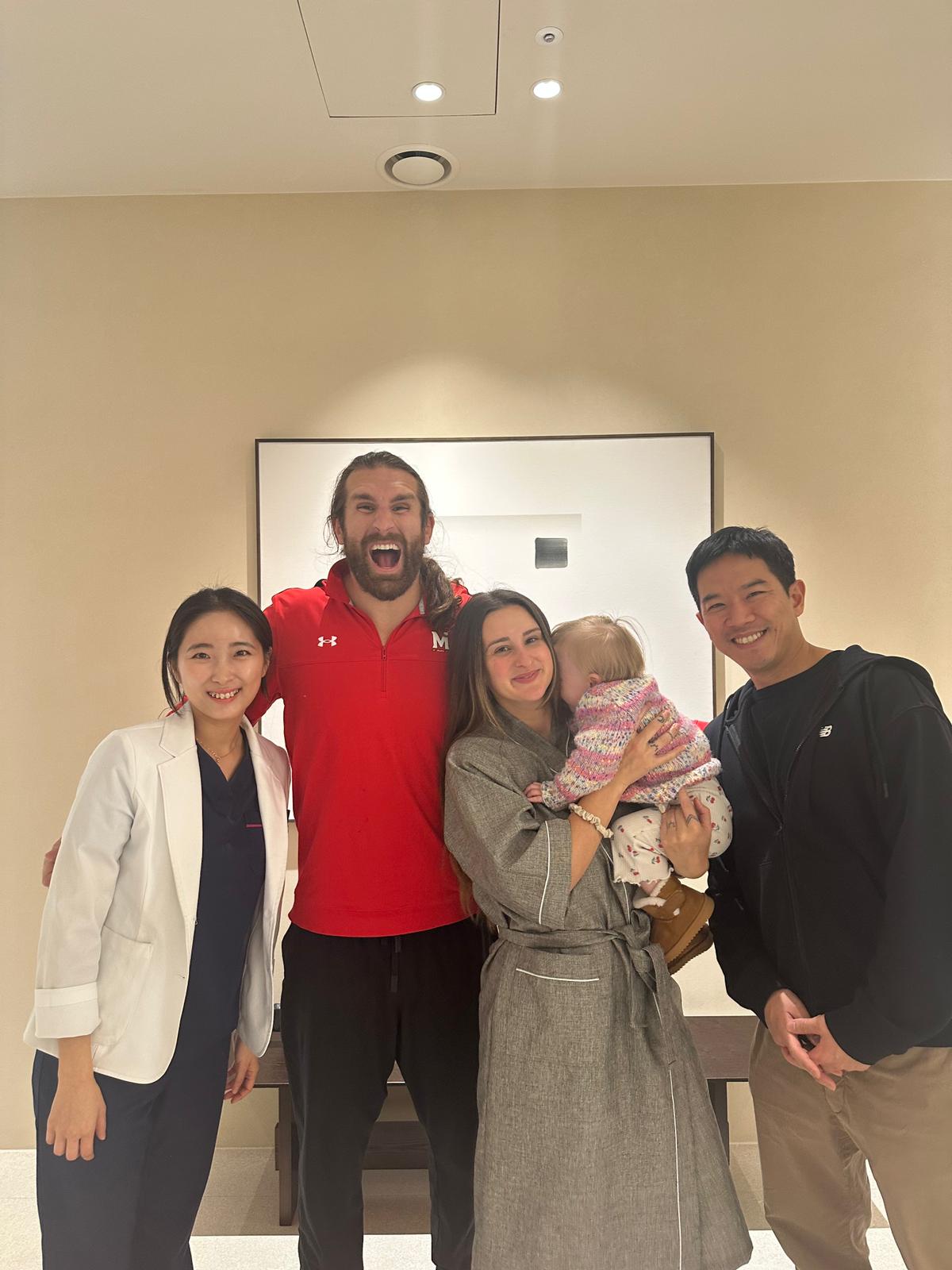
Seo's published field notes show what “clinic side” means in practice. He writes about signage, privacy, the flow between consultation and treatment, whether the physician speaks directly with international patients, and who owns the follow-up. During Himedi's evaluation of one boutique clinic, he returned several times and used its service twice himself. Elsewhere, he records introductions made by doctors, meetings with clinic directors, and the difference between a domestic reputation and readiness for visitors.
This is the opposite of building a directory by scraping logos. The information Seo values often resists a spreadsheet. Does the space calm people? Is responsibility fragmented? Will an English-speaking visitor know who is making the decision? The answers live in behavior, not metadata.
The narrow network
More options, or fewer doubts?
The internet's default move is abundance. Add inventory, add filters, and give the user control. Himedi makes a different wager. Seo has said that fewer than 10 vetted checkup centers and clinics account for nearly 80 percent of bookings among customers from North America, the UK, and Australia.
The concentration is deliberate. A smaller network produces repeated handoffs. Staff learn one another's rhythms. Feedback can be acted on. The concierge knows where an unusual request belongs, and the provider knows what kind of context will arrive with the patient. Choice is replaced by institutional memory.
That idea explains the peculiar charm of Seo's work. His company is digital, but its advantage is accumulated in rooms. Its service crosses borders, but improves through local repetition. It sells access, while protecting that promise by saying no to most of the available supply.
The stealable idea
When a customer is anxious, choice has a cost. Narrowing the field can be a serious operating strategy if every recommendation is backed by repeated experience, clear criteria, and responsibility for what happens next.
Seo's public ambitions have remained consistent even as the customer mix changed. He has described medical tourism as an export industry and argued that Korea's combination of cost, speed, and capability can serve a much larger international market. In a 2022 interview, he compressed his national comparison into seven blunt words: “The United States is expensive, Germany is slow. Korea is cheap and fast.”
The quip is memorable. The harder work begins after it. A country's advantage means little to a traveler who cannot choose a provider, make a booking, or understand the instructions. Seo's career has become an attempt to convert a macro thesis into a series of dependable, human-sized steps.
His more recent writing has the texture of an operator making his criteria public. Rather than publishing generic lists of “top” clinics, Seo explains why a provider made the cut, who introduced the team, what happened during the visit, and which pieces of the experience may suit a particular traveler. The articles double as accountability. Once the standard is printed, customers can notice when the service falls short. Transparency, in this version, is less a price table than a promise to show the reasoning behind a recommendation.
That first favor for a friend now looks like a prototype. It contained the core insight, the initial distribution channel, and the product spec: make a complicated system understandable to someone arriving from elsewhere. Everything since - the army, the factory systems, the case interviews, the delivery dashboards, the clinic tours - has given Seo another tool for finishing the job.
The front door he is building is not grand. It is well labeled, answered by a person, and connected to the room you meant to reach. In a maze, that is plenty.