Don White went to Citi Field and encountered a problem that no amount of baseball could solve. Somewhere inside the stadium was bacon on a stick. He wanted it. Finding it was another matter. A ballpark could assemble players, crowds, sponsors and an elaborate menu, yet leave a hungry customer wandering around looking for something it was perfectly willing to sell.
White has returned to that episode when explaining Satisfi Labs, the conversational AI company he co-founded in 2016. The detail has survived the company’s subsequent vocabulary of assistants, language models and agents. It deserves to. A snack on a stick is a useful restraint on abstract thinking. Someone either finds the concession stand or keeps walking.
His career has taken him through Bloomberg, a sales analytics startup and the business of helping physical places answer back. Across those settings runs a recognizable interest: what people can do once the information they need becomes easier to reach. The ballpark gave that interest a particularly good appetite.
The job that answered back
White grew up in Brooklyn, the son of a pastor and a teacher. During college, he applied for what he understood to be a receptionist position at Bloomberg. The work involved handling 120 calls an hour, in four-hour shifts, for $10 an hour. It was an introduction to an information business conducted at a fairly unforgiving pace.
He stayed for 15 years. Operations led to product work and eventually sales leadership. At Bloomberg Tradebook, he became head of sales for the Americas; early professional biographies describe responsibility for a $110 million sales and strategy division. He earned a BBA from Baruch College and an MBA from Cornell. By the usual measures, there was plenty of career to point to.
Then a startup interview supplied a less comfortable measure. In White’s account, the founders questioned whether his success demonstrated his own ability or Bloomberg’s. It was a difficult distinction to sit with after years inside the company. He went on to lead sales at Datahug, whose software dealt with sales analytics and forecasting. The question had done its work.
A stadium has a menu. A fan has a question.
The early Satisfi Labs proposition belonged to the physical world. Its company history names the New York Mets, Macy’s and the US Open among its early work. These were places with information that a visitor might struggle to retrieve from a conventional website. An organization could possess the answer without making it accessible at the moment somebody needed it.
White’s 2019 account of the business already extended beyond answering service questions. Marketing and ticketing departments were becoming interested in the conversations. A request revealed something about demand. If enough visitors asked for an item, the venue acquired evidence about what people wanted, including things its existing information had failed to explain.
He also described the value of questions at Bonnaroo: what artists people sought, what performances interested them, what preferences might otherwise remain invisible. The audience supplied its own vocabulary. That was part of the attraction of conversational search. People could describe their intentions rather than navigate somebody else’s filing system.
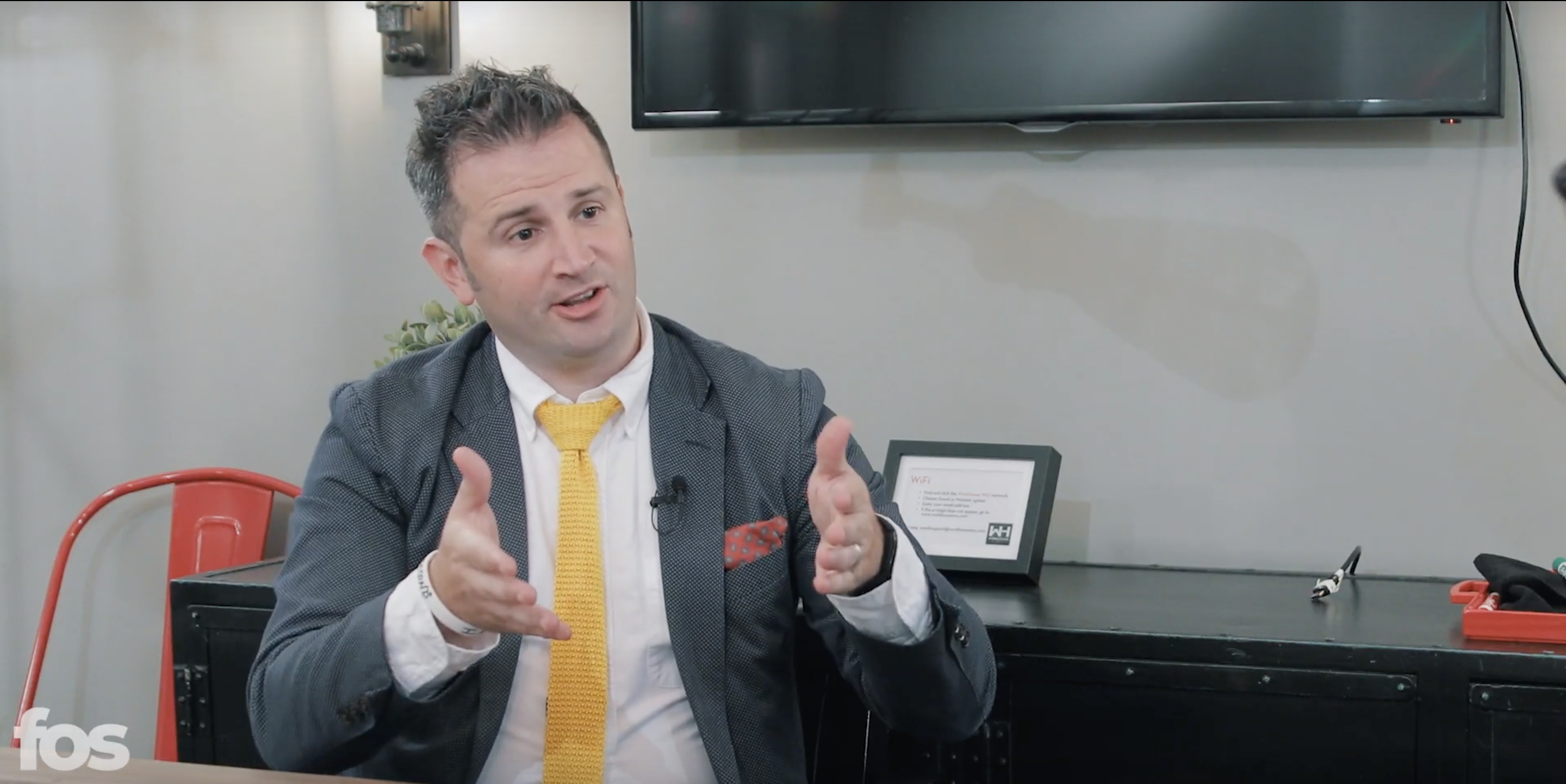
A conceptual view of the approach White described in 2019.
In a separate 2019 interview, White described ambitions for connected destinations, using Atlanta’s teams and zoo as an example. The visitor’s day could continue across organizations. It was an expansive idea built from a modest observation: people visiting a place tend to have another question after the first one.
The bag at the gate
At the 2019 All-Star festivities in Cleveland, White had a useful encounter with his own product. A friend was uncertain whether her bag would be permitted inside Progressive Field. The league’s All-Star Concierge, powered through Apple Business Chat, let her ask through the MLB Ballpark app. She received the size requirements without returning to her hotel.
There is an entire argument for useful software in that saved trip. The bag policy was a small piece of information with an immediate consequence. Nobody needed a tour of the underlying technology. They needed to know whether they could get through the gate.
White noticed something else about these exchanges: fans sometimes thanked the assistant, and some asked about its plans after the game. Human manners had found their way into the interface. A system designed to organize answers was also becoming a recipient of courtesy, curiosity and the occasional invitation it could hardly accept.
The growth problem behind the screen
White has been willing to describe a less charming early episode. While concentrating on revenue and investment, he paid too little attention to the product’s infrastructure. Technical debt accumulated. He said he ignored warnings until the system began showing weakness. His response was to tell investors and employees that the team needed a 45-day effort to rebuild parts of it.
The admission complicates the smooth founder narrative in a useful way. Winning customers creates obligations that selling alone cannot discharge. White credited the team’s work and the understanding of the product that came from the rebuild. The machinery behind a convenient answer had required his attention too.
His stated advice to his younger self was concise: “Get into the startup world sooner.” He also described the value of asking an experienced investor for help. Leadership, in this version, included having new questions and finding someone willing to hear them.
“Get into the startup world sooner.”
Don White, advice to his younger self
The week the conversation changed
The arrival of ChatGPT forced another reconsideration. Satisfi Labs had been preparing to announce an upgrade to its own contextual language technology when the new system appeared in late 2022. White later recalled an investor’s dry assessment: “Great job for nothing.” Timing had supplied an unusually economical product review.
He came to see an opportunity in combining the technologies. The ability to generate language could sit alongside a system organized around specific requests and answers. By 2023, he was discussing Satisfi’s Context LLM Response System, with options for generated responses and pre-written answers according to the control a brand needed.
His examples remained stubbornly concrete. In one discussion, a question about bringing an umbrella into a stadium produced an answer that contradicted the actual policy. A convincing sentence could still create an inconvenient afternoon. White’s concern was the responsibility a business assumed when the answer appeared beside its name.
That concern fits the earlier bag-at-the-gate episode. Accuracy has a location, a date and somebody waiting to act on it. The conversational surface may become more fluent; the guest still has to pass through a real entrance.
From the concourse to the theater lobby
By March 2019, Satisfi Labs had announced investment led by Major League Baseball and Red Light Management, bringing its disclosed funding at that point to $6 million. It was working with more than 100 professional teams and had begun working with Big Bash League cricket in Australia. White said international expansion had waited until the company could support it appropriately.
The company’s reach also followed people into theaters. Its 2024 merger with Broadw.ai brought an existing collaboration under the Satisfi Labs umbrella. The two had worked together since 2018 on a round-the-clock theater assistant. Broadw.ai’s portfolio included Hamilton, Moulin Rouge, Sweeney Todd and Wicked, and its founder Micah Hollingworth joined as head of entertainment.
These are different evenings out, with related practical demands. A theatergoer and a baseball fan both need to understand what they are buying and how the place works. The setting changes the details, which is precisely why the details matter.
In 2025, the company hired Dima Galat to lead AI. White discussed communication between agents and the connection between incoming conversations and outbound marketing. The acquisition of Factoreal had added marketing capabilities. A customer’s initial request could become part of a longer relationship, with further work required to connect the systems involved.
Even the software gets a review
White’s next management idea arrived during employee reviews. If people were being assessed against expectations, why should the company’s agents escape the exercise? In February 2026, he described the Agent Performance Console, which lets customers inspect an agent’s objectives and results. He said 115 clients had deployed it at launch.
The console made room for a different kind of conversation: asking an agent about its own performance. A client could examine results and ask about a change in activity or sales conversions. The founder who had built around guest questions was now making the software answer questions about its work.
clients deployed the Agent Performance Console at launch, White said.
The idea brings his ambitions into view without requiring a prediction. He wants conversational systems tied to tasks a business can define and evaluate. The language of employment makes the expectation familiar: give the agent work, establish what success means, then examine what happened.
A little pudding at the end
White’s personal details have often been as specific as his product examples. In a 2018 interview, he praised New York’s variety within a subway ride, named blueberry pancakes at Friedman’s near Penn Station as a favored breakfast, and described a Nespresso machine within arm’s reach at work. His daily goal was two words: “To win.”
He also offered an unusually actionable dessert recommendation: hot chocolate pudding poured over vanilla ice cream. It is a pleasingly direct instruction from someone whose professional life involves helping people find what they want.
The bacon story remains the better business parable. A venue had something to sell; a visitor had the appetite; the missing piece was an answer. Years of product development have followed that gap. Somewhere in the middle of all the talk about intelligence, White kept hold of the hungry person walking around the concourse.
Keep the conversation going
- Satisfi Labs
- Donny White on LinkedIn
- Don White on X
- Watch: the 2019 ballpark conversation
- Watch: Sports Loft Showcase 2023
- Watch: Executive Insight, 2025
- Read: career and company origins
- Read: early founder lessons
- Read: the 2023 AI interview
- Read: the All-Star Concierge
- Read: AI and verified answers
- Read: brand control, 2023
- Read: Broadw.ai merger
- Read: the 2025 AI team expansion
- Read: the performance console
- Read: the 2018 daily routine
- Read: connected destinations, 2019