The fence you can't see, on a frequency nobody else uses
A cat and a new sofa started it in 1990. Thirty-five years later DogWatch runs the last big hidden-fence brand that stayed independent - and the only one broadcasting on FM.
In 1990, Fred King had a furniture problem. His family's cat, Slapshot, had claimed the new living-room sofa, and King - looking for a way to keep the animal out of one room without building a wall - started paying attention to a small, strange corner of the pet business: electronic containment. At the time there were exactly two companies in America making hidden fences. One was Invisible Fence. The other did not exist yet. King built it, called it DogWatch, and set it up in Natick, Massachusetts, where it still designs, assembles and tests its products today.
Thirty-five years later, that furniture annoyance has become one of the last big independents in a category most people never think about until they get a dog. DogWatch, Inc. remains privately held. It never took venture money. It never sold to a larger pet conglomerate while competitors around it were acquired and rolled up. And it built its entire identity on a technical decision almost no customer will ever notice: it broadcasts on FM.
01Why a radio frequency became the whole story
The AM / FM betEvery hidden fence works on roughly the same idea. A thin wire is buried in a loop around the yard. A transmitter in the garage or basement runs a low-power radio signal through it. The dog wears a collar with a receiver. Cross the line, and the collar warns - a tone, then a mild static correction - so the dog learns where the edge is. It is a simple, decades-old concept.
The difference DogWatch chose to fight over is the signal itself. Nearly every competitor sends that boundary signal on an AM frequency. DogWatch developed and patented an FM version - branded SafeLink - and it is, by the company's account, the only underground pet fence running on FM. The practical claim is the same one that made FM radio pleasant to listen to: it shrugs off interference. Stray signals and electrical noise are far less likely to trigger a false correction, which is the failure mode that erodes a dog owner's trust fastest.
AM signal · the rest of the industry
Amplitude-modulated. More exposed to stray radio noise, which can mean false triggers.
FM signal · DogWatch SafeLink
Frequency-modulated and patented. Designed to resist interference and false activation.
02What it actually costs a dog owner
The kit and the caveatsA DogWatch install is not a gadget you buy in a box and plug in. It is buried wire, a transmitter, a fitted collar and, crucially, a person who comes out to lay the loop and teach both dog and owner how the training flags work. That is the trade. You give up the instant, do-it-yourself convenience of a GPS collar. In return you get a physical boundary that does not drift, does not need a satellite lock, and - the detail the company leans on hardest - a collar battery rated to last up to two years, where much of the industry runs three to four months.
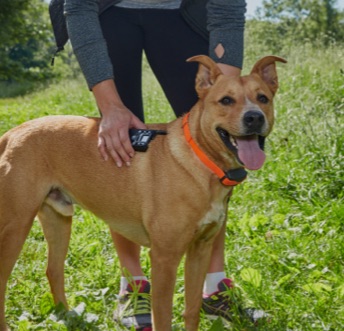
The correction is tunable, too: up to 20 levels plus an audible-only setting, so a nervous terrier and a stubborn Lab are not treated the same. DogWatch also makes a point about reaction time - the collar is meant to sound its warning before the dog reaches the wire, not while he is already sailing over it. For a fast dog at a full run, that head start is the difference between a boundary and a suggestion.
03When a buried wire learned to text you
The SmartFenceFor a product category built on wire and radio, DogWatch's most interesting recent move is software. The SmartFence, introduced in 2017, was the first "connected" hidden fence: it pairs the standard system with a mobile app that reports the status of the fence and sends text or email alerts when the boundary wire breaks or the collar battery runs low. That solves the category's quiet anxiety. A cut wire used to be invisible until the dog was already gone. Now the fence tells on itself.
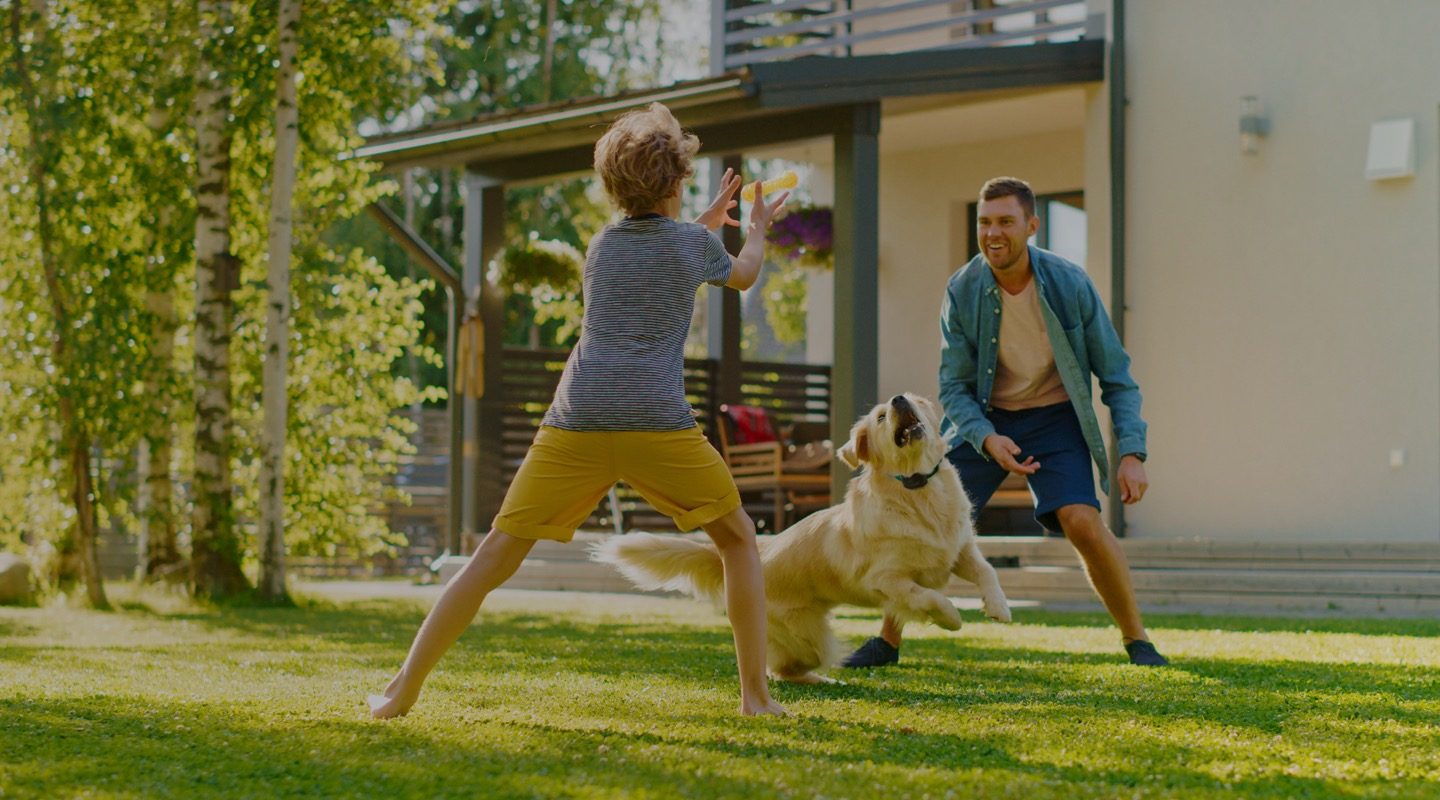
The rest of the lineup fans out from there. The ProFence is the flagship outdoor system. The 1200Fence scales to properties up to 200 acres. SkyShepherd adds a GPS option for owners who want to skip the wire entirely. Indoors, the same trick keeps cats off counters and dogs out of the trash. And a set of training products - the BigLeash remote trainer, the BarkCollar and the SideWalker leash trainer - extend DogWatch past containment into everyday behavior.
04The business is the dealers
A distribution strategy in disguiseHere is the part worth stealing. DogWatch does not, for the most part, sell to you. It is a wholesale manufacturer that sells through more than 200 independent, locally owned Authorized Dealers across 46 states and roughly 17 countries. The dealers handle sales, installation, training and service in their own territory. It looks like a franchise but is not one - there are no franchise or royalty fees; dealers simply license the DogWatch trademarks for a defined area.
That structure is the reason a hardware company from Natick can operate in 17 countries without owning a single storefront. It also explains the loyalty: seven dealers have been with DogWatch since it started, and some have handed the business to a second generation. When your distribution partners think in decades, so does your product roadmap.
Figures are DogWatch's own product claims; competitor battery life is an industry approximation.
05Where it sits on the map
The competitive laneThe field splits four ways. Invisible Fence is the original rival and DogWatch's founding benchmark - buried wire, but on AM. PetSafe plays the budget end with wired and wireless kits. Then there is the newer app crowd, Halo Collar and SpotOn, selling GPS boundaries with monthly subscriptions and no digging. DogWatch's position is the contrarian middle: professionally installed wire that will not drift, a patented FM signal for interference resistance, and no subscription. In a market racing toward the app store, "we designed it to just work, and a local person installs it" is a real stance.
06The dealers who show up for police dogs
The K9 Care ProgramA distribution network of local operators turns out to be good for more than sales. In 2024 DogWatch launched its K9 Care Program, in which dealers donate canine first-aid - K9 Medic kits - to police and working-dog teams. It began with one dealer in Michigan donating kits to 14 Michigan State Police K9 units, and spread from there to sheriff's offices and police departments in other states. It is a small program, but a telling one: the same people who install your fence are the ones handing emergency kits to the local K9 handler.
07What you can copy - and where it breaks
The takeawaysThe reusable lessons are clean. Start from a problem you personally refuse to live with. Pick a technical lane your competitors ignored and make it your identity. Push distribution and customer ownership out to committed local partners. Sell reliability, not features - a two-year battery and a fence that texts you are both really pitches for peace of mind. And stay independent long enough that longevity itself becomes the moat.
Where the model would not travel: it depends on a dense network of skilled local dealers, which is hard to build from scratch and slow to scale. It suits homeowners with yards, not renters or apartment dwellers. And in a market drifting toward DIY GPS and subscriptions, the wire-and-installer approach asks customers to value durability over convenience - a bet that works precisely because DogWatch has spent 35 years making it credible.
Explore DogWatch
Watch
Company figures such as revenue and headcount are third-party estimates; DogWatch is privately held and does not disclose them.