The invisible fence is one of the last products in the American yard still running on buried wire. You trench a loop around the property, plug in a transmitter, and hope the dog respects a shock line it cannot see. It has worked more or less the same way since the 1970s. Then a dog named Ruby escaped one, ran into the road, and was hit by a car - and Ken Ehrman, an engineer who had spent 25 years putting radios and GPS on forklifts and delivery trucks, decided the whole category needed to be dug up.
Ehrman is not a pet-industry lifer. He built I.D. Systems, an industrial Internet-of-Things company now known as Powerfleet, and holds more than 40 patents in wireless tracking. After his niece's dog died escaping a wired fence, he looked at the problem the way a fleet-telematics person would: a boundary is just a geofence, a dog is just an asset you want to keep inside it, and GPS already solves that for trucks. The missing piece was not the technology. It was making a dog understand the line - and that is where the second phone call went out.
"The invisible fence is really one of the last wire products out there."Ken Ehrman, Co-Founder & CEO
Ehrman connected with Cesar Millan - the behaviorist known to a generation as the "Dog Whisperer" - reportedly through LinkedIn. Millan did not sign on as a face for the box. He came on as a co-founder, and his training method got welded into the product itself: the collar does not simply zap a dog at the boundary, it walks it through a sequence of tones and vibration meant to teach the edge the way a trainer would. Ehrman's brother Michael, former CTO at I.D. Systems and holder of another 30-plus patents, rounded out the founding trio and gave the pitch its tagline. They were, he said, building a smartphone for dogs.
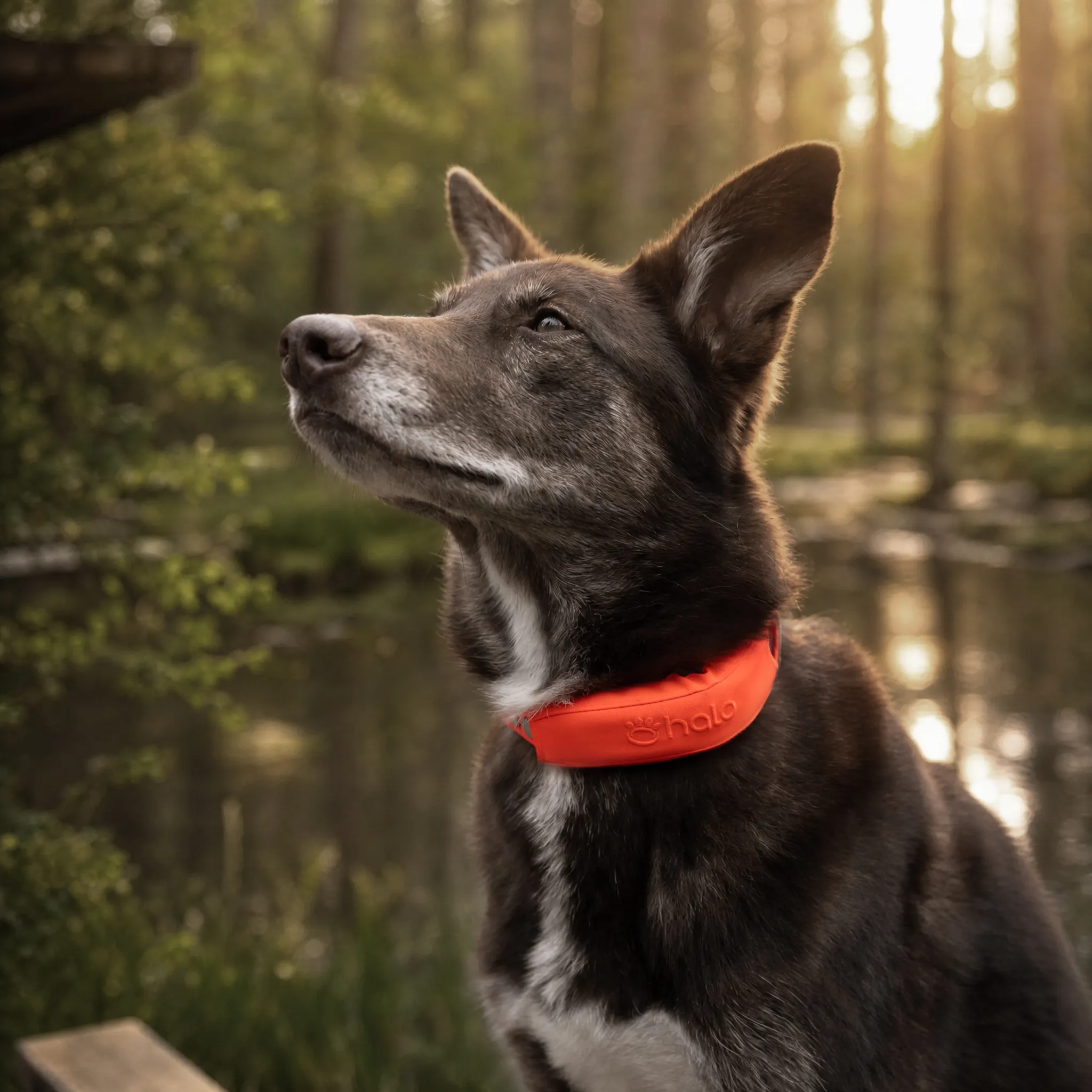



The company runs fully remote out of Plano, Texas, on a team of roughly 76 - small for the noise it makes, and decorated enough to keep showing up on Inc.'s Best Workplaces list two years running. That lean, distributed shape is part of how a pet-safety startup ends up on the same innovation lists as companies ten times its size.
01 / WHAT IT ACTUALLY DOES
You draw the fence on a map
Instead of trenching wire, a Halo owner opens the phone app and draws virtual fences on a map - a backyard, a campsite, a friend's farm. The collar tracks the dog's position in real time and, as it nears a boundary, delivers a chosen sequence of feedback: a tone, a vibration, and if needed a static cue, all sequenced around Millan's method. The newest model, Halo Collar 5, launched in September 2025 with what the company calls "AlwaysOn" GPS reporting up to 20 location updates per second, dual-frequency positioning, roughly 48 hours of battery, and a "positive-cue" guidance mode it markets as escape-proof. The 2024 model, Halo Collar 4, introduced the dual-frequency GPS and an adjustable tailoring system fitting necks from 8 to 30.5 inches.
The portability is the part wired systems can never match. A buried fence lives at one address. A GPS fence travels in a backpack, which is why Halo leans hard on the outdoor and travel crowd - people who want a boundary at a rented cabin or a trailhead, not just the suburban lawn.
02 / THE BUSINESS MODEL
Sell the collar, rent the fence
Here is the move that hardware founders should actually study. Halo sells the device direct-to-consumer - Halo Collar 5 launched around $599 - and then charges a mandatory monthly "Pack Membership" to keep it working. The subscription funds the cellular data, the GPS fencing, the app and the training content. Skip it and the collar loses its core features. Plans run from roughly $9.99 a month for five fences up to about $19.99 for unlimited fences plus live training sessions and expert Q&As.
Most physical-product companies get one transaction and thin margins. Halo turned dog containment into recurring revenue, which is exactly why its reported numbers climb the way software numbers do - from a few million in 2020 toward $75M-plus in 2024 by the company's own telling, with roughly 600,000 collars sold cumulatively. Those revenue figures are company-sourced and should be read as claims, not audited fact. What is on firmer ground: a Series B closed at a reported $400M valuation in December 2021, followed by growth funding from Decathlon Capital Partners in 2023 and a term loan from Chicago Atlantic that November.
03 / THE COMPETITION
$999 up front, or a monthly fee
The direct rival is SpotOn, another GPS virtual fence that costs about $999 - with no required subscription. That is the whole strategic split: SpotOn asks for more money once, Halo asks for less up front and then every month. Independent testers generally credit SpotOn with tighter boundary accuracy, while Halo counters with a lower entry price, Cesar Millan's training system, and a heavier software and health-tracking layer. Further out sit GPS trackers like Fi, Tractive and Whistle - useful for location and activity, but they do not contain a dog. And underneath everything sits the incumbent Halo was built to replace: the legacy buried-wire Invisible Fence.
| Halo Collar | SpotOn | Invisible Fence | |
|---|---|---|---|
| Type | GPS virtual fence | GPS virtual fence | Buried wire |
| Up-front | ~$599 | ~$999 | Install cost varies |
| Subscription | Required | None | None |
| Portable | Yes | Yes | No |
| Training built in | Cesar Millan method | App guidance | Flags & pro training |

04 / WHERE IT STRUGGLES
GPS hates a roof
No honest profile skips the fine print, and Halo's is written into physics. The collar needs to see satellites, so it is not built for indoor tracking - walls and especially metal roofs can block the signal. Under heavy tree canopy or in tight urban settings, positioning can drift, and independent tests have reported more boundary wander than SpotOn in those conditions. When GPS gets too weak, the fence preventions auto-disable and tracking pauses by design, which is the safe failure mode but not the reassuring one. And near windows, garages or upper floors, a stronger indoor read can occasionally trigger feedback the dog did not earn. It is a genuinely clever product operating inside genuine limits: open sky, a charged battery, and an active subscription are the conditions for it to do its job.
"You're not really searching that term unless you're looking to buy, so we knew there was definite demand."Ken Ehrman, on why "invisible fence" was the market to attack
05 / WHERE IT FITS
The recurring-revenue race in pet tech
Halo sits at the intersection the whole industry is drifting toward: hardware plus health data plus a monthly bill. It has picked up the trophies that signal a company is being taken seriously - TIME Best Inventions 2025 (special mention for Halo Collar 5), Fast Company's Most Innovative Companies 2024, and repeat spots on Inc.'s 5000 and Best Workplaces lists as a fully remote team. The retail push into Walmart, Best Buy, Chewy and Scheels is the tell that management thinks the direct-to-consumer ceiling is close and the aisle is next.
What is copyable here is not the GPS. It is the packaging: take a frozen category, attach a recurring reason to keep the device switched on, and hire your credibility as a co-founder rather than an endorsement. Whether a monthly fee for a fence is fair is a question every owner answers for themselves - but the more than 200,000 dogs already wearing one suggest a lot of people have decided it is.