Beuhi Built a Home Candy Factory for the Edibles Generation
A New Jersey team wants a machine that presses out infused gummies, chocolates, and hard candies - your botanicals, your dose, about forty minutes - in every kitchen. Here is the pitch, and where it gets complicated.
There is a strange gap in the $20 billion market for infused candy: almost nobody trusts the dose. Buy a gummy at a dispensary and you are handing your evening to a stranger's mixing bowl - the potency that floored you last week might do nothing tonight, and the aftertaste is something you have learned to tolerate. Beuhi, a small food-tech company in Westfield, New Jersey, looked at that gap and built the literal machine to close it: a countertop appliance that makes gummies, chocolates, and hard candies at home, doses them with an app, and hands the recipe back to you.
Think of it as a Keurig for edibles. You drop in a pre-filled flavor pod, add your own botanical - CBD, cannabis, a vitamin blend, a sports supplement - and the machine handles the melting, mixing, dispersion, and cutting. Roughly forty-five minutes later you have a batch of finished candy where, in theory, every piece carries the same dose. The company calls the whole idea "Make Your Own Bliss," which is either delightfully on-brand or a red flag, depending on your tolerance for wellness copy.
The problem it is chasingConsistency, not novelty
Beuhi's origin story is a complaint. Co-founder and designer Paloma Campo has said the idea started with watching a friend struggle with store-bought edibles - the same product working "wonders one day only to falter the next." Uneven dispersion is a real manufacturing headache: mix an active ingredient into a warm candy base badly and it pools, so the corner piece is a knockout and the middle one is sugar. Beuhi's pitch is that a machine with app-controlled timing and mixing can spread the active evenly across a batch, then cut it into uniform pieces.
"He couldn't understand how one gummy would work wonders one day only to falter the next. I knew there had to be a better way."
Paloma Campo, FounderHow the box worksPod in, candy out
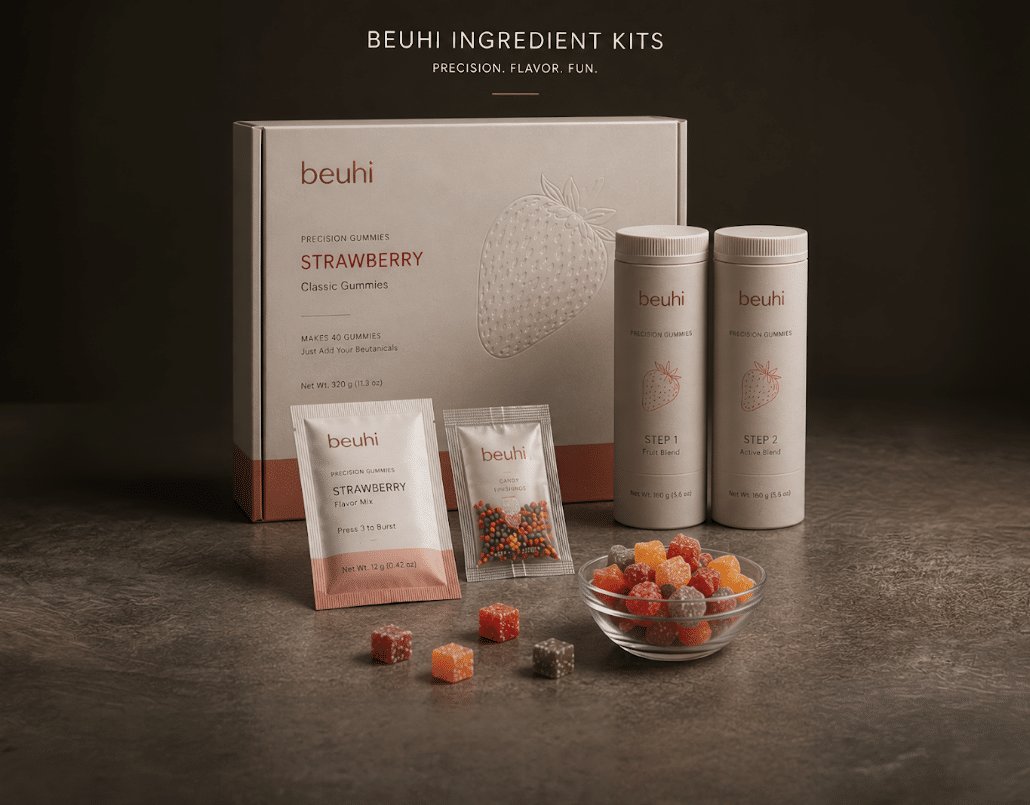
The hardware is a sealed countertop unit with a door, a small screen, and a heated chamber. Beuhi sells pre-filled "Precision Gummies" ingredient kits - a Step 1 fruit blend and a Step 2 active blend, plus a flavor sachet - alongside a reusable "universal" pod that lets you infuse a batch with a botanical you already own. Load it, pick a program, and the appliance runs the cycle. Depending on which of the four included cutting molds you use, a single batch yields somewhere between 35 and 140 pieces.
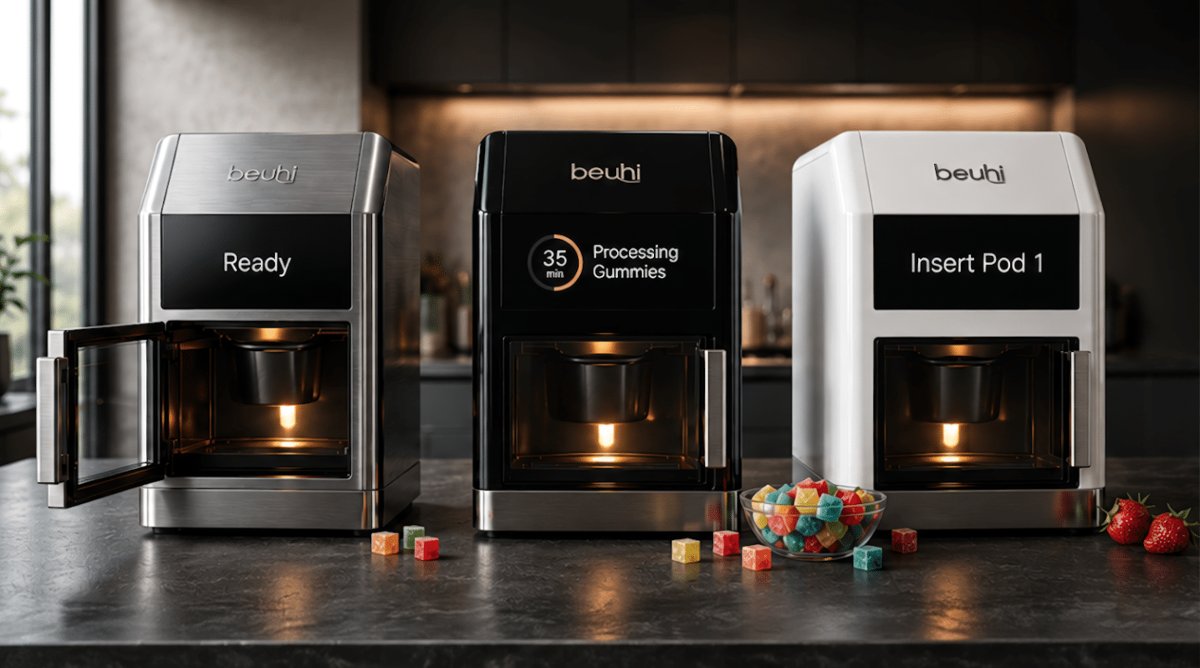
The second half of the product is software. The Beuhi app is pitched as the brains: a precision infusion calculator to set your dose, appliance control, formula management, journaling, data analytics, and a community layer with recipes and shared formulas. It is also where the business quietly lives - the app connects to e-commerce for the pods and drops, which is how a candy machine becomes a subscription.
The business modelThe Keurig move
The clever part of Beuhi is not the machine, it is the economics around it. This is razor-and-blade, straight out of the single-serve coffee playbook: the appliance gets you in the door, and the recurring money comes from pods, the "Beutanicals" infusion drops, and a monthly subscription of ingredient kits. The app is the lock-in - your saved formulas, your dose history, your community all live inside it. Hardware companies love this pattern because a box you buy once is a bad business, and a box that needs refills every month is a good one.
Bigger than cannabisOne machine, many markets
Cannabis gets the headlines, but the smartest thing about Beuhi is that the same appliance also makes a vitamin gummy, a magnesium sleep chew, or a protein candy for someone who would never set foot in a dispensary. That optionality is a hedge: where cannabis is legal, Beuhi is a cannabis product; where it is not, it is a wellness appliance. The Beutanicals line reads like a mood board - Rest, Focus, Energy, Calm, Recover, Glow - which tells you exactly which shelf the company wants to sit on.

Who it is forThe dose-sensitive crowd
Beuhi's real customer is not the seasoned stoner who is fine eyeballing it. It is the cautious one: the wellness shopper, the older adult managing sleep or pain, the sober-curious person who wants a mild, predictable effect and total transparency about what is inside. For that buyer, the effort of making your own candy is not a bug - it is the entire value proposition. Control over dose, ingredients, and flavor is the product; the gummy is just the delivery format.

A batch of 10 mg sleep gummies dosed to your exact tolerance. A tin of low-dose "microdose" chocolates for a dinner party. Caffeine-free focus chews with your own nootropic blend. Vitamin gummies for kids without the mystery-sugar coating. Same box, different pod.
The market it is betting onA category that keeps growing
Beuhi describes itself as solving systemic problems in the "$20B+ infused confection market." The broader functional-confectionery category - candy that claims to do something beyond taste good - is on a steady climb by most third-party estimates, which is the tailwind the company is leaning into. The bet is that a chunk of that spending shifts from finished products bought at a counter to ingredients bought for a machine on your counter.
The alternativesWhat Beuhi is up against
Beuhi is not the first company to sell home infusion. Devices like LEVO and Ardent's decarboxylation and infusion machines already let people make infused oils and butters, and the internet is full of magic-butter blenders and silicone gummy molds for anyone willing to do the chemistry by hand. And of course, the simplest competitor is the dispensary shelf, where the candy is already made. Beuhi's wager is that none of those combine finished-candy output, app-controlled dosing, and branded flavor pods in one appliance. That is the whole differentiation - and it is also a lot of surfaces to get right at once.
The money and the teamA big swing from a small crew
Beuhi was founded by David Martin, who serves as CEO, alongside designer Paloma Campo and Rick Martin, its COO. Martin's path into the business ran through cannabis: a career in the industry and a stint in 1871's Cannabis Innovation Lab. The company has kept the headcount lean - around ten people - and layered on an advisory board of cannabis-industry veterans, including John Svoboda of the Cannabis Chamber of Commerce. To fund the jump from prototype to production, Beuhi opened a Wefunder community round at roughly a $15 million valuation cap, inviting everyday investors in rather than chasing a single venture check.
"Beuhi has created a unique, versatile, and fun way for consumers to control their journey."
John Svoboda, advisory boardIt has also collected partners at a fast clip for a company this size: a retail tie-up with Weedland, a medicinal-patient partnership with Plesio Health, a content collaboration with cannabis chef Guidance Moon, and an augmented-reality experiment with AR Hero shown at MJBizCon. That is a company building a hardware product, a CPG brand, and a software platform simultaneously - ambitious, and hard.
The honest partWhere it gets complicated
Here is the catch worth naming. Beuhi is a bet that people will do more work to get more control, and most people, most of the time, choose convenience. Buying a gummy is frictionless; making one - pod, botanical, cleanup, a forty-minute wait - is not. The idea works best for a specific, dose-sensitive buyer who genuinely cares about what is inside; it works worst for the casual user who just wants the effect and would rather not run a small factory to get it. Add the realities of hardware - a product still marketed as "coming soon," no public price yet, and a candy market where kitchen appliances go to die - and the honest read is that the concept is sharp and the execution is the entire ballgame.
What is genuinely worth stealing, whatever happens to the machine, is the framing. Beuhi took a category people quietly distrust and made "control" the feature - your dose, your ingredients, your recipe, printed one batch at a time. That reframe travels well beyond candy. Whether enough people want to make their own bliss at home is the billion-dollar question hiding inside a very fun product.