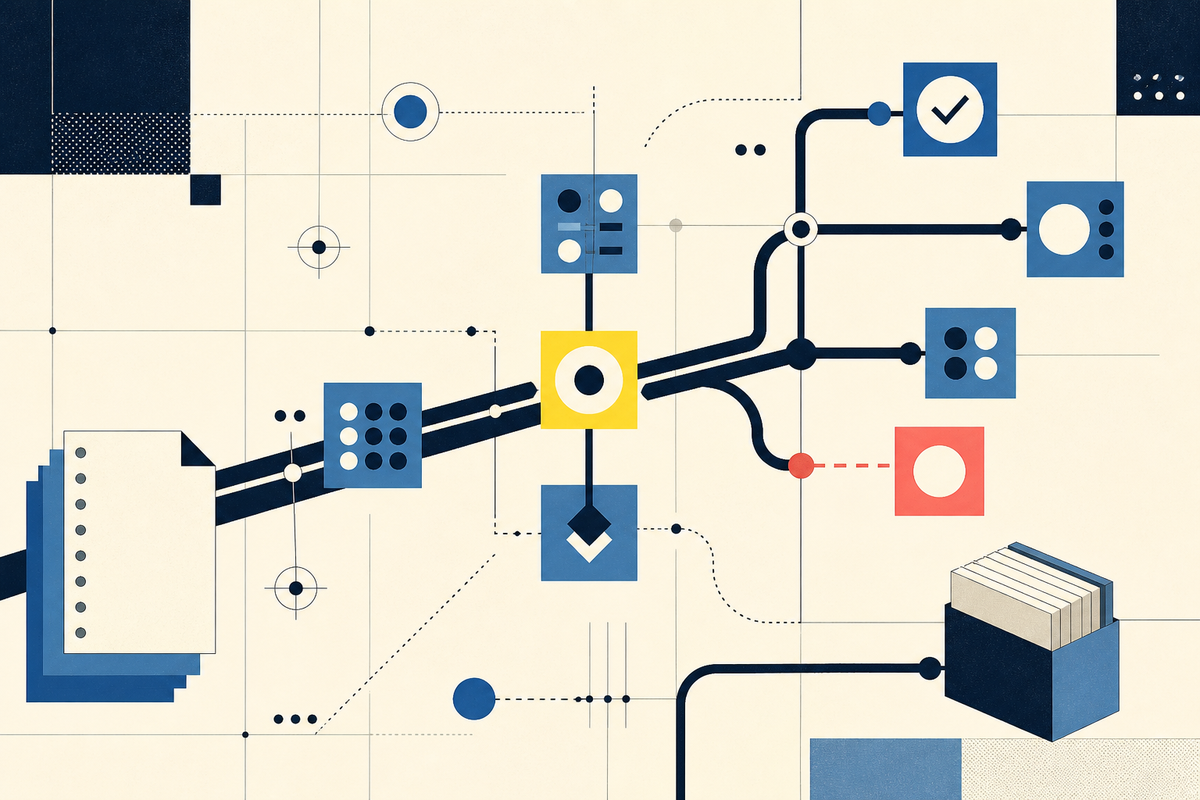
The least interesting thing about a modern document is the page. A customer sees a contract, a statement or a benefits letter. Behind it sits a small factory: source data, approved language, conditional rules, brand templates, human sign-off, delivery preferences, accessibility requirements and an archive that may need to explain the result years later.
That factory used to be treated as office plumbing. Someone exported a file, someone else fixed the formatting, and a watched folder carried it toward print or email. The routine looked harmless because people supplied the missing logic. They knew which spreadsheet to clean, which template was current and which job had to be restarted. Then volumes grew, channels multiplied and the person who remembered the workaround left.
Adobe, Solimar Systems, Bottomline, Oracle, Crawford Technologies and Formstack all sell into some part of this problem. Grouping them together is useful only if the differences remain visible. Formstack can turn CRM data into a proposal without code. Crawford can re-engineer a high-volume print stream after another application has composed it. Adobe can join adaptive forms with personalized communications. Oracle describes Documaker as a document factory. These are adjacent tools, not interchangeable boxes.
The file is the receipt
The output is evidence that a larger process ran. A reliable system should be able to answer basic questions: Which record supplied the address? Which clause library was active? Who approved the exception? Which template version rendered the page? Was the recipient's channel preference honored? Did delivery succeed? Can support retrieve the same artifact?
That last question - can you prove what happened? - separates a convenience tool from operational infrastructure. Generation speed matters, but evidence matters more when money, coverage, consent or a regulatory deadline depends on the page. The best design is not necessarily the system with the longest feature list. It is the one that owns the risky handoff without creating a new mystery beside it.
Six centers of gravity
Each platform reveals its history in what it treats as the center of the workflow. Start there, then work outward.
Adobe
Experience Manager Forms combines adaptive and paginated forms with reusable content, back-end data, document services, security and delivery across web, email, apps and print. It fits organizations already treating digital experience as a managed content system.
Solimar Systems
Chemistry is modular workflow software for onboarding, enhancing, producing, tracking, storing and reporting on print and digital jobs. Its vocabulary begins on the production floor, where visibility and output control are daily concerns.
Bottomline
Transform customizes ERP output without custom ERP programming, then supports multichannel distribution, storage, retrieval and auditing. Bottomline's broader payments business makes the document part of a transaction rather than an isolated creative asset.
Oracle
Documaker Document Factory applies an assembly-line model to production, delivery and monitoring. Its dashboard, administration, web services and interactive correspondence tools point toward controlled, high-volume publishing in complex enterprises.
Crawford
Crawford works heavily after composition: converting formats, adding controls, extracting data, orchestrating output and producing accessible alternatives. That can extend a legacy source without forcing the originating application to change.
Formstack
Documents follows a direct create, populate and deliver model. Teams can upload templates, apply conditional content, connect business systems, use an API and route output to repositories or e-signature tools with less engineering overhead.
The right shortlist begins with the broken handoff, not the product category.YesPress field note
Start where the process breaks
A buyer who says “we need document automation” has described the aisle, not the item. The useful brief names the failure. Sales spends hours copying CRM fields into proposals. A bank cannot trace which content rule produced a notice. A print operation needs to migrate AFP output without rewriting the policy system. A government agency has years of inaccessible PDFs. Each problem creates a different shortlist.
The diagram should include the awkward parts: shared drives, macros, watched folders and the employee who renames a file before lunch. Those are not footnotes. They are undocumented interfaces. A platform can automate the polished middle while leaving the fragile edges untouched, producing a faster process that still depends on memory.
Exceptions are the product
Happy-path generation is easy to demonstrate. The operational burden lives in bad addresses, missing records, duplicate jobs, unavailable delivery services, unapproved copy and corrupted files. Ask vendors to run a failed job during evaluation. Watch what the operator sees, what can be retried and whether the system prevents a duplicate from reaching a customer.
Version control deserves the same attention. Business users should be able to change approved content without opening a software release every time, but freedom needs guardrails. A durable setup separates content, design and logic; assigns owners; requires appropriate approvals; and preserves the exact combination used for each output. Otherwise a no-code editor merely relocates production risk.
Accessibility changes the architecture
An accessible document is not simply a visual PDF with larger type. Reading order, headings, tables, labels, alternatives and navigation carry meaning that sighted readers may infer from position alone. W3C says WCAG is organized around four principles - perceivable, operable, understandable and robust - with testable success criteria. The European Accessibility Act came into effect in June 2025 for covered products and services, adding another reason for organizations to understand which communications fall within their obligations.
This makes accessibility a pipeline decision. Adobe can design responsive forms and multichannel communications upstream. Crawford emphasizes post-composition transformation into formats such as accessible PDF, HTML, braille, large print and audio. Those approaches can coexist, but they solve different inventory problems. New templates should carry structure by design. Existing archives may require a repeatable remediation layer. Neither approach eliminates testing or legal analysis.
AI enters the template room
The newest pitch is faster authoring. Formstack markets an AI-powered document builder. Adobe documents a form-creation job that can turn plain-language requirements or an imported PDF into a form structure. These capabilities can reduce setup time, especially for a first draft. They do not remove the need to validate calculations, clauses, data mappings, brand rules or accessibility.
A sensible boundary is to let automation propose structure while named owners approve meaning. Track the prompt, source material, generated changes and final approval just as you would track a human edit. In document systems, plausibility can be dangerous: a clause that reads smoothly but changes an obligation is worse than a visible formatting error.
A buying test you can steal
Choose one real workflow with enough volume or complexity to hurt. Give every vendor the same source data, templates, conditional rules, approval path, delivery target and accessibility requirement. Include deliberate failures. Then score the whole operating experience, not just the generated page.
- Measure time from source event to confirmed delivery, including human waiting.
- Count manual touches, custom scripts and ownership changes.
- Test a source-system outage, a bad record and a duplicate submission.
- Retrieve the audit trail for one output without engineering help.
- Change and roll back a template while work is in flight.
- Validate the output with users and appropriate accessibility tools.
- Estimate migration, template maintenance and exception-handling costs, not only license fees.
After launch, watch exception rate, rework, delivery failures, retrieval time and the age of unresolved jobs. Hours saved is useful, but it can hide a queue that moved from clerks to engineers. The point is not to ban human judgment. It is to reserve people for choices that deserve judgment and make every routine handoff easier to see.
The page will survive. So will print, email and the PDF. What has changed is the standard around them. A document can no longer be evaluated only by how it looks when it opens. It must carry the right data, approved meaning and usable structure, arrive through the right channel and leave behind a trustworthy record. The back office did not disappear. Its logic became software.
Frequently asked questions
What is enterprise document automation?
It is software that combines data, templates and business rules, then generates, reviews, delivers, tracks and archives documents with fewer manual handoffs.
How does document generation differ from CCM?
Generation creates an output from data and a template. Customer communications management usually adds content governance, personalization, channel coordination, delivery and lifecycle controls at larger scale.
Which of these platforms is best?
There is no universal winner. Formstack emphasizes approachable generation; Adobe joins forms and communications; Oracle centers managed production; Bottomline connects output with ERP and transactions; Solimar and Crawford concentrate on demanding output workflows and transformation.
Can a platform modernize output without replacing the source?
Some can. Solimar and Crawford explicitly work with existing print streams, while Bottomline says Transform can customize ERP output without custom ERP programming.
What should a buyer test?
Run a real workflow with bad data, a changed approval, failed delivery, template rollback, audit retrieval and an accessibility check. The exception path is part of the product.