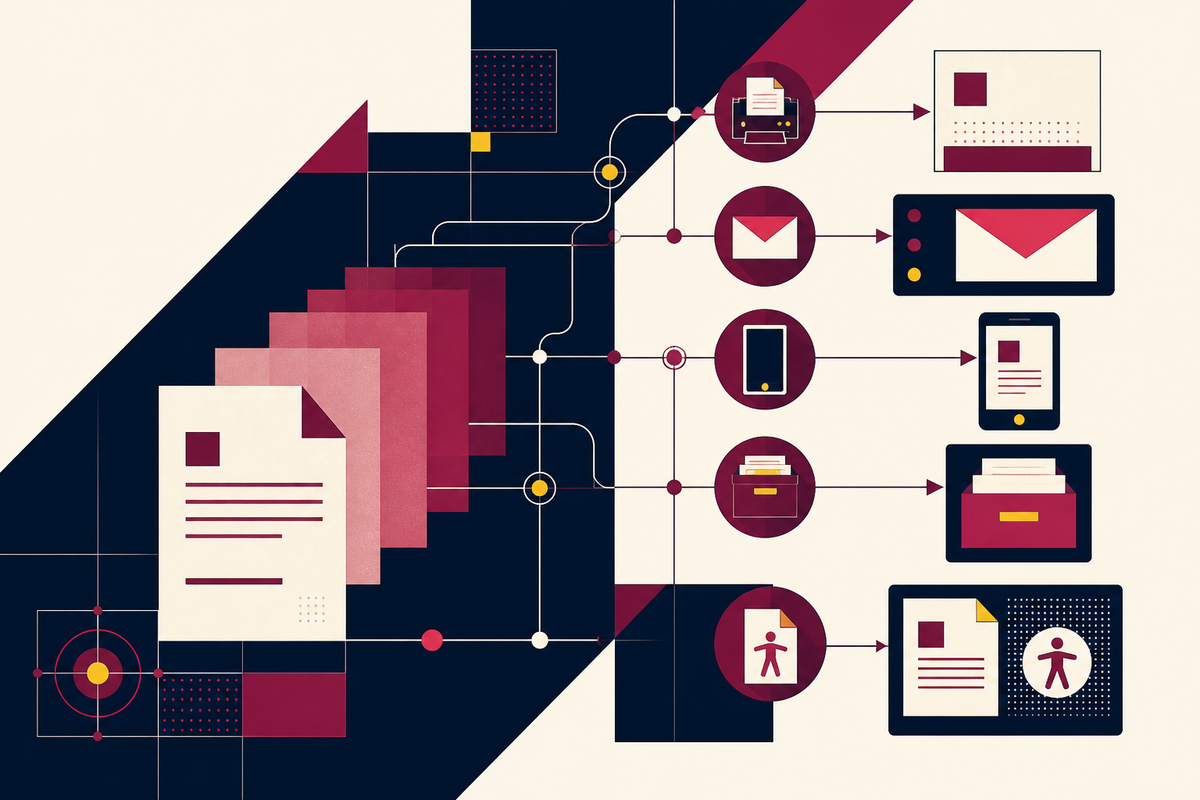
A customer opens an insurance letter and sees a few paragraphs, a table and a date. The company that sent it sees something else: account data pulled from an old system, approved language, a template, a rendering engine, a print queue, an email service, an accessibility check and an audit record. Every ordinary notice is the visible tip of a small industrial process.
That process explains why Messagepoint bought Sefas in March. The announcement was not simply one software vendor absorbing another. It was a bid to own more of the route between an approved sentence and a provably delivered communication. Messagepoint already sold Sefas technology through an OEM partnership announced in 2021. It used Sefas Designer for composition and Sefas Producer for high-volume processing. Acquisition turns a working relationship into a joined product strategy.
The companies did not disclose a price. They did explain the machinery. Sefas Conductor coordinates and tracks high-volume print and digital communications. Its Electronic Delivery Gateway connects delivery providers for email, SMS and other channels. Producer manages production. Designer creates and assembles the communication. Messagepoint brings content intelligence, migration tools and governance aimed at business users. Together, they cover more of the chain.
The fight is over the whole trip
Customer communications management, or CCM, grew out of document composition and print production. The category now claims a wider job: create, govern, personalize, deliver, archive and retrieve communications across channels. The examples are prosaic but consequential. Bills influence cash flow. Policy documents define coverage. Claims letters explain decisions. Regulatory notices can create legal exposure if they are late, wrong or inaccessible.
Sefas has worked in this terrain since 1991, before a web browser became a normal business tool. Its longevity matters because regulated organizations rarely replace every upstream system together. A bank may need to modernize a statement while preserving the account platform that supplies its data. An insurer may add mobile delivery while a print obligation remains. Sefas and several rivals sell a practical promise: keep what works, gain control over the output and move in stages.
The hard product is not the letter. It is the confidence to change the letter without losing control.YesPress analysis
Messagepoint says Sefas customers will not be forced to migrate and that no products are planned for discontinuation. The Harmonie Communication Suite name is being retired externally, while its modules continue within the Messagepoint portfolio. Designer becomes a Communications Cloud capability; Producer, Conductor, EDG and eAccess remain identifiable offerings. The French organization and team remain in place. Those promises lower immediate anxiety, though buyers should still ask how road maps, contracts and deployment choices evolve after integration.
Eight companies, four versions of the problem
The named competitors do not fit neatly in one box. Quadient, Elixir and Compart resemble broad CCM platforms. Broadridge combines communications technology with enormous operating scale and delivery experience. Lob begins closer to developers and direct mail. Crawford Technologies emphasizes document transformation, enterprise output and accessibility. Apryse sells document SDKs that let product teams build viewing, conversion, redaction, extraction and generation into their own applications.
Broadridge says its Communications Cloud handles seven billion omnichannel communications and connects print with more than a dozen digital channels. Lob says more than 12,000 companies use its direct-mail platform, which combines APIs, postal routing and a distributed print network. Those figures are company-reported, but they make an important distinction visible. Software that designs communication is different from infrastructure that gets it into a mailbox.
Apryse makes a similar point from the other side. Its server SDK processes more than 30 file types and can generate, convert, edit, redact, sign and extract data on premises or in a cloud chosen by the customer. It is a kit, not an editorial control room. For a product company that wants document capability inside its own interface, that difference may be an advantage.
Accessibility changes the buying brief
The most revealing front in this market is accessibility. A PDF can look correct to a sighted reviewer and remain unusable with a screen reader. Reading order, headings, table structure, alternative text and form labels live below the page's visual surface. Fixing those elements after millions of documents are produced is slow and expensive.
Crawford puts accessibility at the center of its pitch, including PDF/UA, WCAG-oriented remediation and outputs such as braille, large print and audio. Compart advertises accessible output alongside audit trails and approvals. Apryse includes accessibility compliance in its server toolkit. Quadient agreed in December 2025 to acquire accessibility specialist CDP Communications, explicitly linking the move to requirements in Europe and North America. Accessibility is becoming part of composition and transformation, not a cleanup station at the end.
This changes the definition of delivery. A file landing in an inbox is not necessarily a usable communication. A mailed statement arriving on time is not necessarily understandable. The better platforms will treat preference, format and accessibility as properties of the same job, with evidence attached.
AI is more useful before the first draft
Nearly every current platform story now includes AI, but generated prose is only the conspicuous part. The harder problem is inherited content. A large institution can hold thousands of templates containing repeated clauses, stale branding and slightly different versions of the same rule. Finding those patterns, comparing them and moving them into a governed system consumes more time than writing a fresh paragraph. Messagepoint emphasizes AI-assisted migration and content analysis; Elixir promotes migration automation and private writing tools; Compart and Quadient describe assistants inside their communication workflows.
The useful test is not whether a model can make a sentence friendlier. It is whether the system can show its work. Which source clause did it replace? Which documents inherit the change? Who approved it? Can sensitive data remain inside the buyer's chosen environment? In regulated communication, an untraceable improvement is another risk. AI earns its place when it shortens inventory, comparison and quality-control work while leaving a reviewable chain of decisions.
A buyer's test for the post-Sefas market
A procurement team can easily spend months comparing feature matrices that hide the real risk. The sharper questions follow the communication itself. Start with one difficult artifact, such as a multilingual benefits notice containing a table, legal clauses and a customer-specific calculation. Trace it from source data to archive. Ask who can change each component, what approval is required and what happens when one channel fails.
- Migration without theater. Demand a representative inventory, conversion test and exception rate. A demo template proves very little about thousands of inherited documents.
- Proof at document level. A green batch status cannot explain what happened to one customer's notice. Look for piece-level tracking and durable audit evidence.
- Accessibility in the engine. Test tagged output with assistive technology and real documents. Do not accept a checkbox as a workflow.
- Channels with ownership. Identify which vendor controls production and which hands off to partners. Measure failure recovery, not just channel count.
- An exit route. Confirm how templates, content, rules, archives and event data can be exported. Consolidation is useful until it becomes captivity.
The Sefas deal gives Messagepoint a more complete answer to that test. It also raises the standard by which the combined company should be judged. Integration must reduce duplicated controls, expose one reliable audit trail and preserve the deployment flexibility that legacy-heavy organizations need. A larger catalog alone does none of those things.
There is a reason this market attracts both suites and specialists. No single abstraction erases the physical mailroom, the inaccessible PDF, the core banking system or the developer who needs an API rather than a console. The winning architecture may be a strong control plane with replaceable edges. That would let a company govern language and proof centrally while choosing the best delivery network, transformation engine or embedded toolkit for a given job.
Most customers will never know Sefas changed owners. They will notice if a notice arrives late, if its language is confusing or if their screen reader cannot navigate it. This is the strange discipline of customer communications software: success disappears into an ordinary day. The acquisition matters because Messagepoint has taken responsibility for more of what must go right.
Follow the paper trail
Questions readers ask
What is customer communications management?
CCM software creates, approves, personalizes, delivers, archives and tracks customer-facing communications such as bills, statements, policies and notices across print and digital channels.
Who owns Sefas Innovation?
Messagepoint announced its acquisition of Sefas from Docaposte on March 5, 2026. Sefas now operates within Messagepoint.
What did Messagepoint gain?
The acquisition adds composition, high-volume production processing, orchestration and digital delivery technology to Messagepoint's existing content-management and migration capabilities.
Are all eight companies direct competitors?
No. Their capabilities overlap, but some sell broad CCM platforms while others specialize in delivery infrastructure, accessibility, transformation or developer SDKs.
What should buyers compare first?
Start with migration effort, governance, accessibility, document-level tracking, delivery ownership, deployment fit and the ability to export content and data.