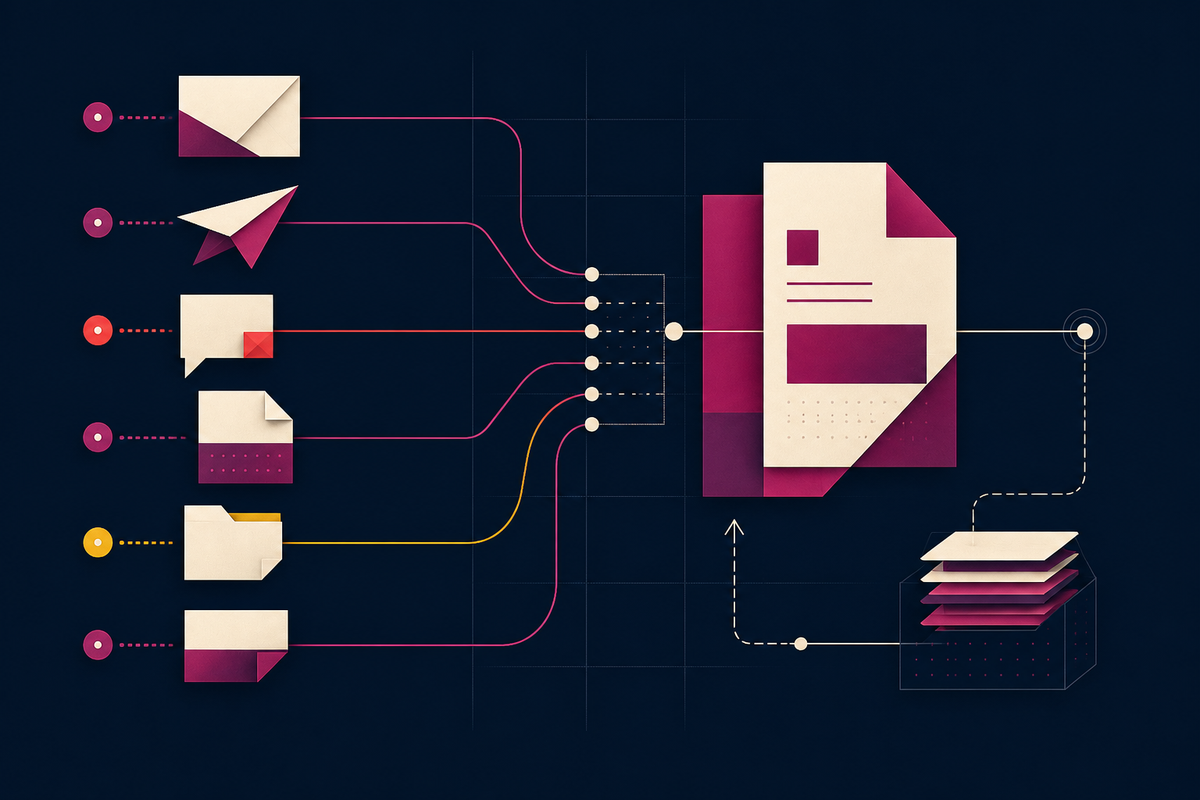
A customer opens a utility bill. Another taps a push notification. An insurance adjuster assembles a claims letter, while a salesperson turns CRM data into a proposal. In software directories, all four activities can drift under the same loose banner: customer communications. In practice, their risks, users and rhythms barely resemble one another.
That is how a buyer can arrive at a shortlist containing Doxim, Smart Communications, CleverTap, Experlogix, Windward Studios and GhostDraft. The list looks coherent from far away. Up close, it is a map of adjacent markets: customer communications management, or CCM; customer engagement; document automation; and industry-specific content governance.
The category confusion is not merely semantic. It encourages feature-grid shopping, where every row reads “personalization,” “omnichannel,” “automation” and “AI.” Those words flatten the decision. The sharper question is which failure the organization cannot tolerate. A late push notification wastes an opportunity. A wrong policy clause can create legal exposure. A bill that never arrives can interrupt cash flow.
A push notification and an insurance policy are both customer communications. They are not the same software problem.
Five layers hiding inside one label
A useful way to read this market is as a stack. At the bottom sits composition: templates, rules and data become a finished document or message. Above it sits governance: teams approve language, manage versions and preserve an audit trail. Delivery routes the output to print, email, SMS, portals or apps. Orchestration decides what should happen next. Feedback measures behavior and changes the next decision.
The communications stack
The handoffs matter as much as the layers. If the engagement platform decides to send but the document system owns the approved language, which one has final authority? If a customer changes a channel preference, how quickly does that choice propagate? If a template changes, can the company prove who approved it? Buying a suite does not automatically answer those questions.
Six names, six centers of gravity
Doxim
Built around regulated communications and managed delivery, including the stubbornly physical world of print and mail. Its public materials emphasize financial services, utilities and healthcare.
Company profile ↗Smart Communications
A cloud CCM platform that stretches from composition and digital forms toward conversation orchestration and archiving. Its 2025 Joisto and Pendula acquisitions widened that span.
Company profile ↗CleverTap
The outlier here: an engagement and retention platform centered on behavioral data, segmentation, experiments, journeys and decisioning rather than complex regulated documents.
Platform overview ↗Experlogix
Document automation joined to CPQ and digital commerce. The fit is clearest when quotes, proposals and other data-driven sales documents sit close to CRM or ERP workflows.
Company profile ↗Windward Studios
A familiar document-generation name in older comparisons. PDFTron acquired it in 2021; the technology now sits in Apryse's broader document toolkit.
Acquisition notice ↗GhostDraft
A vertical specialist for insurance. Its platform covers forms and communications from content creation and bureau libraries through testing, deployment and delivery.
Product profile ↗These descriptions are centers of gravity, not hard borders. Doxim offers digital engagement. Smart Communications reaches beyond document composition. GhostDraft delivers omnichannel output. CleverTap orchestrates messages. Experlogix generates more than sales proposals. Yet a product’s center still predicts its strongest users, implementation assumptions and definition of success.
Start with the cost of failure
The bar lengths are illustrative, not market data. They show how a different failure mode changes the buying priority.
The regulated document is still alive
The software industry likes a clean migration story: paper becomes digital, campaigns become conversations, and AI makes each one personal. Doxim’s own operating figures complicate that arc. The company reports 700 million mail pieces alongside 835 million email and SMS alerts and notifications. Even allowing for vendor-reported numbers, the coexistence is the point. Physical and digital are not consecutive eras. Large institutions operate both at once.
That reality favors platforms designed around continuity: core-system data, document composition, accessible output, delivery evidence, archives and service-level commitments. A healthcare explanation of benefits or a utility shutoff notice carries obligations that a promotional message does not. Design still matters, but proof matters too.
Vertical expertise can shorten the gap between a generic engine and a working process. GhostDraft, for example, advertises pre-built ISO and AAIS insurance content libraries, version controls and integrations with insurance core systems. Its case studies are vendor evidence rather than independent audits, but they illustrate the operational target. One quoted customer says letter design and development fell from more than 90 days to two days.
Days to design and develop customer letters in a Florida Peninsula Insurance example published by GhostDraft. The result is vendor-reported and specific to that implementation.
AI raises the price of weak governance
AI is entering every layer of the stack. CleverTap promotes decisioning that interprets intent and selects a message, channel and moment. Smart Communications has announced AI capabilities across its Conversation Cloud. GhostDraft writes about AI-assisted insurance content while warning that generic systems lack the controls required by insurance teams.
The tempting use case is faster writing. The durable use case may be faster controlled change: finding affected clauses, proposing a revision, tracing dependencies, routing an approval and testing every output variant. In regulated communication, generation is the easy demo. Provenance, permissions and rollback are the product.
This changes the RFP. Buyers should ask what the model can see, where customer data goes, whether generated language can bypass approval, how suggestions are logged, and how the platform behaves when confidence is low. “Has AI” reveals little. A bounded role with an inspectable trail reveals much more.
A shortlist you can defend
Before scheduling demos, write a one-page communication anatomy. Pick a real artifact, not a generic journey. Follow it from trigger to outcome. Name the system that provides data, the person who controls language, the approvals required, the delivery channels, the archive, and the metric that says the communication worked.
- Choose the failure. Is the current pain slow production, compliance exposure, unreliable delivery, weak personalization or poor measurement?
- Name the operator. A legal editor, operations team, developer and lifecycle marketer need very different kinds of control.
- Trace the data. Inventory core systems, CRM and ERP records, preferences, consent and behavioral events before admiring integrations.
- Test the ugly case. Ask vendors to revise a clause across hundreds of variants, recover a failed batch or explain a message to an auditor.
- Assign each decision once. One source of truth should own content, consent, channel choice, delivery evidence and performance.
Then shortlist by center of gravity. A regulated organization seeking managed print and digital delivery will read Doxim differently from a mobile-first product team tuning retention in CleverTap. An insurer rebuilding forms governance will notice GhostDraft’s domain model. A Salesforce or Microsoft shop automating proposals may look closely at Experlogix. A large enterprise consolidating composition, forms, orchestration and archiving may put Smart Communications through a broader test.
Windward deserves special handling because acquisition changed the sign on the door. Existing users should evaluate the current Apryse roadmap and support model, while new buyers should compare the active product rather than a remembered brand. Software categories age slowly; ownership and product strategy do not.
The winning platform is the one that removes the handoff nobody owns.YesPress analysis
There may be no single winner because the stack can require more than one system. The discipline is to keep the boundary explicit. Let the document platform own approved content and rendered output. Let the engagement platform own behavioral timing. Connect them through documented data contracts, consent rules and delivery events. Consolidate only when the operating model becomes simpler, not because two brochures share the word “conversation.”
Customer communications software does have an identity crisis. Buyers do not have to inherit it. Start with the artifact, the operator and the cost of getting it wrong. The category will become clearer as soon as the problem does.
Questions buyers keep asking
What is customer communications management software?
CCM software helps organizations create, govern, personalize, deliver and often archive customer-facing communications across print and digital channels.
How is CCM different from document automation?
Document automation centers on generating documents from templates and data. CCM usually adds content governance, channel delivery, preferences, archiving and lifecycle management.
Why is CleverTap different from the other vendors here?
CleverTap is primarily an engagement and retention platform built around behavioral data, segmentation, journey orchestration and experimentation. Its center is not regulated document composition.
Which products focus most clearly on regulated industries?
Doxim and Smart Communications explicitly target highly regulated enterprises, while GhostDraft is purpose-built for insurance. Actual fit depends on geography, workflow, integrations and delivery requirements.
What happened to Windward Studios?
PDFTron acquired Windward Studios in 2021. PDFTron later became Apryse, where document-generation capabilities continue within a broader document SDK portfolio.