A witness can speak for an hour. The work of turning that hour into a dependable written record can take much longer. Someone must identify the voices, untangle interruptions, check names and deliver a document in the right format. VIQ Solutions has built its business around that unglamorous distance between something said and something ready to use.
Its pitch pairs AI with the people who still have to read the output. Recording software captures the event; speech recognition produces a draft; a workflow platform routes the job through editing and delivery. Courts, police departments, insurers and broadcasters buy different combinations of those capabilities. The common purchase is relief from a pile of recorded material waiting to become useful text.
There is a corporate complication. VIQ is trying to make this labor-intensive business more profitable through software, while retreating from an Australian operation that could not make its global operating model work. The result is an unusually concrete AI story: microphones, document templates, human judgment and the price of a failed expansion strategy.
The first draft has a very literal name
VIQ calls its automated transcript product FirstDraft. The name usefully describes what arrives. Customers upload recordings, receive editable text and choose whether to review it themselves or request professional editing. VIQ advertises up to 95 percent accuracy, explicitly dependent on audio quality. That is a vendor claim with a qualification attached, not a promise that every testimony will emerge ready for a court file.
In FirstDraft’s review interface, text can be synchronized with audio or video for checking. A lawyer can search a deposition before deciding which passages need closer attention. An insurance adjuster can review a recorded statement. A detective can locate a name without listening to an entire interview again. The draft changes how people navigate recordings, even when the final document still needs work.
The speech engine, aiAssist, uses vocabulary tuned to an industry and accommodates client-specific workflows. Its job includes identifying speakers and making recordings searchable. That gives VIQ a more particular target than a general meeting-notes app: documents with recurring terminology, identifiable speakers and an established destination.
- 01CaptureAudio + video
- 02DraftSpeech to text
- 03ReviewPeople + context
- 04DeliverA usable record
The microphone gets a vote
CapturePro handles the beginning of that journey. It records audio and video, attaches comments and related material, and connects with external case and evidence systems. A courtroom deployment therefore involves more than pressing a red button. The recording has to remain associated with the event, the participants and the information people will need later.
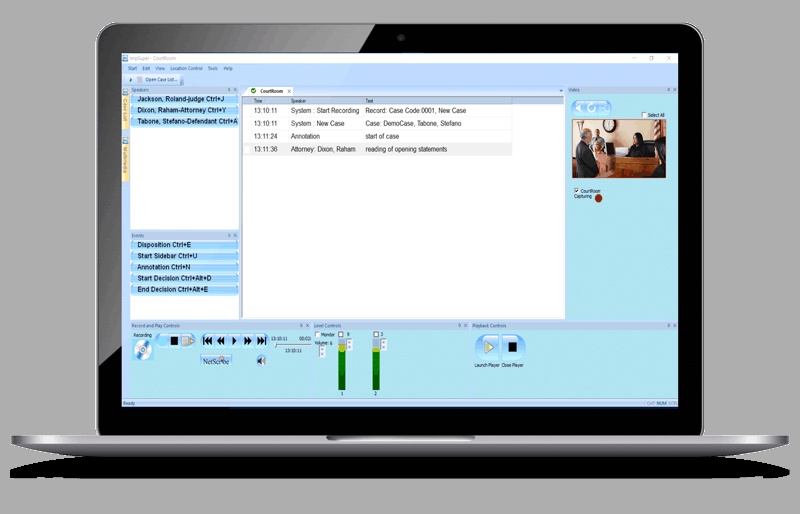
VIQ’s own audio-quality guidance gives the microphone its due. Overlapping speakers, poor placement, compression and dropped audio packets can all damage the input. A more elaborate language model cannot reliably restore words that were never captured. For a buyer, the practical implication is refreshingly physical: test the room and the recording equipment before judging the transcript engine.
NetScribe then organizes production. It can divide long recordings among typists and reassemble the results, apply routing rules and handle formatting, quality assurance and billing. It also accepts For The Record TRM and JAVS OGG files. That compatibility matters: an organization can retain existing recording equipment while changing how its transcripts get made.
A detective’s two-step upgrade
The customer problem comes into focus in VIQ’s Upper Gwynedd police case study. The Pennsylvania department had relied on typing during interviews. A district attorney’s requirement to record serious-crime interviews prompted a search for another approach. A recommendation from nearby Hatfield Police helped bring VIQ into the conversation.
Detectives used NetScribe Connect to drag in a recording and enter identifying details, including the interview participants and incident number. The company’s case study says transcripts were available in less than an hour. It is a customer story published by the supplier, but its mechanism is specific enough to understand: preserve the interview, submit it, then work from the returned draft.
“No IT required! The easy-to-use solution is simple to adopt and quickly receive transcripts.”
Detective Jon Kelcy
VIQ’s Upper Gwynedd case study, 2023
Courts have a different staffing problem. VIQ’s NetScribe documentation describes sharing transcription work between districts or sending overflow to its own services team. In July 2025, the company secured what it described as its largest SaaS engagement to date, covering nine judicial districts and 22 counties in the US Midwest. That is a test of pooled production capacity as much as speech recognition.
The software ambition, the services reality
VIQ was incorporated in 2004. Its later development included acquisitions of UK transcription business The Transcription Agency and Australian provider Auscript in 2021. This background helps explain the company’s hybrid identity: it owns software, but it also sells the finished work produced with that software.
The audited accounts make the distinction visible. Technology services contributed about US$37.23 million of US$41.49 million in 2025 revenue, roughly 90 percent. Separately reported SaaS revenue was about US$352,000. Licenses, maintenance, subscriptions and professional services supplied other income. Calling the whole business SaaS would obscure the economics it is trying to change.
Those economics depend on how much checking and coordination each job requires. An automated draft can reduce typing without removing editorial labor. VIQ’s recruitment pages still seek independent contractor typists and editors, offering flexible hours. The production expertise sits partly in those people: software can route a difficult passage, but a person must still listen to it.
Distribution is another piece. ORdigiNAL agreed in 2022 to offer NetScribe and FirstDraft through its dealer network, and still lists VIQ in its dictation portfolio. The company competes with internal transcription teams, outside agencies and specialist recording systems. Its case rests on joining several stages of the work, with customers able to choose software, services or both.
Australia put a price on the plan
The ambition met its harshest test in Australia. In November 2025, VIQ was telling investors that integrating its operating architecture there was expected to contribute more than US$3 million annually. By March 2026, the division was in voluntary administration. The speed of that reversal is central to understanding the company now.
Delivery problems were already affecting the numbers: VIQ attributed much of its 2025 revenue decline to Australian late-delivery fees and abatements. Then, in February 2026, it disclosed unauthorized access by members of its global personnel to certain Australian customer data. At that time, VIQ said there was no evidence of public disclosure or misuse and that other jurisdictions were unaffected. It engaged an independent cybersecurity firm to investigate.
The year-end results included US$9.1 million in non-cash impairments tied to reduced growth expectations following the privacy incidents, plus about US$1.2 million in restructuring charges. The audited net loss reached US$13.79 million. These figures describe different costs; an impairment is an accounting write-down, not the same thing as a cash bill.
Financing added pressure. VIQ had fully drawn a US$15 million Beedie secured facility by December 2023. The Australian administration constituted an event of default under the amended credit agreement. Management said it was redirecting money and attention to North America and the UK. In August, it confirmed that administrators had failed to sell or recapitalize Australia and that much of the operational wind-down had occurred in June.
One quarter. Two views.
A smaller business, with work still booked
VIQ’s August results show the new scale. Excluding Australia, quarterly revenue was approximately US$5.1 million, broadly unchanged from a year earlier, with a 65.5 percent gross margin. Adjusted EBITDA was about US$1 million. That adjusted measure excludes costs and is not interchangeable with net profit; it is useful here as one view of operations.
There is continuing customer business behind the figures. In June, VIQ announced two contract extensions: a US media customer representing about US$1.6 million annually, renewed to the second quarter of 2029, and a UK government customer worth approximately US$800,000 annually, renewed to the third quarter of 2028. Both customers were unnamed. Together, they illustrate the value of relationships that survive several technology cycles.
The useful lesson is in the handoff
A newer product detail captures VIQ’s approach at its most practical. NetScribe Connect can create a structured summary from a completed transcript. The product documentation describes it as optional and off by default. It leaves the transcript and recording unchanged, records the action in an audit trail and asks users to check the generated summary against the transcript.
That separation is worth copying: keep the record, then make helpful derivatives. A team can search or summarize material without quietly replacing the underlying account. The same discipline should govern a trial of the wider platform. Measure how long staff need to produce an accepted document, including corrections, formatting and review. A quickly generated draft is only one intermediate result.
The approach needs usable recordings, people who can check them and access arrangements that match the customer’s requirements. Its economics weaken when poor sound creates extensive rework, or when local operations cannot adopt the proposed process. VIQ’s products offer a way to organize that work. Its Australian experience supplies a reason to test the whole arrangement before assuming it will travel.