The first thing to fail was the room. Not the microphones, not the registration desk, not the coffee. The room itself - the old assumption that a thousand people, flying in from 36 countries, could be gathered and reshuffled every 20 minutes for thousands of private meetings. In 2020, a large professional-services firm brought that impossible calendar to Digimentors. Its annual Entrepreneur Summit had roughly 1,000 attendees and more than 3,000 requested meetings between investors and companies. The pandemic had made the physical venue useless. The obligation remained.
Digimentors did not try to imitate the ballroom with a grid of webcams. It treated the summit as a broadcast and a scheduling problem. The team selected an end-to-end event platform, built a microsite, managed invitations and registration, paired investors with entrepreneurs, wrote attendee communications, and generated a different schedule for each person. At peak load, 200 meetings ran simultaneously. Twenty-five minutes later, the grid turned over and did it again.
Then came the revealing part. In 2022, the client wanted the summit back in person. Yet it did not want to surrender the useful machinery invented for the virtual version. Digimentors brought in badging and schedule-printing kiosks tied to the software. The event returned to handshakes, while the control system stayed digital. Three thousand meetings took place, with 200 conversations cycling every 20 minutes.
The pivot was not from physical to virtual. It was from “event” as a place to “event” as an operating system.That distinction explains most of Digimentors
The company between the newsroom and the green room
Founded in New York in 2018, Digimentors calls itself the place where journalism, marketing, and innovation meet. This sounds like agency language until you inspect the service list. Live-streaming sits beside script development. Social audits sit beside executive coaching. Public relations shares a menu with event programming, recruiting, newsletters, SEO, and AI policy. The connective idea is not a channel. It is the movement of useful information from an expert to an audience, without losing the audience halfway there.
Sree Sreenivasan, the co-founder and CEO, spent years in institutions that had to explain complicated things in public. He was chief digital officer for New York City, the Metropolitan Museum of Art, and Columbia University, where he also taught journalism. His preferred phrase for a piece of live content good enough to interrupt an idle phone is a “thumb stopper.” Yet his more valuable advice is less glamorous: put a “digital wingman or wing woman” beside the presenter. That person reads comments, answers confusion, and keeps telling late arrivals what they are watching.
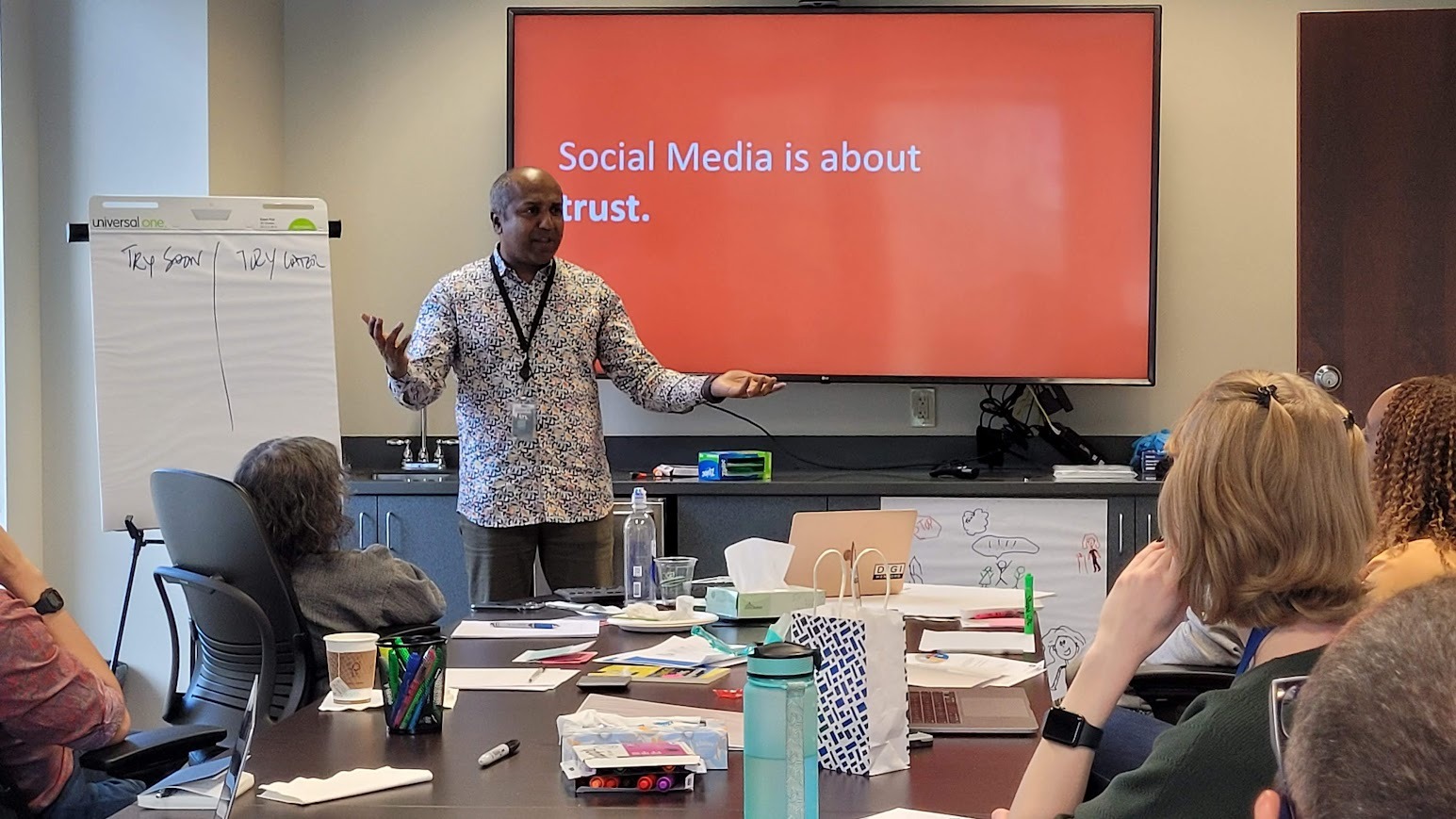
That small role reveals how Digimentors differs from a conventional production shop. Cameras matter, but orientation matters more. Viewers enter live programs without context. Speakers know too much. Institutions speak in acronyms. A good broadcast keeps repairing that gap in real time. A good social strategy does the same thing more slowly, post by post.
The gala that became a department
The pattern repeats in client work. Hip Hop Public Health first hired Digimentors in 2021 to amplify a virtual gala featuring its founder, Dr. Olajide Williams, and founding artist Doug E. Fresh. Digimentors promoted the event in real time and commissioned live sketches of key moments. The immediate job was the show. The larger problem appeared after it: the nonprofit lacked a dedicated digital communications function able to support its growth.
So the engagement widened. Digimentors audited the organization's social channels, website, newsletters, and campaigns. The resulting document ran more than 40 pages. It mapped immediate fixes, long-term goals, content plans, and workflow changes. Then the consultants helped define a missing job, write and circulate the description, vet candidates, lead interviews, check references, and onboard a digital communications manager. The hiring process took about six weeks.
Produce the high-stakes moment
Audit the system underneath it
Write the workflow and train people
Leave behind internal capacity
Readers can copy that sequence without copying the agency. Start with the moment when attention is concentrated: a launch, gala, summit, or difficult announcement. Observe every workaround required to produce it. Turn those workarounds into an audit. Turn the audit into roles, calendars, templates, and decisions. Finally, teach someone inside the organization to run the system. The artifact is not the livestream. It is the competence that remains on Monday.
The Southern Poverty Law Center followed a related path. Digimentors joined the planning committee for its 50th-anniversary celebration, helped secure speakers and talent, made a historical highlight reel, and directed a multi-camera stream. The relationship continued into social audits, a content roadmap, recurring workshops, process documents, a social calendar, and help filling key roles. A one-night production became ongoing communications infrastructure.
A consultancy with a classroom attached
Digimentors does not publish the cost of its custom production or consulting work. It does, however, sell a recording of a two-hour generative-AI workshop and panel for $10. More substantial AI work includes team workshops, scenario planning, strategy, policy, and an eight-week masterclass aimed at nonprofit leaders. The offer is consistent with the company's older social-media teaching: lower the fear, demonstrate the tool, establish useful rules, and let people practice.
This is where the education subcategory matters. Training is not an add-on to the production work; it is the business's delivery mechanism. The company serves nonprofits and universities as naturally as corporations because many of its buyers do not merely want a campaign. They need executives who can appear on camera, staff who can interpret analytics, and teams that know what to do after an outside adviser leaves.
Its own Sunday #NYTReadalong is a public laboratory for that thinking. Sreenivasan and Neil Parekh review the print edition of The New York Times in a recurring livestream and podcast, invite journalists and public figures into the discussion, and give the audience links and reading material. In June 2026, the program reached 400 episodes. The achievement is not a viral spike. It is the accumulation of a habit.
Useful when the stakes are live
Digimentors fits between several familiar alternatives. An event producer can stage the show. A PR firm can pitch the story. A social agency can fill the calendar. A coach can prepare the executive. A recruiter can find the next staff member. Digimentors' wager is that these are frequently the same problem viewed at different distances. Its value rises when the program is public, the logistics are brittle, the subject is complicated, and the client's team must become more capable while the work is underway.
That model has limits. It depends on access to decision-makers and staff who will adopt new processes. A client seeking only cheap media buying, a commodity webinar platform, or a single polished video may be better served by a narrower vendor. The approach also loses force when an organization wants attention but will not define what the audience should learn or do. Production can rescue a bad connection. It cannot rescue an absent purpose.
But when the room fails - or the plan, platform, staffing chart, or speaker confidence fails with it - the Digimentors instinct is useful: stop treating communication as a deliverable and map the whole system. The summit story ends with people returning to the building. It does not end with the old event returning. The room came back changed.