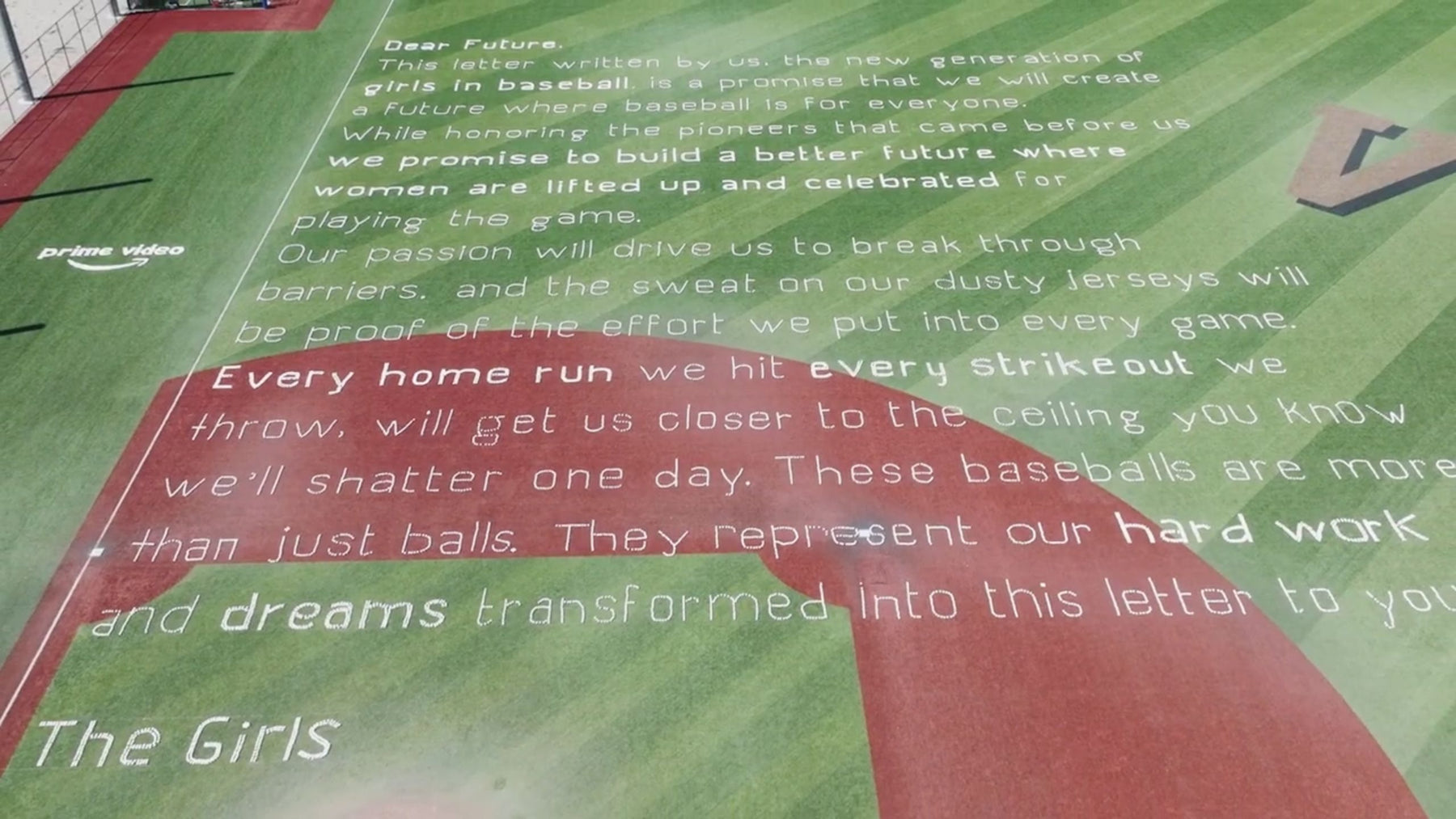
The message was 300 feet long, and it was written in baseballs. Thirty thousand of them, arranged on a field by more than 100 volunteers. Read from above, they formed a letter to the future: a promise that the next generation of girls would belong in baseball. Read from ground level, they looked like an operations problem with red stitching.
This was Newhouse working for Prime Video’s A League of Their Own. The New York agency also assembled a three-inning celebrity game, an interactive tunnel into the 1940s, concessions and a recovery lounge. Three hundred people came. Fifty-two creators participated without a fee, according to the agency. The campaign produced 232 posts and a reported 15.5 million impressions. The baseball letter was shortlisted twice at the 2022 Clio Sports Awards.
It is tempting to call the thing a stunt. That misses the useful part. The baseballs were a picture before they were a press release, an activity before they were an impression count, and a statement before they were content. Newhouse had made an object that explained the campaign without needing an account executive nearby.
The baseballs were not decoration. They were the media plan.
An agency built for the unruly middle
Founded in 2018 by William Heath and based on Clinton Street in Lower Manhattan, Newhouse occupies the unruly middle between PR firm, creator agency, event producer, social shop and production house. Its public service list runs from audience research and KPI dashboards to permitting, fabrication, press pitching, TikTok effects and payment reconciliation. That breadth sounds like a menu until you look at the work. Then it looks more like one kitchen.
Its customers are largely studios, streaming platforms and consumer brands with a familiar problem: they have a release date, a crowded feed and no automatic claim on anyone’s attention. Prime Video, Max, Warner Bros., Walmart, TikTok, Discovery+, Polkadog and Brud appear in the portfolio. These are not clients short of media inventory. They are clients short of reasons for people to care about this title or this product today.
The portable-moment system
Newhouse’s difference is less a secret style than an organizational decision: the experience and its distribution are designed together. For a Prime Video comedy, The People We Hate at the Wedding, the agency built an awkward-family-photo studio in a Los Angeles mall. Visitors entered sets, borrowed props and wardrobe, and left with printed and digital photographs. More than 25 creators opened the run. Roughly 100 posts followed, attached to a combined creator following above 57 million. A national contest extended the joke and drew thousands of submissions.
The booth worked because awkward family photography is already a social behavior. Nobody needed training. A person saw the set and understood both the joke and the resulting post. The experience had a built-in exit route.
What failed first was the old audience assumption
One of the agency’s earliest revealing assignments came from TikTok. The platform was popular with teenagers but wanted an older group - people in their twenties and beyond - to download and use it. A normal campaign might have explained TikTok to them. Newhouse instead devised #RunwayReady around New York Fashion Week: show the transformation from everyday to extraordinary. Four fashion and culture creators demonstrated the move, and a how-to video made the mechanic plain. Newhouse reports that it became TikTok’s fastest-growing challenge at the time, exceeding 100 million views in its first few days.
The clever part was not the hashtag. It was the recognition that a new audience would not be persuaded by a description of the platform. They needed a behavior they could imitate. Newhouse later helped create #ChallengeAccepted, described by the agency as TikTok’s first scripted content play, moving from scripts through 3D post-production in four weeks.
There is another kind of patience in the portfolio. For Miquela, the computer-generated influencer created by Brud, Newhouse treated the character like human talent: fashion partnerships, merchandise, music press and fundraising came first. The agency says it held back deeper interviews until the personality felt formed, then built longer relationships with outlets including The New York Times, Wired, Vogue and Interview. Newhouse reports growth from zero to 1.4 million Instagram followers in a year.
What changed the approach was not a campaign failure disclosed in a postmortem - Newhouse publishes successes, not autopsies. But its case studies repeatedly show an initial limitation forcing a change in method. TikTok could not age up by explaining itself. Miquela could not earn fascination by revealing everything immediately. A streaming title could not manufacture fandom with one broad creator list. For the Max launch, Newhouse built clusters around audience worlds, from comics to cooking, and reported 184 posts from 59 confirmed creators.
The cost is private. The cost structure is visible.
Newhouse does not publish fees, campaign budgets or revenue. The honest answer to “what did it cost?” is that the contract values are private. Its work, however, reveals where money and labor go. Large activations require locations, permits, fabrication, staffing, food, travel, talent coordination, production and post-production. Creator programs add research, negotiation, contracting, payment and verification. Paid media and reporting arrive after the content exists.
The large version
A field, 30,000 baseballs, more than 100 volunteers, 300 guests, sponsors, creators and a seven-minute documentary. High coordination, many failure points, one unforgettable aerial.
The lean version
For Moonshot, creator couples received $100 UberEats codes for at-home date nights. The prop was dinner, the scene was home, and the distribution came from 44 confirmed couples.
That contrast is important. The transferable method is not “buy 30,000 baseballs.” It is to make the creator action legible, visually particular and easy to connect to the product. Polkadog tied responsibly sourced cod-skin treats to World Oceans Day and paired creator outreach with product films shot at the company’s headquarters. Walmart’s Store No. 8 campaign split creators between gaming and fashion for a virtual collection on ZEPETO and Runway Z; Newhouse reported roughly 500,000 organic views and a 6 percent average engagement rate.
What a smaller team can steal
The practical lesson is architectural. Start with the audience behavior, not the channel plan. Find an action that can be explained in one sentence. Give it a prop or setting that reads instantly on a phone. Allow creators enough room to make it theirs. Decide what evidence matters before launch: participation, posts, earned coverage, view-through, clicks or sales. Then build only what serves that chain.
- Write the action first. “Turn everyday into extraordinary” is usable. “Drive awareness among young adults” is not.
- Design the photograph. If the central idea is unclear without a caption, the activation will ask the feed to do too much work.
- Segment by affinity. The Max creator clusters suggest that several precise fandoms can outperform one generic celebrity layer.
- Plan the afterlife. A physical room earns its keep when posts, footage, press, contests or community formats continue after teardown.
This approach is poorly suited to products with nothing demonstrable, audiences that cannot share publicly, or campaigns whose legal and approval process removes every trace of spontaneity. It also becomes wasteful when teams mistake production scale for conceptual clarity. A bigger room does not repair a vague behavior. A celebrity list does not rescue an object nobody wants to film.
Newhouse’s work is a reminder that “social-first” need not mean “screen-only.” The agency builds for the camera while respecting the person holding it. A baseball, a dinner code, a ridiculous family portrait - each gives the participant a small role, then gives the internet a compact story. In a business devoted to reach, the decisive move is often to make something worth reaching for.
Keep exploring