The most consequential number in The Syndicate's history may be 500. Not 500 million impressions or 500 celebrity followers. Five hundred dollars, loaded onto Taco Bell gift cards and handed to a touring band. The offer came with no demand to pose beside a chalupa, praise a sauce packet or turn dinner into content. The band could simply eat.
This was 2006, when a corporate relationship could still make an indie musician fear the word “sellout.” The Syndicate had noticed something less philosophical: after a show, musicians piled into a van and looked for an inexpensive place still serving food. Taco Bell was already part of the tour. The agency's clever move was to treat that habit as evidence, not as a blank surface for advertising.
The resulting program, Feed the Beat, has lasted two decades and supported more than 2,000 artists. Its 2026 anniversary class added another 100. Some musicians later opted into songs for advertisements, performances and other paid opportunities. The sequence matters. Utility came before visibility. The handshake came before the contract.
The mood around brand work changed too. When hardcore band Turnstile appeared in a Taco Bell spot, Landman recalled that people in the punk community called it cool. The old binary of selling out versus staying pure had softened into a better question: was the artist buying into something that already made sense? Feed the Beat had earned the benefit of that distinction.
“We view these artists being part of Feed the Beat as much more of a handshake and a high five than an endorsement deal.”Jon Landman, co-founder of The Syndicate
The company born on / the day after
That preference for relationships over spectacle was present before The Syndicate had a name. In December 1997, AIM Marketing closed and left its promotion staff without jobs. Five colleagues - Jon Landman, Tracey Zucatti, Bernie Mueller, Marc Meltzer and Dave Ciancio - decided to rebuild the useful part themselves. They started assembling an office the next day. On January 5, 1998, The Music Syndicate was operating in Weehawken, New Jersey.
The early product was independent college and loud-rock radio promotion. In practical terms, they helped labels and artists persuade programmers to listen, play a record, arrange an interview or create a local moment around it. The technology was telephones, stereos and accumulated goodwill. The first team was 13 people by 2002. It also started a label, We Put Out Records. The company learned early that attention moves through people before it moves through media.
That is still the operating system, though the menu has sprawled. The Syn, as it now brands itself, sells cultural and brand strategy, publicity, radio promotion, label services, social and digital marketing, paid media, influencer programs, grassroots promotion, out-of-home work, talent relations and live production. It serves brands and networks, record labels and festivals, artists and comedians. Taco Bell, HBO, Marvel, FX, AEG, Atlantic Records, Columbia Records, Comedy Central, Adult Swim and truTV appear across its public record.
This puts the agency in an odd, useful middle. A traditional ad shop can make a campaign. A publicist can earn coverage. An experiential producer can build the room. A radio promoter can call the station. The Syndicate's proposition is that entertainment clients often need all four, and that the handoffs are better when one team already understands the fan.
The company says its average client relationship lasts 8.1 years, with account leads staying 4.9 years on average. Those numbers are less glamorous than reach, but more revealing for a business that sells continuity and access.
A spite store becomes / a real queue
Consider Latte Larry's. In the final season of HBO's Curb Your Enthusiasm, Larry David's fictional coffee shop had become a fan obsession: dry scones, coat racks, Purell on every table, no wobbly furniture. The Syndicate and HBO partnered with Menotti's Coffee Stop and remade its Venice Beach and Culver City locations as the spite store for three days.
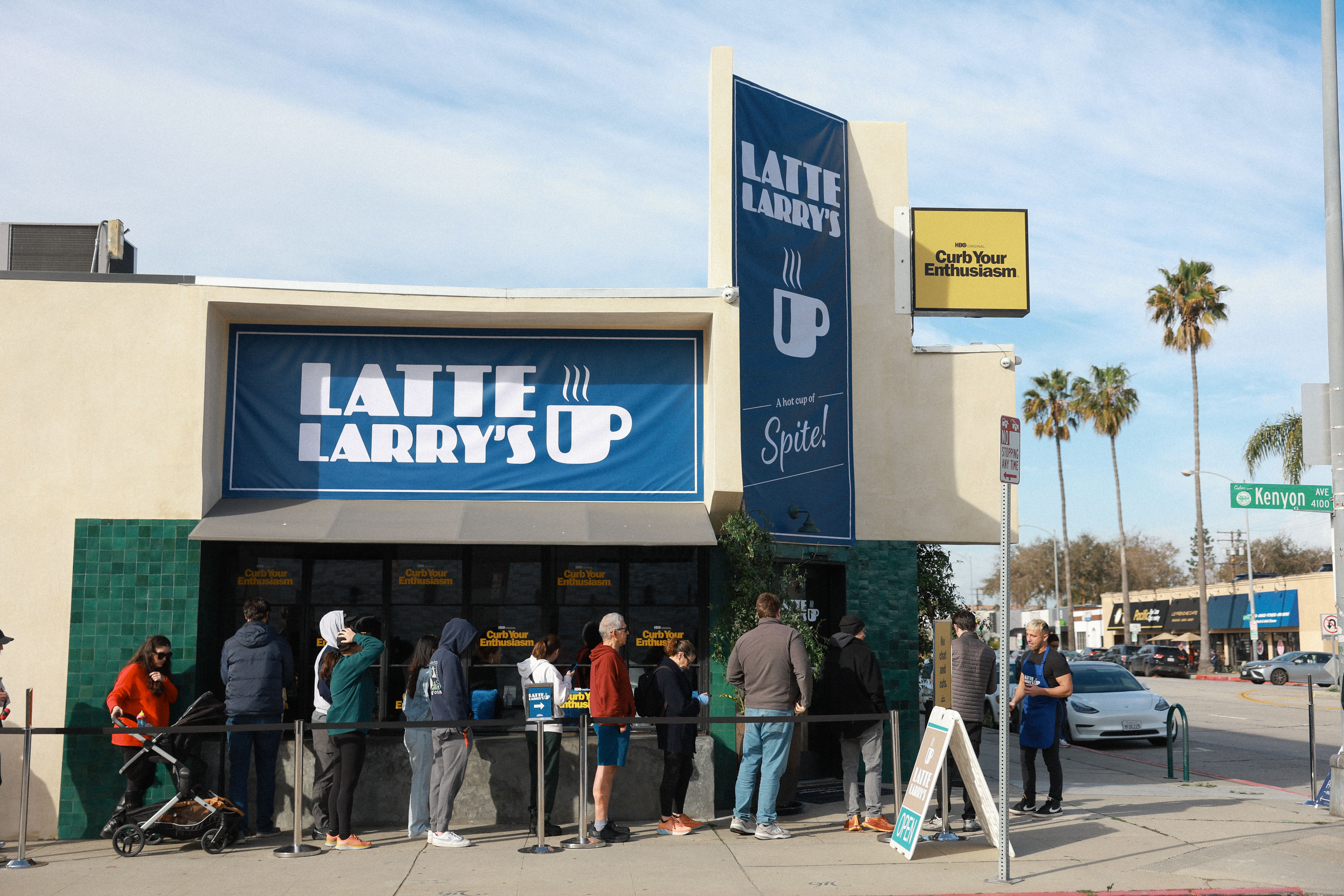
The funny part was not the logo. It was the needless specificity. “Defecation free store” signs made the fiction tangible. Fans tried to buy decorations off the walls. Merchandise disappeared quickly enough to require more pre-orders. A concept from television had been made inhabitable, down to the annoyances.
The company reports that more than 5,000 people visited; some waited over two hours. Baristas served more than two customers a minute. The event produced 19 million social impressions and an 80.3 million press feature audience. HBO's season premiere rose 26 percent from the previous season. One should not pretend a coffee shop alone caused a television rating. It did, however, give fans a highly photographable way to announce that the show mattered to them.
The product is / cultural translation
Agencies like to call themselves integrated because the word makes a capabilities slide look orderly. The Syn's version is more concrete. For High Water Festival it coordinated lineup announcements, embargoed outreach, media credentials, on-site press and post-event reporting, producing more than 100 placements. For Marvel it designed influencer mailers around individual releases, work that earned a Gold Clio. For Panic! at the Disco, it helped hide an enormous crop-circle tour announcement until the reveal generated a reported 11 million views.
The common product is translation: what will feel native to this audience, in this subculture, on this channel? Its radio department historically maintained relationships with more than 600 stations across commercial, college, satellite and internet radio. Its street teams place actual people in markets. Its events group builds the physical joke. Its publicity staff explains why anyone should care. The business earns project and retainer fees for putting those pieces together, although it publishes no rate card.
Its competition therefore changes with the brief. Culture agencies such as Cashmere, 160over90, Wasserman, FlyteVu and Cornerstone can pitch for adjacent work. So can specialist publicists, event shops and in-house network or label teams. The Syn's defense is neither proprietary software nor cheap scale. It is the accumulated memory of which joke a fan will recognize, which programmer might answer and which partnership already contains a true sentence.
The moat is not a dashboard. It is 28 years of returned calls.
What to borrow / without borrowing the tacos
Feed the Beat provides a compact playbook for anyone trying to enter a community without being booed out of it.
The tactic is portable; the permission is not. A bank cannot hand out tacos and inherit two decades of music credibility. The approach depends on a brand already fitting the behavior, offering something participants actually value and tolerating a return measured over years. It weakens when executives need immediate reach, when the benefit is conditional or when a celebrity has been selected before anyone asks whether the connection is true.
The Syndicate itself has changed shape many times. Graham Rothenberg, who joined as a radio promoter in 2005, now serves as CEO. Landman is chief business development officer; Zucatti is chief operating officer; Chris Elles is president. The agency has returned to artist management, expanded its casework and moved from calling college stations to producing motorcades through New York for Wu-Tang Clan. Yet the original instinct remains visible: start with people who know one another, find the small point of friction and make yourself useful.
There is a pleasing symmetry here. The first thing that failed was the founders' employer. What survived was the network among the employees. Twenty-eight years later, The Syn still sells the thing that could not be shut down with the old office: trusted passage from one group of people to another.
Keep listening
The agency's current work, campaign reels and social updates live at the links below.