The useful thing about crossing a border is that it exposes which parts of a reputation were real and which parts depended on context. Dharti Desai Chatterjee arrived in Canada in 2021 with a career already stacked with recognizable names: DuPont, Shell, Baker Hughes, Aviva, Disney Star, J. Walter Thompson. She had led brands, communications and go-to-market work across India and the Middle East. Then Toronto handed her a blunt lesson. The work traveled. The meaning attached to it did not.
A title from Dubai could sound impressive without being legible. A crisis managed across three markets could become a line on a résumé instead of evidence of judgment. Familiar corporate signals lost voltage at the border. Chatterjee had to translate them for a new set of founders, partners and institutions.
That personal reset now sits at the center of her professional thesis. As chief marketing officer of the Toronto Business Development Centre and BHive, and as founder of the consultancy Radiate, she works with companies facing a similar problem at larger scale. They have products, customers and home-market proof. What they lack is a reason for an unfamiliar buyer to believe any of it.
“Credibility doesn’t travel like you do.”Dharti Desai Chatterjee
A résumé loses its accent
Chatterjee did not respond to Canada by disowning her earlier career. She changed its interface. In her account of the move, she describes choosing specific founder ecosystems and returning to them consistently. She volunteered to diagnose problems before asking for anything. She learned to convert corporate experience into a sentence with local utility. A big-company title was abstract. Navigating communications across markets during an industry downturn was proof that she could operate when momentum turned hostile.
The distinction seems small until you notice how much market entry depends on it. A founder says, “We are established in Europe.” A Canadian buyer hears, “You are unknown here.” An investor sees a list of logos and wonders who will answer the reference call. A prospective partner does not merely need the old achievement repeated. They need it recoded in a language of risk they recognize.
Her announcement of the move was unusually open for a senior executive. She called it a “sweet spot” where family and professional ambitions seemed able to meet. She thanked mentors by name. She described her children’s ambitions with delight and comic precision: one looking toward space engineering, the other toward poetry, screenwriting and directing. The post reads less like a polished arrival than a person naming the community that made arrival possible.
Brand before the brand book
Long before startup founders began asking her about North American expansion, Chatterjee learned brand inside large organizations. She started in agency account management, passed through Disney Star and Aviva, then spent more than a decade at DuPont. The sequence matters. Agencies teach the compression of an idea. Consumer companies teach attention. A science and industrial company teaches that communication must survive technical detail, multiple business units and long decision cycles.
At Shell and Baker Hughes, the environment became more global and the stakes more operational. The message had to remain coherent across functions and countries. Chatterjee’s later shorthand for the lesson is memorable: “Brand wasn’t a campaign, or two. It was infrastructure.” Her point is less poetic than mechanical. If product, sales, leadership and marketing describe a company differently, every handoff sheds trust. Scale magnifies the leak.
This is also why she is suspicious of an early-stage company reaching for a visual refresh before its language is settled. A sharper logo cannot rescue a vague promise. A beautiful pitch deck cannot make three executives agree on the problem they solve. Chatterjee’s preferred raw material is language: the repeated phrases that let a customer recognize a company before seeing its mark.
The cross-border credibility circuit
The loop is deliberately unglamorous. Translate the claim. Get close enough to be observed. Produce proof that the next person can verify. Then repeat. It asks more of a company than buying awareness, because the founders themselves have to expose how they think.
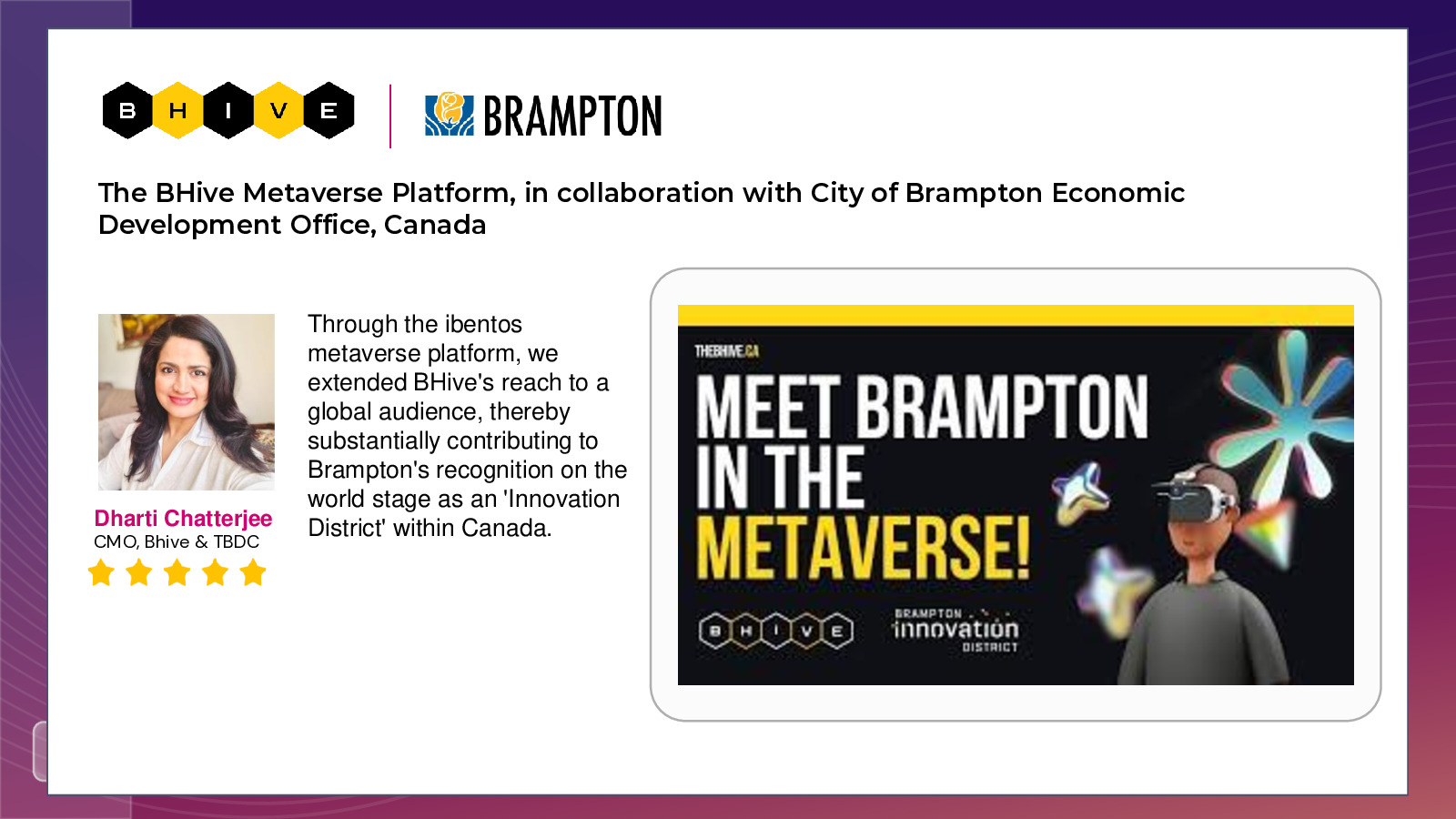
The BHive metaverse project offers a concrete example of that instinct. Built with Brampton’s economic development office, the virtual platform gave an international audience another way to encounter the city’s startup community. Chatterjee described the work as extending BHive’s reach and contributing to Brampton’s identity as an innovation district. The technology was the visible artifact. The strategic job underneath was familiar: create a setting where a place, a program and a group of founders could become understandable before a physical meeting. In her framework, even a virtual room succeeds only when it carries enough context for a relationship to begin.
Canada as a listening test
Chatterjee frames Canada as more demanding than the phrase “soft landing” suggests. It is a multilingual, regulated, geographically distributed market where public programs and private buyers often share the same founder’s map. A message has to work across cultural context, procurement logic and sector language. Loudness offers little protection from imprecision.
That makes Toronto useful to an international company. A founder can test whether the product survives a diverse customer base and whether the story stays coherent across unfamiliar rooms. The city’s density of finance, technology, universities, immigrant communities and government-backed programs creates plenty of entry points. It also creates a maze. Introductions without interpretation can leave a founder with a calendar full of meetings and no accumulated trust.
TBDC’s recent programs sit inside that gap. Chatterjee has highlighted Horizon’s work with European companies through structured customer access, curated conversations and fast market discovery. The phrasing reveals her bias. An ecosystem is useful when it produces contact with reality: a buyer objection, a regulatory path, a talent constraint, a partner willing to make the next introduction.
A market-entry plan can travel as a document. Trust has to be earned in the room.The practical lesson running through Chatterjee’s work
Judgment in public
Her newer writing pushes the credibility idea one step further. In a feed crowded with frameworks, Chatterjee argues that trust grows when people reveal judgment: what they noticed, what failed, what changed their mind, where one market behaves differently from another. Polish is easy to imitate. A specific call, attached to a place and consequence, is harder.
This explains the mix of analysis and autobiography in her public voice. She will break down why a go-to-market story leaks across functions, then explain what it felt like to discover that her own résumé did not speak fluent Canadian. The personal detail is doing business work. It establishes that the advice came through friction, not from a slide template.
Colleagues’ public recommendations describe someone who combines hard data with “softer fuzzy insights,” stays composed in a crisis and brings a team along. That combination fits the career arc. Chatterjee has spent years moving between the quantitative promise of a plan and the ambiguous human signals that decide whether people accept it.
The bridge is the product
The obvious way to describe Chatterjee’s current work is marketing. The more accurate unit may be translation. She translates an industrial career into a founder’s immediate problem. She translates a European company’s traction into Canadian proof. She translates a brand from something the communications team owns into a shared operating language.
Radiate, the consultancy she founded in 2023, makes that focus explicit. Its premise is that early wins need to become repeatable growth systems. At TBDC and BHive, the same instinct operates at ecosystem scale: attract international founders, help them read the market, and create the conditions for local relationships to compound.
There is restraint in this theory. It does not promise that reputation can be hacked into existence. It asks a founder to do the slower work of becoming understandable and useful in public. The reward is more durable than attention. A customer can explain you to a colleague. A partner can place you in context. An investor can repeat the story without sanding off its meaning.
Chatterjee’s border crossing turned an inconvenience into a field of study. Her old credibility did not vanish. It became raw material. Toronto forced her to process it again, and the resulting method now travels with the founders she advises: translate the proof, choose the room, contribute before asking, and let consistency carry the story the rest of the way.